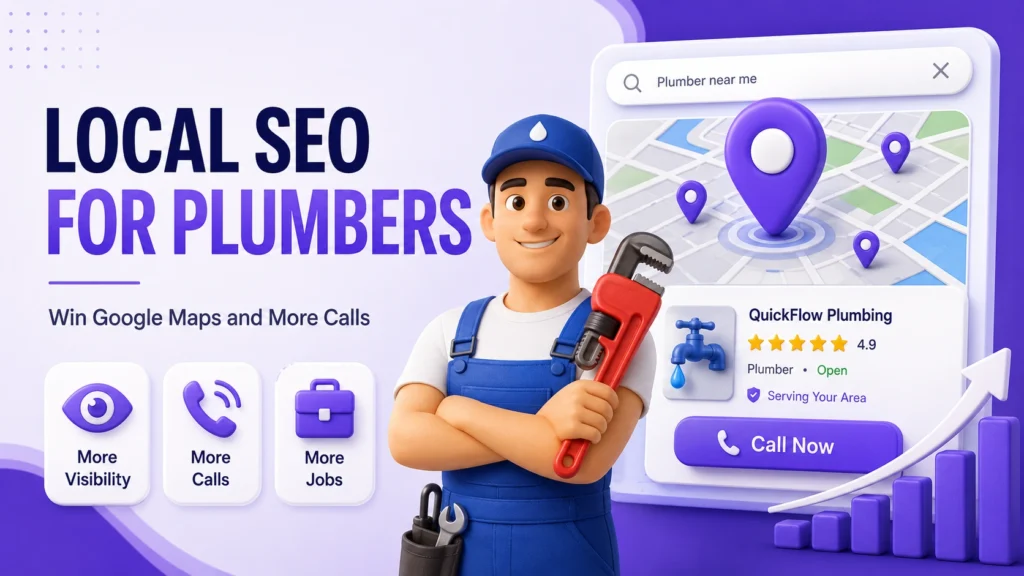
Local SEO for plumbers helps plumbing companies become visible when nearby customers search Google Maps, local results, and increasingly AI-powered search experiences for services they need now. The strongest strategy combines an accurate Google Business Profile, legitimate service-area signals, customer reviews, local citations, locally relevant pages, authority, and clear conversion tracking. The aim isn’t simply to appear higher. It’s to be visible in the right part of the service area, look trustworthy when the customer compares options, and turn that search into a qualified call or booked plumbing job.
A plumbing search rarely begins because somebody suddenly became interested in pipes. It begins because something went wrong.
The water heater stopped working before work. A drain backed up into the kitchen. Water is dripping through the ceiling. A homeowner hears running water behind a wall and has no idea where it’s coming from. That urgency changes search behavior.
Someone with an active leak isn’t likely to study ten plumbing websites for an hour. They search for an emergency plumber, scan the local results, look at availability and reviews, and call a company that appears credible. That’s what makes local SEO for plumbers different from broad search engine optimization.
The goal isn’t nationwide traffic. It’s visibility among customers inside the geographic area where the plumbing company can actually take the job.
Local SEO for Plumbers: What It Means
Local SEO for plumbers is the process of strengthening a plumbing company’s visibility for searches tied to a real location or local service need.
That may be an explicit query such as:
“emergency plumber Dallas”
or an implicit local query such as:
“emergency plumber”
Google may understand the searcher’s location even when the city name or “near me” doesn’t appear in the phrase.
What matters is that the business can clearly establish three things: what it does, where it genuinely operates, and why it deserves consideration. For plumbers, that local search journey can now span several surfaces.
| Search surface | Typical customer behavior | What matters most |
| Google Maps / Local Pack | Customer compares nearby plumbers quickly | Accurate GBP, relevance, proximity, reviews, prominence |
| Local organic results | Customer opens websites for more detail | Useful location context, service relevance, trustworthy landing pages |
| AI Overviews / AI Mode | Customer asks a more detailed local question | Clear entity information, useful source content, accurate Business Profile |
| Local Services Ads / paid search | Customer wants immediate options | Eligibility, budget, responsiveness, lead quality |
The important point is that these aren’t four separate businesses. The same plumber needs to look consistent and credible across each surface.
Why Local Search Works Differently for Plumbing Companies
Plumbing combines high local intent with unusually short decision windows. A customer researching bathroom fixtures may take days. A customer with a burst pipe may take minutes. That gives local SEO an operational role in the plumbing business. Search visibility has to meet availability.
If Google shows a plumbing company as open but nobody answers the phone, ranking did its job, and the business still lost the lead.
If a company ranks well but the profile has weak reviews, no real project images, and unclear service coverage, the customer may simply choose the next result.
If the website promises emergency service in cities the business rarely serves, the campaign can attract enquiries the company cannot profitably fulfil.
Good plumbing local SEO therefore connects visibility, geography, trust, and operations.
Emergency and Planned Plumbing Searches Need Different Responses
A homeowner searching for “emergency plumber near me” wants a very short path to a decision. They need to know whether the company handles the problem, whether it serves the area, whether someone is available, and how to call.
A homeowner researching a planned water heater replacement has more time. They may compare experience, options, reviews, warranties, process, and cost factors before requesting an estimate.
That difference matters even inside local search. Your Business Profile, local landing pages, hours, review profile, and contact experience should reflect how quickly each type of customer needs to make a decision.
How Google Decides Which Plumbers Appear in Local Search
Google does not publish a secret plumber-specific local algorithm. Its official local-search guidance says “Local results are mainly based on relevance, distance, and popularity.” Google describes prominence in its detailed guidance in terms of how well known a business is, including information such as links and reviews.
Those three principles give plumbing companies a far more useful framework than invented ranking-factor percentages.
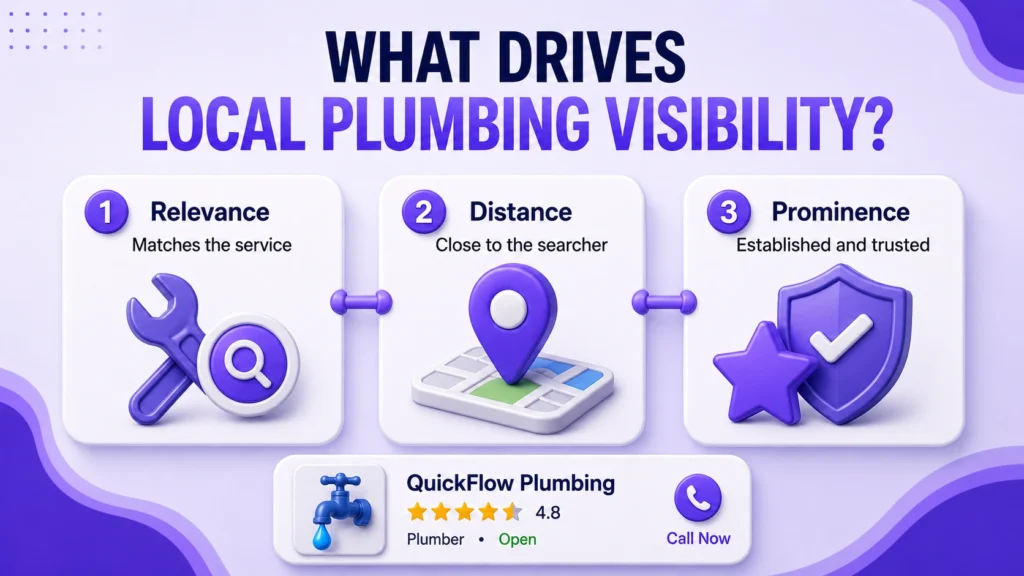
Relevance: Does the Business Match the Plumbing Search?
Relevance is about how well the business matches what the customer is looking for. A company that genuinely provides emergency plumbing, drain cleaning, sewer repair, leak detection, and water heater services should make those services clear in its Google Business Profile and on the website.
That doesn’t mean adding every keyword an SEO tool suggests. It means accurately representing the services customers can actually book. A vague profile tells Google and customers less. A clear profile supported by corresponding website information gives both more context.
Distance: Local SEO Cannot Rewrite Geography
Distance is the uncomfortable part of local SEO because no agency can “optimize” a plumber into being physically closer to every searcher.
A plumbing company based on one side of a metropolitan area may perform strongly nearby and much more weakly twenty miles away. That’s normal.
Adding a distant city to the service area doesn’t move the physical business closer to customers there. Creating a fake office doesn’t solve that problem either.
The useful strategy is to understand where the business is genuinely competitive, improve controllable signals there, and build organic service-area relevance where the company regularly works.
Prominence: Does the Plumbing Business Look Established?
Prominence reflects how well known and credible the business appears. Google explicitly notes that links, reviews, review count, and positive ratings can contribute to local ranking.
For plumbers, prominence may also be reinforced by a broader real-world footprint: legitimate directories, local associations, supplier relationships, local press mentions, community involvement, and a website that clearly represents a real operating company.
One signal doesn’t replace the others.
- A large review count doesn’t eliminate distance.
- A strong website doesn’t make a fake office legitimate.
- A perfect profile doesn’t compensate for a business that barely exists elsewhere online.
Local SEO works because those pieces reinforce one another.
Audit Your Google Maps Market Before Changing Anything
This is one of the biggest gaps in many plumbing SEO campaigns. The company begins with a checklist instead of a diagnosis. Someone says “get more reviews,” so reviews become the priority.
Someone else says “create city pages,” so ten city pages get published. A third person says backlinks are everything, so the owner buys links. None of that tells you where the actual local gap exists.
Start with the market. Search visibility should be checked from different parts of the service area, because a ranking observed from the office does not represent what customers twenty minutes away necessarily see.
A local rank grid or another location-based ranking method can reveal where the business is strong, where it disappears, and which competitors repeatedly occupy the Map Pack. Then compare the competitors that win consistently.
| What to compare | What it can reveal | What not to assume |
| Primary GBP category | Possible relevance gap | Category alone caused the ranking |
| Review count and recency | Reputation/trust gap | More reviews automatically mean position #1 |
| Service information | Weak service relevance | Adding keywords guarantees visibility |
| Real photos and profile completeness | Customer trust/profile quality gap | Weekly photo uploads are a ranking requirement |
| Local citations and links | Prominence gap | Any directory or backlink will help |
| Service-area/location content | Organic local relevance gap | More city pages always improve Maps rankings |
| Mobile call experience | Conversion gap | Rankings alone determine lead volume |
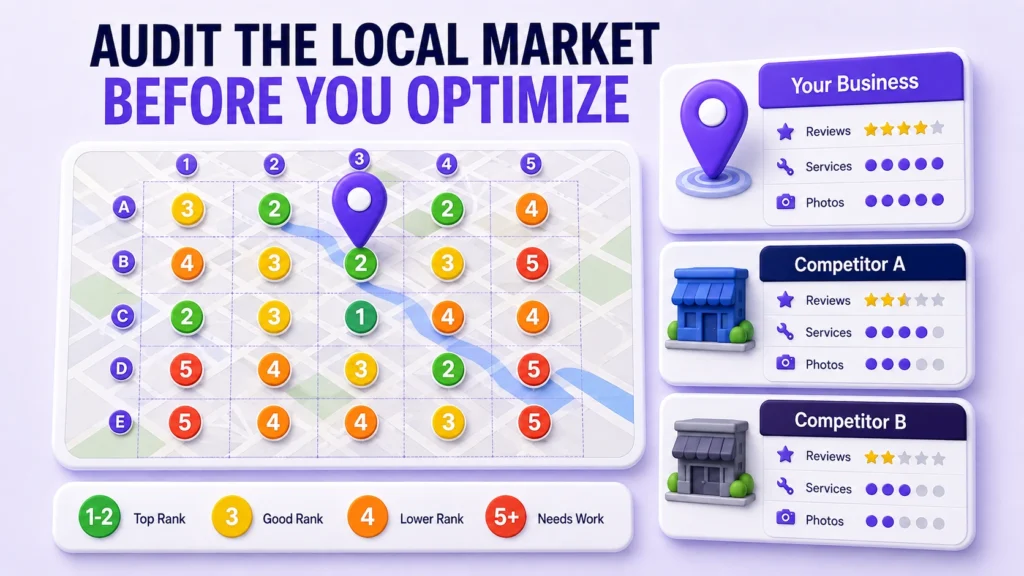
The objective is not to reverse-engineer one magic factor. It is to find patterns. If every plumber consistently beating you has a stronger review profile, better local authority, clearer services, and a more credible website, you now have a useful campaign direction. That’s more valuable than blindly adding another blog post.
Optimize Google Business Profile for Plumbing Searches
For many local plumbing queries, the Google Business Profile may be the customer’s first serious interaction with the company.
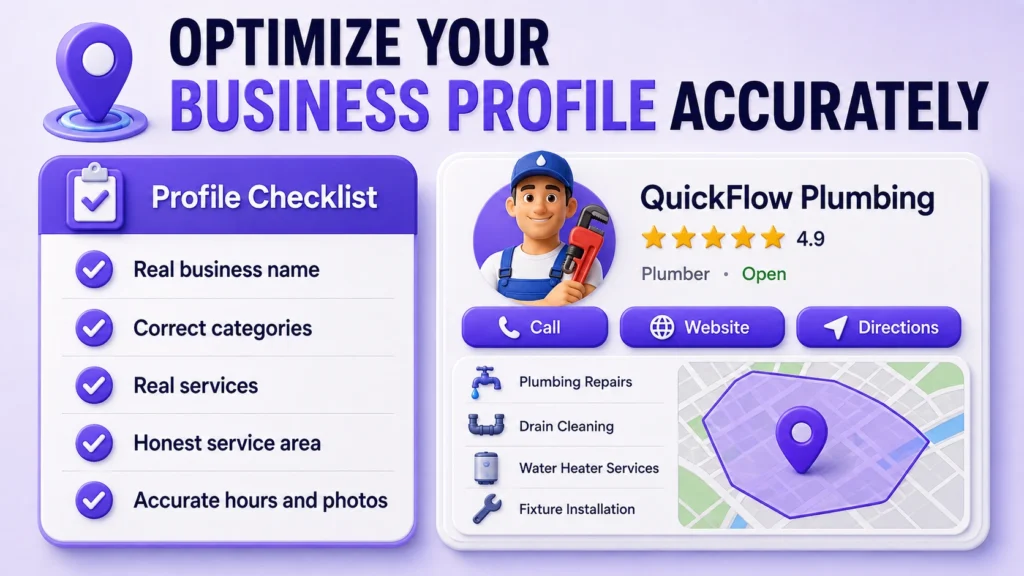
Google recommends complete and accurate business information because it helps the platform understand the business and helps customers know what they are dealing with. That means the profile deserves more attention than setting it up once and forgetting it.
Use the Correct Business Name and Categories
The business name should reflect the real-world company name. Do not add “Best Emergency Plumber Dallas 24/7” to the name unless that phrase is genuinely part of the business’s established real-world name.
Google’s Business Profile guidelines specifically require businesses to represent themselves consistently with real-world branding and recommend using the fewest categories necessary to describe the core business.
For a general plumbing company, the primary category should accurately describe the core operation.
Secondary categories can support genuine additional services where an applicable Google category exists.
The rule is simple: choose categories because they describe the business, not because you want another keyword.
Add the Plumbing Services Customers Can Actually Book
The Services section should reflect genuine service lines. If the company provides drain cleaning, water heater repair, sewer services, pipe repair, leak detection, or emergency plumbing, the profile should not leave customers guessing.
The website should support those same services. That alignment matters. A customer who discovers a plumber in Maps and then visits the website should see the same business, services, hours, and operating area. Local SEO works better when every important source tells a consistent story.
Set the Service Area Honestly
Plumbers are one of Google’s own examples of a service-area business. If the company travels to customers and does not receive customers at its address, Google says the address should be hidden from the public profile.
Google also says a service-area business should use its real central office or operating location and that virtual offices are not eligible simply because a company wants another Maps location.
This is an important competitive distinction. A competitor may appear to have five locations. That does not mean you should create five fake ones. A sustainable local SEO strategy should improve the legitimate business, not create profile risk to imitate somebody else’s shortcut.
Keep Business Hours Accurate
Hours are especially important in plumbing because emergency intent is time-sensitive. If the company truly answers emergency calls overnight, the profile should accurately represent availability.
If the company stops answering at 9 p.m., don’t advertise 24-hour service simply because “24 hour plumber” has search volume.
Local SEO can bring the customer to the profile. Operations still have to fulfil what the profile promises.
Use Real Plumbing Photos
Real photographs do something stock images can’t: they prove there is a business behind the listing. Technicians, branded trucks, equipment, completed installations, water heaters, drain equipment, before-and-after work where appropriate, and team images all provide context.
Photos should be useful and authentic. There is no need to invent a universal “upload X photos every week” rule.
Google’s own local guidance recommends photos and videos as a way to show customers what the business offers. It does not publish a mandatory weekly photo quota.
Use Google Business Profile Posts When There Is Something Worth Saying
Business Profile posts can communicate useful updates, offers, events, or current information. For plumbers, that might mean holiday availability, genuine weather-related service information, a legitimate promotion, or an important service update.
Don’t turn GBP Posts into busywork. A weak post published only because Monday arrived doesn’t automatically make the business more relevant. Write for the customer first.
Reviews Are a Local Trust System, Not a Numbers Game
The better approach is to understand what Google says and what customers actually do. Google confirms that more reviews and positive ratings can help local ranking. But Google does not publish a rule saying every plumber needs a certain number of reviews per month to hold a Map Pack position.
Customers care about more than total volume too.
BrightLocal’s 2026 Local Consumer Review Survey found that 97% of consumers use reviews to guide purchase decisions, while 74% said they focus on reviews written within the previous three months.
That makes review recency important for a simple reason: customers want evidence that the plumbing company is still delivering good work now.
Ask Real Customers for Honest Feedback
The review process does not need a clever trick. Complete the job. Make sure the customer knows how to contact the company if something is wrong. Then make honest feedback easy to leave.
A neutral request could say:
Thanks for choosing [Company Name] today. If you have a minute, we’d appreciate your honest feedback about the service. Here’s our Google review link: [link].
Notice what it doesn’t say.
It doesn’t ask for five stars.
It doesn’t tell the customer to mention “emergency plumbing Dallas.”
It doesn’t offer a discount in exchange for praise.
Google’s review policies prohibit incentives offered in exchange for posting, changing, or removing reviews. The safest review strategy is also the most believable one: real customers describing real work in their own words.
Respond to Both Positive and Negative Reviews
A review isn’t read only by the person who wrote it. Future customers are watching the response. A thoughtful reply to positive feedback shows that the company pays attention.
A professional response to criticism can show how the business handles problems when things don’t go perfectly. Avoid turning the response into a keyword insertion exercise.
“Thanks for choosing the best emergency plumbing company in Dallas for your drain cleaning” does not sound like a conversation. Respond to the person.
Target Local Plumbing Searches Without Stuffing City Names
Local keyword strategy should be narrow enough to match the actual market. The most useful queries tend to combine a service need, urgency, and geography.
| Local search pattern | Example | What the customer probably wants |
| Near-me intent | emergency plumber near me | Someone available nearby now |
| City-modified | plumber in Phoenix | A plumber serving that city |
| Service + city | drain cleaning Phoenix | A specific service locally |
| Availability | plumber open now | Immediate contact |
| Trust/local qualification | licensed plumber Phoenix | Evidence of credibility |
| Area-specific | water heater repair Scottsdale | Service in a defined nearby market |
You don’t need to repeat “near me” throughout the copy. Search engines understand location context. The page should instead make the actual service area, services, and business identity clear.
Listen to How Local Customers Describe the Problem
Keyword tools are useful, but customers can expose valuable local language that no volume report explains properly.
Call notes, enquiry forms, reviews, live-chat records, and technician conversations can reveal what people say before they know the professional name for the issue.
A homeowner may not search “slab leak detection.” They may ask why one section of the floor feels warm or why the water bill suddenly doubled.
That insight belongs mainly on the broader SEO/content side of the strategy, but it can also help local landing pages reflect the language customers in the market actually use.
Build Service-Area Pages Only Where They Add Local Value
Service-area pages can help a plumbing company build organic relevance in the cities and communities it genuinely serves. They should not be treated as substitutes for Google Business Profile locations.
A page for a nearby city makes sense when the company regularly operates there and has something useful to say to customers in that market.
That can include actual service coverage, relevant housing or plumbing characteristics, genuine work examples, local testimonials, project photographs, response considerations, and service information.
What doesn’t work well is creating twenty pages where only the city name changes.
“Plumber in City A.”
“Plumber in City B.”
“Plumber in City C.”
Same introduction. Same services. Same testimonial. Same FAQ. That’s not local expertise. It’s a template.
Don’t Add Random Landmarks Just to Look Local
Mentioning a shopping mall or famous park does not automatically make a page locally valuable. Local references should help the customer understand the company’s experience in the area.
If technicians repeatedly work in older housing stock with galvanized pipes, that could be useful context. If a municipality has genuine plumbing or permitting considerations relevant to the service, that may help. If you only mention the football stadium because it appeared in Google Maps, leave it out.
Don’t Create a Local Phone Number You Don’t Actually Use
The same honesty applies to contact information. Don’t fabricate offices, phone numbers, or addresses to make a company look more local than it is.
Google’s policies are quite clear about representing the real business. Your local SEO should strengthen reality, not manufacture it.
Let the Broader SEO Page Handle Technical SEO
Local SEO depends on a usable, crawlable website, but this page does not need to become another complete technical SEO manual. For a broader strategy covering technical SEO, service-page architecture, content strategy, and organic search authority, see Webtec’s SEO for plumbers guide. For local SEO, the technical questions are narrower.
- Can Google access the local pages?
- Does the site clearly connect the business with its genuine service areas?
- Does important business information match the Business Profile?
- Can a mobile customer call easily?
- Does any LocalBusiness structured data accurately reflect what appears on the page?
Keep Local Business Information Consistent Across the Web
Citations are online references to the business. The old local SEO playbook often turned this into a race to submit a company to hundreds of directories. That’s rarely a useful objective.
Start with platforms that are legitimate, relevant, and likely to be used or trusted in the market. The business name, phone number, website, hours, and location information should not conflict across important sources.
For service-area companies, consistency does not mean publishing a hidden residential address everywhere. It means representing the same legitimate business correctly on each platform.
Local Citations Should Support Trust, Not Inflate a Spreadsheet
Major mapping platforms, established review platforms, respected business directories, local chambers, trade associations, and relevant contractor platforms may all play a role.
The exact mix depends on the market. What matters is credibility. A citation from a local organization customers actually know is more useful than a profile on an abandoned directory created only for SEO.
Earn Local Backlinks From Real Relationships
Local links strengthen prominence because they connect the plumbing company with the community and industry around it.
The strongest opportunities often already exist offline.
- A supplier may list approved contractors.
- A local chamber may have a member directory.
- A home builder, HVAC contractor, restoration company, realtor, or property manager may have an established business relationship with the plumbing company.
- A community sponsorship may generate a legitimate local mention.
- A local publication may reference an expert plumbing comment during a freeze or water-related event.
None of those should be pursued solely for a link. The link is useful precisely because the relationship makes sense without SEO.
Publish Something Locally Worth Referencing
Original local information can also earn authority. A plumbing company with reliable historical service data might publish an analysis of common winter pipe failures in its city, the most frequent water-heater problems its technicians encounter, or patterns seen in older local housing stock.
A local homeowner guide reviewed by a qualified plumber has more citation value than another generic “10 Plumbing Tips” article. Local authority becomes easier to build when the business contributes information other sites don’t already have.
Local SEO for Plumbers in AI Overviews and AI Mode
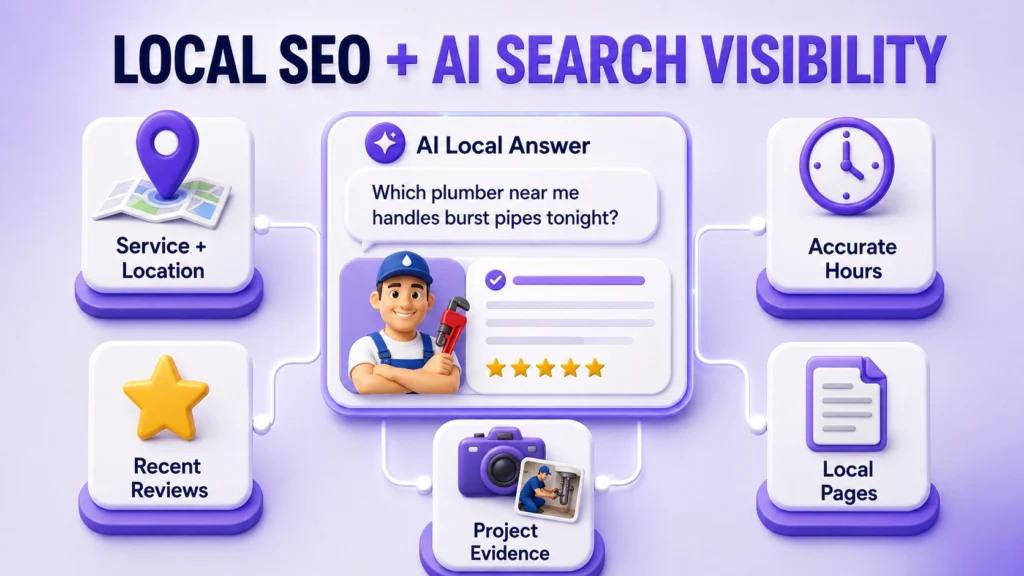
Traditional local search may show a Map Pack followed by organic results. AI Overviews and AI Mode can approach a query differently.
Google explains that both AI Overviews and AI Mode may use query fan-out, issuing multiple related searches across subtopics and sources before forming a response. Google also says AI features may surface a broader and more diverse set of supporting links than a classic web search.
That means the page ranking first for a short query is not automatically the only page that could support an AI-generated answer.
Consider this request:
“Which plumber near me handles burst pipes tonight, has good recent reviews, and works on older homes?”
That question contains several needs:
service, location, availability, reputation, and experience.
An AI system may need information from multiple parts of the search ecosystem to answer it.
You Do Not Need Special “AI Schema” to Qualify
Google explicitly states that there are no additional technical requirements to appear in AI Overviews or AI Mode and that website owners do not need special AI text files or special schema.org markup.
- The fundamentals still matter.
- The page needs to be indexable.
- The information needs to be useful.
- The Business Profile should be current.
- Structured data should match the visible page.
- Local business details should be consistent.
That’s considerably more defensible than installing a plugin and calling the site “AI optimized.”
Local AI Visibility Depends on Strong Business Evidence
A plumbing company has an advantage that generic informational sites do not.
It has first-hand evidence.
- Real jobs.
- Real technicians.
- Real service areas.
- Real reviews.
- Real photographs.
- Real explanations from people who diagnose these problems every day.
That information can strengthen both traditional local search and AI-assisted discovery because it makes the business easier to understand and harder to confuse with generic lead-generation content.
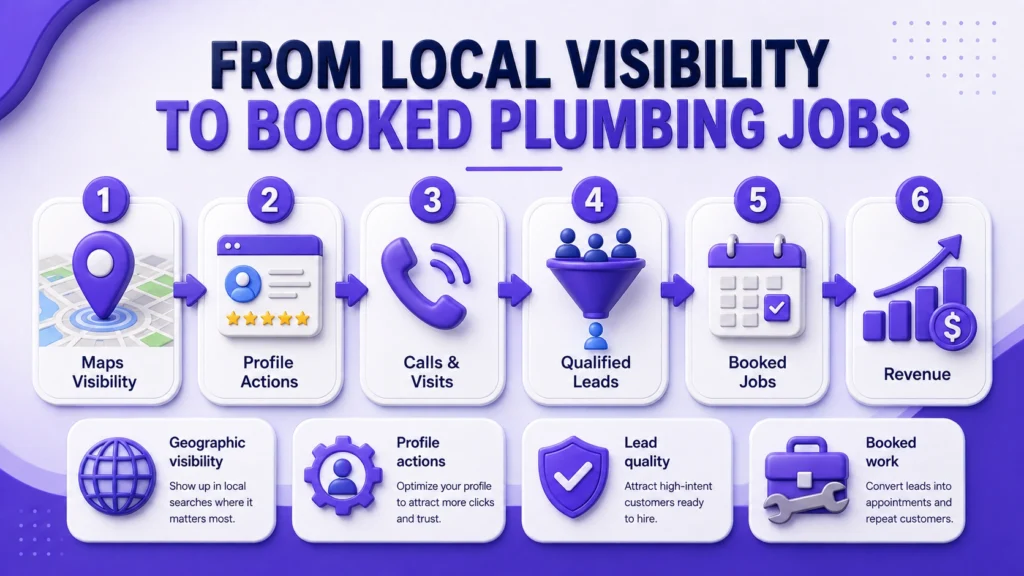
Measure Local SEO by Local Leads, Not a Single Ranking
A Maps position observed from one desk is not enough. Local rankings change by location. The customer’s route to the business changes too.
Someone may discover the company through Maps, visit the website, read reviews, return later through branded search, and finally call. Measurement therefore needs to connect local visibility with customer actions.
Track Geographic Visibility
Monitor important local searches from different parts of the service area rather than relying on one manual search. Look for patterns.
- Where is visibility improving?
- Where does the company disappear?
- Which competitors repeatedly occupy those areas?
That tells you much more than “we rank number four.”
Track Google Business Profile Actions
Business Profile performance can help show whether local visibility generates interaction. Calls, website visits, and other available customer actions provide context beyond the ranking itself. A rise in visibility with no rise in meaningful interactions may signal a trust or conversion problem.
Track Qualified Calls and Booked Jobs
A call isn’t automatically a good lead. Separate spam, existing-customer calls, wrong-service enquiries, and genuine new opportunities where your systems allow it.
Then look deeper.
- Which locations generated the calls?
- Which plumbing services were requested?
- Which calls turned into jobs?
- What was the value of those jobs?
That’s when local SEO becomes a business channel rather than a rankings report.
Watch AI Search Performance Where Reporting Is Available
Google announced dedicated generative-AI performance reporting in Search Console in June 2026, initially for a subset of websites. Where available, it can provide a more direct view of visibility from Google’s generative Search features rather than relying entirely on third-party estimates.
That data should still be treated as part of the customer journey. AI visibility is useful. Booked plumbing work is better.
Local SEO Cannot Fix a Website That Loses Every Call
The Local Pack gets the customer to the business.
The profile and website still have to close the gap between interest and contact.
A mobile visitor should immediately understand what the plumber does, where the company works, and how to call.
A local landing page shouldn’t hide the phone number behind three menus.
A customer shouldn’t have to search the footer to find the service area.
Trust signals should appear near the decision.
If local visibility is growing but leads aren’t, the problem may no longer be the ranking.
That’s where conversion rate optimization becomes useful: identify the friction after the customer arrives and improve the path to the call or form.
Where Local Services Ads and Paid Search Fit
Local SEO takes time to build and does not guarantee a particular Maps position. Paid search can capture demand while organic and Maps visibility develop.
For a plumbing company, that can be useful around emergency services, new service areas, or high-value services where customer acquisition economics support the spend. The important point is not to treat advertising and local SEO as isolated departments.
If paid search reveals that one service and area consistently produces profitable work, that is valuable local strategy data. If local SEO consistently produces strong leads in another part of the market, ad spend can be adjusted accordingly.
Webtec’s digital advertising services can support paid demand where it makes commercial sense, while local SEO builds organic visibility over time.
Common Local SEO Mistakes Plumbing Companies Should Avoid
Creating Fake Google Business Profile Locations
A virtual address doesn’t become a legitimate plumbing branch because somebody added it to Google. If customers aren’t served there and the location doesn’t meet Google’s requirements, don’t build the local strategy around it.
Treating Service Areas as a Ranking Radius Control
Adding twenty cities to a Business Profile doesn’t guarantee strong Maps visibility across those twenty cities. Distance still matters. The service area tells customers where the business operates. It doesn’t rewrite geography.
Chasing an Arbitrary Review Number
A competitor having 300 reviews doesn’t prove that 301 reviews will outrank them. Study the broader market. Relevance, distance, prominence, website strength, review quality, review recency, and customer trust all interact.
Asking Only Happy Customers for Reviews
A review process should seek genuine feedback rather than filter customers according to whether the business expects a positive rating. Keep the request neutral and policy-compliant.
Publishing Thin City Pages
If ten pages say the same thing apart from a city name, you haven’t built ten useful local resources. You’ve created ten versions of one page.
Keyword-Stuffing the Business Name
Adding services and cities to the Google Business Profile name is not an acceptable substitute for real-world branding. Use the name customers actually know.
Treating GBP Posts as a Ranking Schedule
There is no need to manufacture two or three weak posts every week because a blog told you Google rewards the frequency. Use posts when they help customers.
Measuring Only “Plumber Near Me”
One keyword from one location is a poor representation of local visibility. Track multiple commercially important queries across the actual service area and connect that visibility with leads.
A 90-Day Local SEO Roadmap for a Plumbing Company
Local SEO doesn’t come with a guarantee that a plumbing business will rank in the top three within 90 days.
What ninety days can provide is enough time to fix obvious problems, establish local systems, and measure whether visibility is moving in the right direction.
| Period | Main objective | What to focus on | What to measure |
| Days 1–30 | Establish the local baseline | GBP accuracy, categories, services, hours, service-area compliance, review profile, local competitors | Maps visibility, profile actions, current reviews, calls |
| Days 31–60 | Strengthen relevance and trust | Review process, priority local pages, citations, real photos, local authority opportunities | Review recency, local page visibility, qualified enquiries |
| Days 61–90 | Expand and refine | Weak geographic areas, competitor gaps, local links, conversion issues, AI/local search visibility | Geo-grid changes, calls, booked jobs, lead quality |
Days 1–30: Fix the Local Foundation
Start by verifying that the business is represented accurately. Check the Business Profile name, category, services, hours, phone number, website, address settings, and service area.
Then establish the local baseline. Where does the company currently appear? Where is it absent? Which plumbers consistently beat it in different parts of the service area?
Review those competitors for patterns, not magic formulas. This first month should answer a simple question: What is actually holding local visibility back?
Days 31–60: Build Local Relevance and Trust
Once the profile is accurate, work on the gaps closest to the customer decision. That may involve building a consistent review-request process, improving genuinely useful service-area pages, correcting major citation inconsistencies, adding real project photography, or strengthening the relationship between the Business Profile and website.
Don’t try to do everything because it appeared in an SEO checklist. Do what the audit showed matters.
Days 61–90: Expand From Evidence
Recheck visibility. If one nearby market improved and another remains weak, investigate why. If Maps visibility improved but calls didn’t, look at profile trust and conversion.
If calls increased but job quality is poor, examine the services and locations driving them. If competitors have stronger local authority, pursue real local partnerships and references. Then build the next quarter around what the data shows.
FAQs About Local SEO for Plumbers
Why is local SEO important for plumbing companies?
Plumbing services are tied to a geographic service area, and many searches carry urgent commercial intent. Local SEO helps a plumbing company become visible when people nearby are actively looking for services the business can provide.
How do plumbers rank higher on Google Maps?
There is no single action that guarantees a higher Maps position. Start with a verified and accurate Google Business Profile, correct categories, genuine services, real hours, compliant address and service-area settings, legitimate reviews, and a credible wider online presence. Distance will still influence what individual searchers see.
Why does a competitor with fewer reviews rank above my plumbing company?
Review count is only one part of local search. Google also considers relevance, distance, and broader prominence signals. The competitor may be closer to the searcher, have stronger relevance for the query, or have a more established local presence elsewhere online.
Should plumbers create a page for every city they serve?
No. Create a service-area page where the company genuinely works and can provide useful, location-specific information. Avoid dozens of near-identical pages that simply replace one city name with another.
Can a plumber use a home address for Google Business Profile?
A plumber can use a real operating location to verify the business, but if customers are not served at that address, Google says service-area businesses should hide the address from the public profile.
Can I use a virtual office to rank my plumbing company in another city?
Google’s Business Profile guidelines say virtual offices are not eligible simply because a business wants a presence in that location. A location has to meet Google’s real-world eligibility requirements.
How important are Google reviews for plumbers?
Reviews affect both visibility and customer trust. Google says more reviews and positive ratings can help local ranking, while consumer research shows that review recency, sentiment, and quantity influence how customers evaluate local businesses.
How often should a plumbing company ask for reviews?
There is no universal monthly quota. The better approach is to make review requests part of the normal customer follow-up process so genuine feedback continues to arrive naturally over time.
Does local SEO help plumbers appear in AI Overviews?
It can contribute. Google says AI Overviews and AI Mode still rely on its normal SEO foundations and require no special AI schema. Accurate Business Profile information, useful pages, strong local evidence, and a crawlable website all remain relevant.
Is LocalBusiness schema required for local SEO?
No. Structured data can help search engines understand standardized business information when it accurately matches the visible page, but it does not guarantee local rankings or AI Overview inclusion.
How long does local SEO take for plumbers?
There is no universal timeline. Starting visibility, location, competition, review profile, website quality, Business Profile condition, and implementation all affect how quickly performance changes. A 90-day plan is useful for establishing and evaluating the system, not guaranteeing a top-three Maps position.
Be the Plumber Customers Can Find, and Trust, Nearby
Local SEO for plumbers isn’t about gaming Google into believing a business exists somewhere it doesn’t. It’s about making a legitimate local plumbing company unmistakably clear.
What do you do? Where do you actually work? Are you available when customers say they need help? Do recent customers trust you? Does the information on Google match the business they find on the website? Can someone call without hunting for the number?
And when customers across the service area search, can you see where visibility is strong and where competitors still own the market?
Get those fundamentals right and local SEO becomes more than a ranking exercise. It becomes a measurable customer-acquisition channel.
Webtec combines local search strategy with broader SEO services and conversion-focused thinking so rankings aren’t treated as the result. The work starts by identifying where visibility and leads are currently leaking, then prioritizing the changes most likely to affect actual business performance.
If your plumbing company is visible in one neighborhood but invisible in the next, or getting Maps impressions without enough qualified calls, the next step isn’t another generic SEO checklist. It’s finding the gap.