
Search is changing shape. Instead of ten blue links, people increasingly get one synthesized answer from an AI assistant, and that answer pulls from a small handful of trusted sources. Answer Engine Optimization (AEO) is the practice of getting your content selected as one of those sources. The question of what is E-E-A-T and why does it matter for AEO sits at the center of that shift: E-E-A-T is the set of credibility signals answer engines lean on when deciding whose content is safe to quote.
This guide defines E-E-A-T in plain language, clarifies whether it is a “ranking factor,” explains why it matters more (not less) as search moves toward single answers, and gives a practical framework for improving it. If you run SEO for a startup or a growing small business, this is the credibility layer worth building deliberately rather than by accident.
What E-E-A-T Actually Stands For
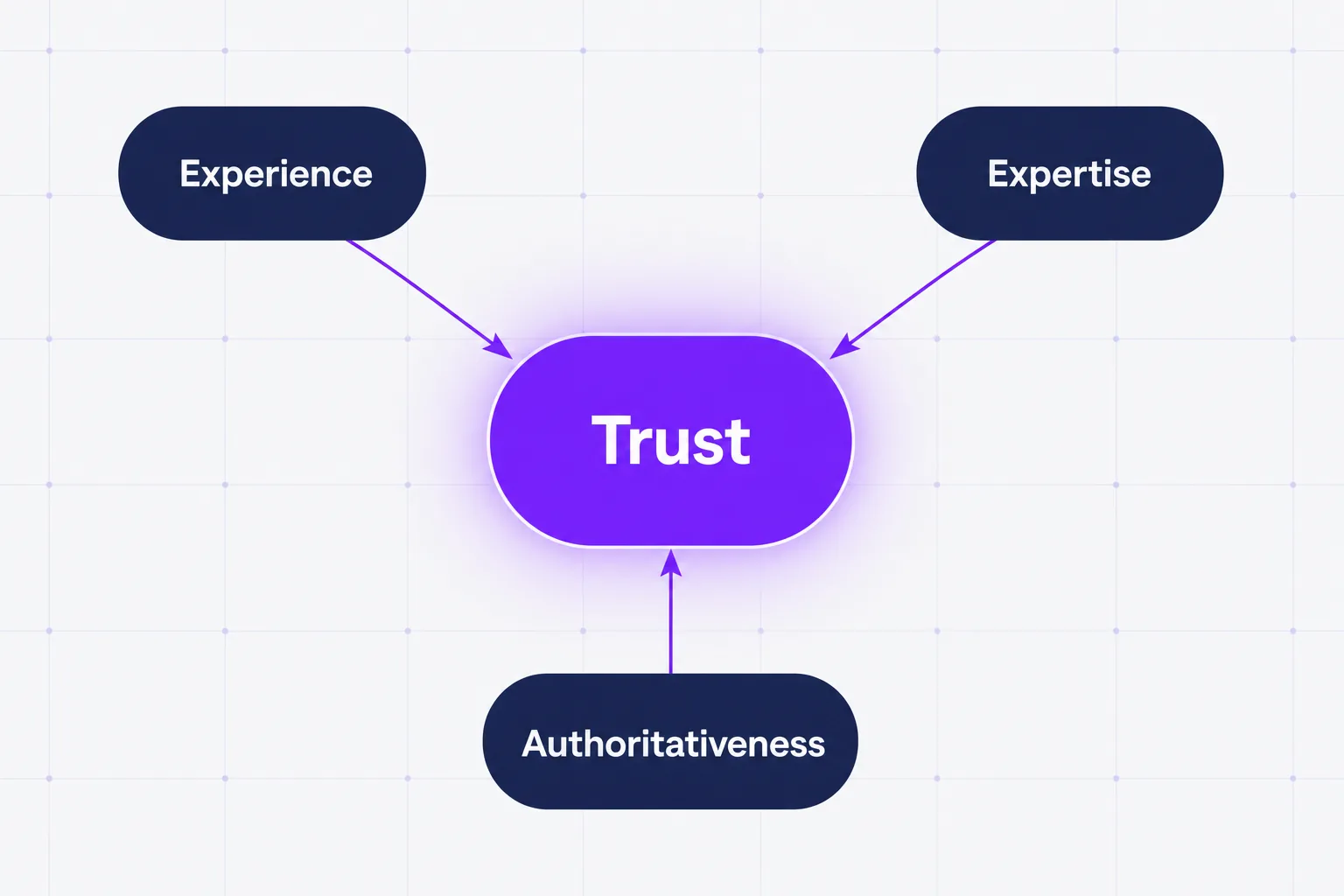
E-E-A-T stands for Experience, Expertise, Authoritativeness, and Trustworthiness. Trust sits at the center, and the other three feed into it: experience, expertise, and authority are the evidence, while trust is the verdict.
E-E-A-T is not a dial in Google’s algorithm. It comes from Google’s Search Quality Rater Guidelines, the manual human evaluators use to judge whether Google’s automated systems are surfacing genuinely helpful content. Clearing that up early prevents a common mistake: treating E-E-A-T as a switch you flip rather than a quality bar you meet.
The first “E,” Experience, was added in late 2022 and is the one that matters most for AEO. It rewards first-hand knowledge: actually using the product, visiting the place, doing the work. That is precisely the signal an AI system struggles to fabricate, because it lives in original detail rather than rephrased consensus.
Is E-E-A-T a Ranking Factor?
No. There is no score Google reads off a page. E-E-A-T is a conceptual framework raters use to assess whether automated systems are rewarding people-first content.
The practical reframe matters more than the technicality. The signals that correlate with strong E-E-A-T, such as named authors with real credentials, citations to primary sources, accurate claims, and genuine reviews, are the same signals Google’s systems are built to reward. So while E-E-A-T itself is not a ranking factor, Google’s guidance on creating helpful, reliable, people-first content describes exactly the qualities it measures.
What AEO Is and Why E-E-A-T Is the Deciding Signal
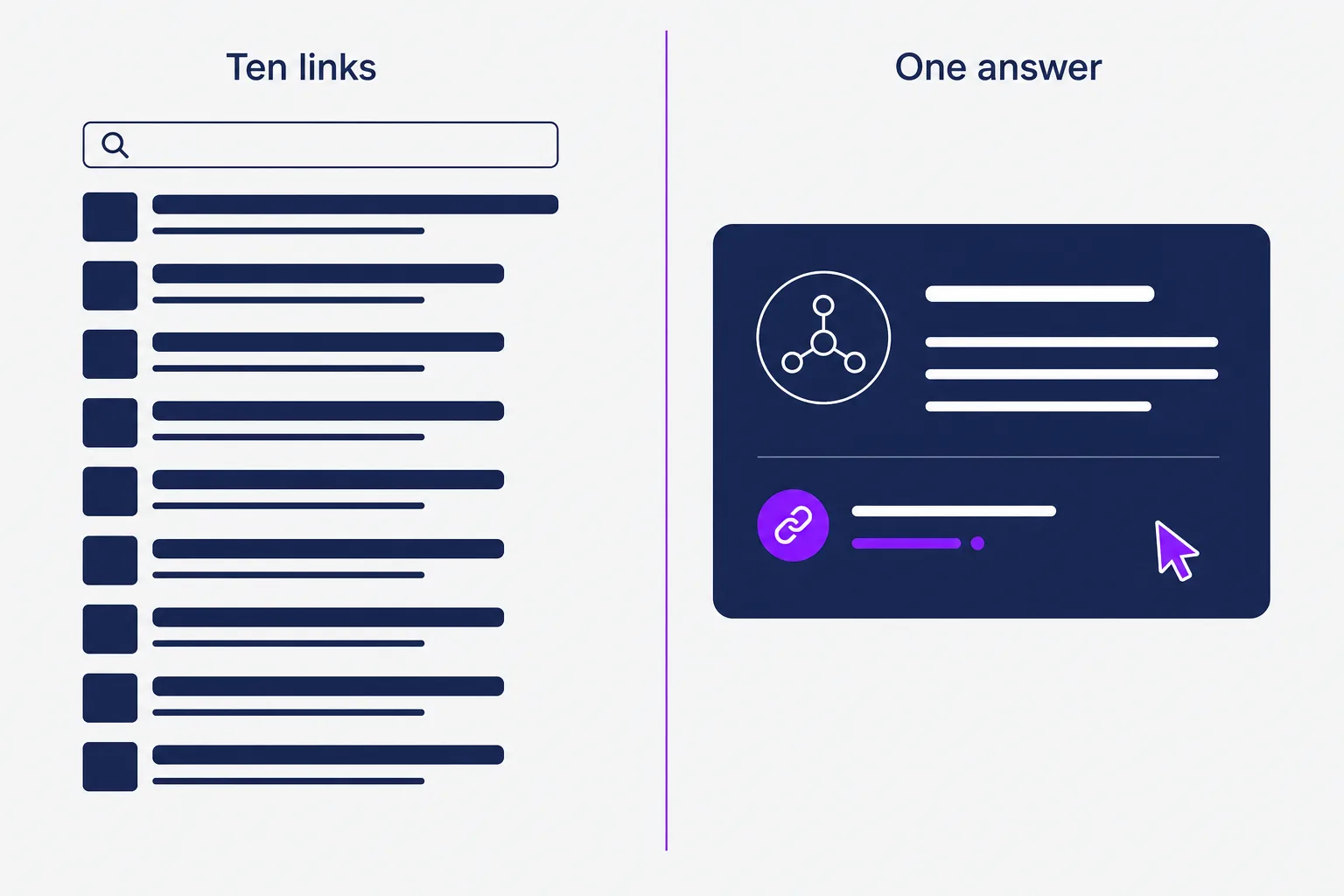
AEO means optimizing content to be selected and cited by answer engines: Google AI Overviews, ChatGPT, Perplexity, Gemini, and voice assistants. Understanding why E-E-A-T matters here starts with one structural fact about these engines.
On a traditional results page, the user scans a ranked list and decides which link to trust. In a single-answer result, that choice disappears. The engine picks one or a few sources on the reader’s behalf and presents a synthesized answer. Selection becomes a trust decision made for the reader, and the engine pre-filters candidates for credibility. E-E-A-T is that filter.
In a single-answer result, selection becomes a trust decision made for the reader, and E-E-A-T is the filter.
One genuine tension is worth addressing. Some argue AEO contradicts E-E-A-T, because answer engines want clean, robot-readable facts while E-E-A-T rewards messy human experience. In practice these are not opposites. Structured, verifiable claims backed by demonstrable expertise are exactly what an engine can safely lift and attribute. Google’s documentation on AI features in Search reinforces that the same fundamentals of quality content apply. Human experience gives an answer its unique substance; clear formatting makes that substance easy to quote.
Breaking Down the Four Signals for Answer Engines
| Signal | What it means | How answer engines read it |
|---|---|---|
| Experience | First-hand, real-world use | Original detail an aggregator cannot invent |
| Expertise | Depth and skill in the subject | Named authors, credentials, accurate technical claims |
| Authoritativeness | Recognition by others | Citations, mentions, and links from trusted sources |
| Trustworthiness | Accuracy, safety, transparency | Verifiable facts, clear sourcing, a secure and legitimate site |
Experience shows up as detail no one could paraphrase from elsewhere: what actually happened when you ran the process. Expertise is visible when a real, named person with relevant background stands behind the claims. Authoritativeness is largely off-page, built when other credible sources reference you. Trustworthiness is the connective tissue an engine can partly verify itself, through consistent facts, transparent sourcing, and basic site integrity. An unattributed claim with no supporting evidence is exactly what gets left out of an answer.
How to Improve E-E-A-T for AEO

Skip the generic checklist. A tighter, AEO-specific approach works better.
Demonstrate Real Experience and Expertise in Your Content
Lead with first-hand detail: original data, real examples, and observations from doing the work. Attach named authors with genuine bios, and add author schema so systems can connect content to a credible person. A startup that publishes its own hands-on product testing notes, rather than rewording competitor pages, gives an answer engine something specific to cite for its niche. That specificity is the point.
Build Authority and Trust Signals Engines Can Verify
Cite primary sources consistently, keep factual claims accurate, secure the site, and make your contact and about information transparent. Implement structured data so machines can parse what a page is about; Google’s structured data documentation sets out the supported formats. This is where solid web development pays off, because clean markup and a technically sound site are trust signals in their own right. Formatting matters too: concise definitions and clear question-and-answer blocks are easy for an engine to lift cleanly.
| Action | Signal it builds | Effort | Time to impact |
|---|---|---|---|
| Add author bios and credentials | Expertise / Trust | Low | Weeks |
| Publish first-hand, original content | Experience | Medium | 1–3 months |
| Earn citations and mentions | Authoritativeness | High | 3–6+ months |
| Implement structured data | Trust / clarity | Low–Medium | Weeks |
These timelines are realistic, not promises. Authority in particular is earned slowly, and no credible approach delivers it overnight.
E-E-A-T Across SEO, AEO, and GEO
E-E-A-T is not tied to one channel, which is why it is a durable investment.
| Discipline | Goal | How it uses E-E-A-T |
|---|---|---|
| SEO | Rank pages in results | Trust signals influence which pages systems surface |
| AEO | Be the cited answer | Credibility decides which single source gets quoted |
| GEO | Be represented in generative outputs | Verifiable expertise shapes how models describe you |
SEO wants your page ranked, AEO wants your page quoted, and Generative Engine Optimization (GEO) wants your brand accurately represented inside AI-generated text. The common denominator is the same set of trust signals. Build them once and they compound across every channel.
Common Mistakes That Undercut E-E-A-T
Most failures trace back to trust. Anonymous, ghostwritten thin content gives an engine nothing to attribute. Unverifiable claims and outdated facts erode accuracy. Keyword stuffing reads as manipulation rather than help. Ignoring updates lets pages drift out of date. And faking experience, padding content with invented “hands-on” detail, is increasingly detectable and the fastest way to lose credibility once it is spotted. Each of these breaks the trust an answer engine needs before it will quote you.
Where to Start
E-E-A-T is not a switch you flip. It is the credibility layer answer engines rely on when there is only room for one answer, and it rewards the same qualities across SEO, AEO, and GEO.
Start with an audit: check current content for clear author attribution, genuine first-hand experience, citations to primary sources, and structured data. That inventory usually reveals the quickest wins. For teams handling startup SEO with limited hours, focus first on author attribution and original detail, the two signals machines cannot fake on your behalf.
Building these signals well sits at the intersection of content, SEO, and development, which is where a partner like Webtec fits. The through-line is simple: earn trust, structure it so machines can read it, and you become the source worth quoting.