
AI answer engines do not reward a single high-ranking page the way classic search once did. They assemble responses by pulling passages from sources they judge to be genuinely authoritative on a subject, then attribute the answer to a handful of them. Learning how to build topic clusters for AI search visibility is the practical response to that shift: a pillar page supported by interlinked subpages tells both Google’s topical systems and large language model retrieval that you cover one subject with real depth, not in scattered one-off posts.
This guide walks through the full build, from choosing a core topic to measuring citations and AI Overview inclusion. You get a repeatable framework (pick a core topic, map subtopics to intent, design the pillar, build cluster pages, interlink deliberately, structure content for extraction, then measure), three reference tables covering roles, timelines, and metrics, and an honest look at when this work is worth building in-house versus with a specialist team. The goal is topical authority that earns rankings and gets your content cited when someone asks an AI engine a question in your field.
1. What a Topic Cluster Is (and Why AI Search Changed the Stakes)
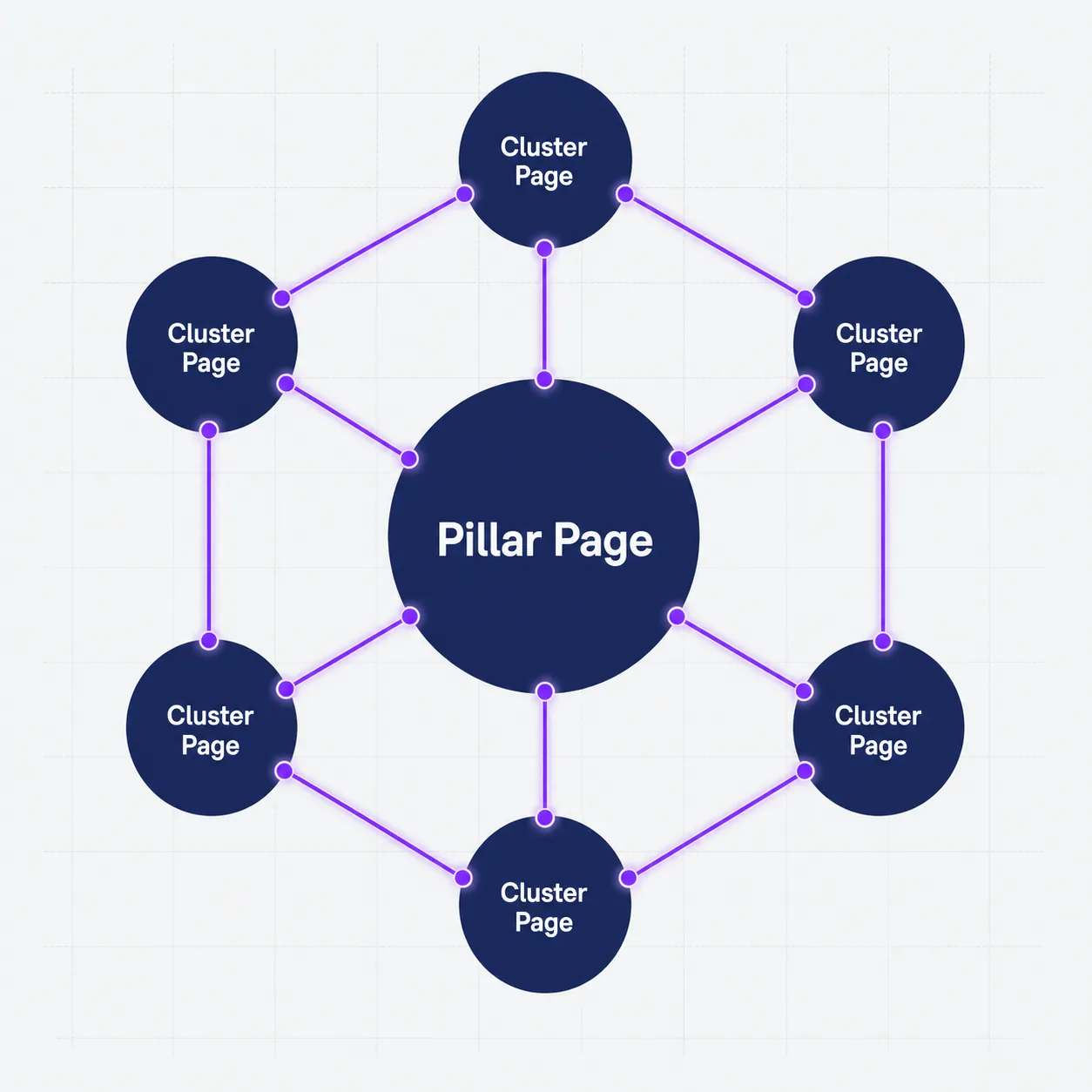
A topic cluster is a three-part content architecture. At the center sits a pillar page: a broad, comprehensive resource that covers a subject at a high level and targets the head term. Around it sit cluster pages (also called subtopic pages), each owning one specific question or angle in depth. Tying them together are internal links that connect every cluster page to the pillar and, where relevant, to sibling pages.
When you build a cluster, the aim is earned authority rather than borrowed authority, and that distinction is what makes the pages visible to AI search. A dozen unconnected articles each borrow whatever authority the domain already has. A cluster you interlink deliberately earns authority for a specific topic by demonstrating consistent, connected coverage that a search system, and the AI retrieval layer built on top of it, can recognize as a body of expertise.
A single thin article is easy to skip. A cluster that answers the surrounding questions too is harder to ignore.
How AI answer engines read a cluster
Most definition posts stop at the architecture. What matters for AI visibility is retrieval. Answer engines built on retrieval-augmented generation do not quote whole pages; they pull the passages that best match a query, then synthesize and cite them. Consistent, interlinked coverage of a topic raises the odds that several of your passages are retrieved and attributed, because the engine repeatedly encounters clear, corroborating information across connected pages. A single thin article is easy to skip. A cluster that answers the surrounding questions too is harder to ignore. Google’s guidance on creating helpful, people-first content makes clear that demonstrable expertise and topical focus are what its systems are built to reward, and the same signals feed the AI-generated experiences layered on top of search.
2. Why Topic Clusters Drive Rankings and AI Citations
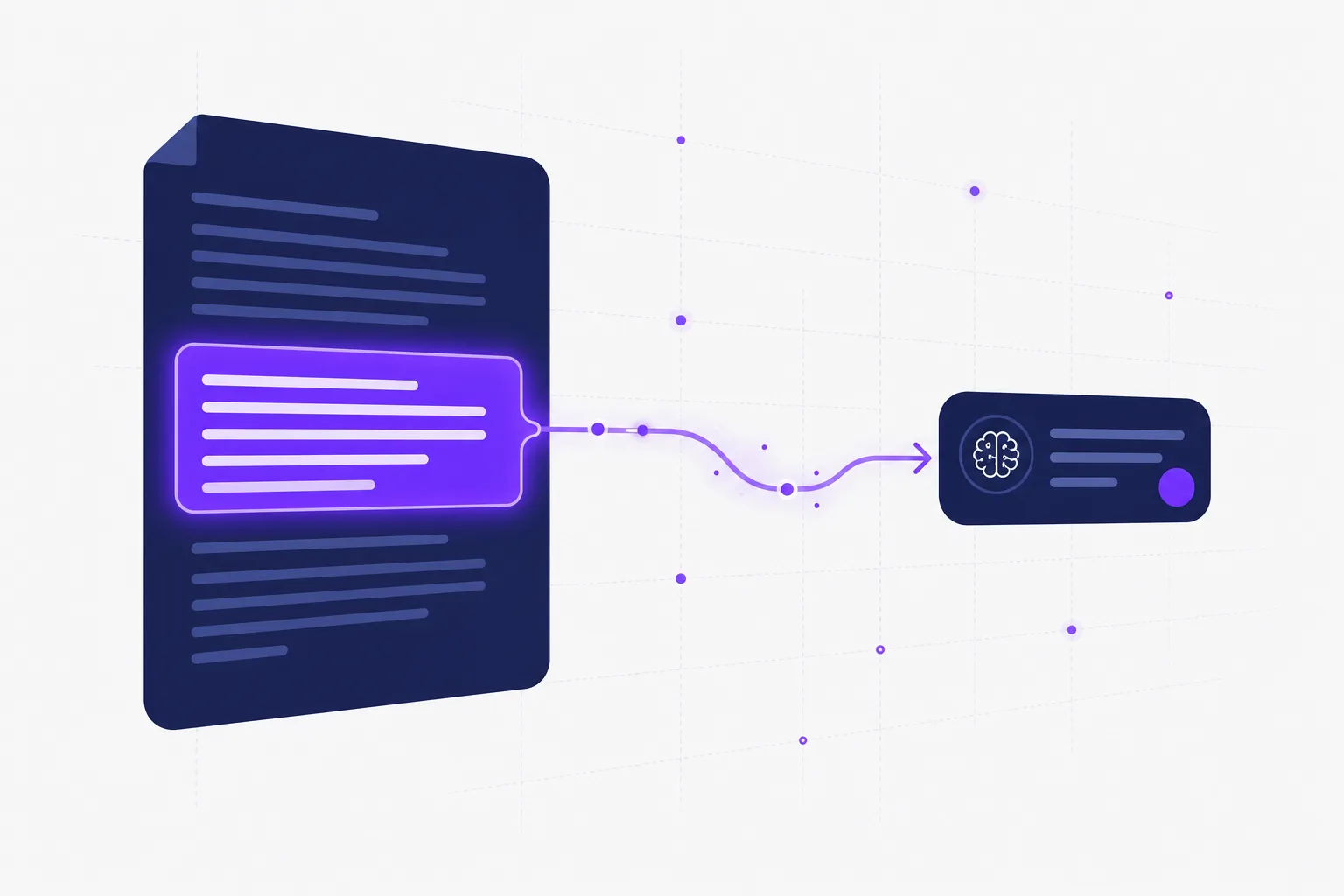
Building a cluster instead of scattered posts pays off in two directions at once: rankings and AI citations. Consolidating authority around one topic, rather than splitting it across competing pages, reduces keyword cannibalization, creates more entry points from long-tail queries, and increases session depth as readers move between connected pages. Those same signals of concentrated, connected coverage are what tell an AI engine your pages are worth retrieving and attributing, and each outcome still maps to something a business cares about: more qualified traffic, more time on site, more chances to convert.
How Google evaluates topical authority
The internal links inside a cluster are what teach search and AI systems that its pages belong together. They distribute relevance and context between pages, helping those systems identify which page is the definitive resource on a subject and how the supporting pages relate to it, which is exactly the structure you are building toward. Depth across several connected pages consistently outperforms a single page trying to cover everything shallowly. That is why a focused cluster on seo for startups tends to outrank a general marketing blog that mentions startups once.
Why AI models favor structured, comprehensive sources
This is why the cluster pages you build should be complete and clearly structured: those traits make individual passages easier for an AI engine to extract and attribute. When a page is well organized, answers a question directly, and defines its terms, a model can lift a clean, self-contained passage and cite it with confidence. Long-running research from the Nielsen Norman Group shows that people scan rather than read, favoring clear headings and front-loaded information. AI retrieval rewards the same structure for the same reason: the meaningful unit is easy to isolate. Content built for scanning humans turns out to be content built for machine extraction.
3. How to Build Topic Clusters for AI Search Visibility: The Framework
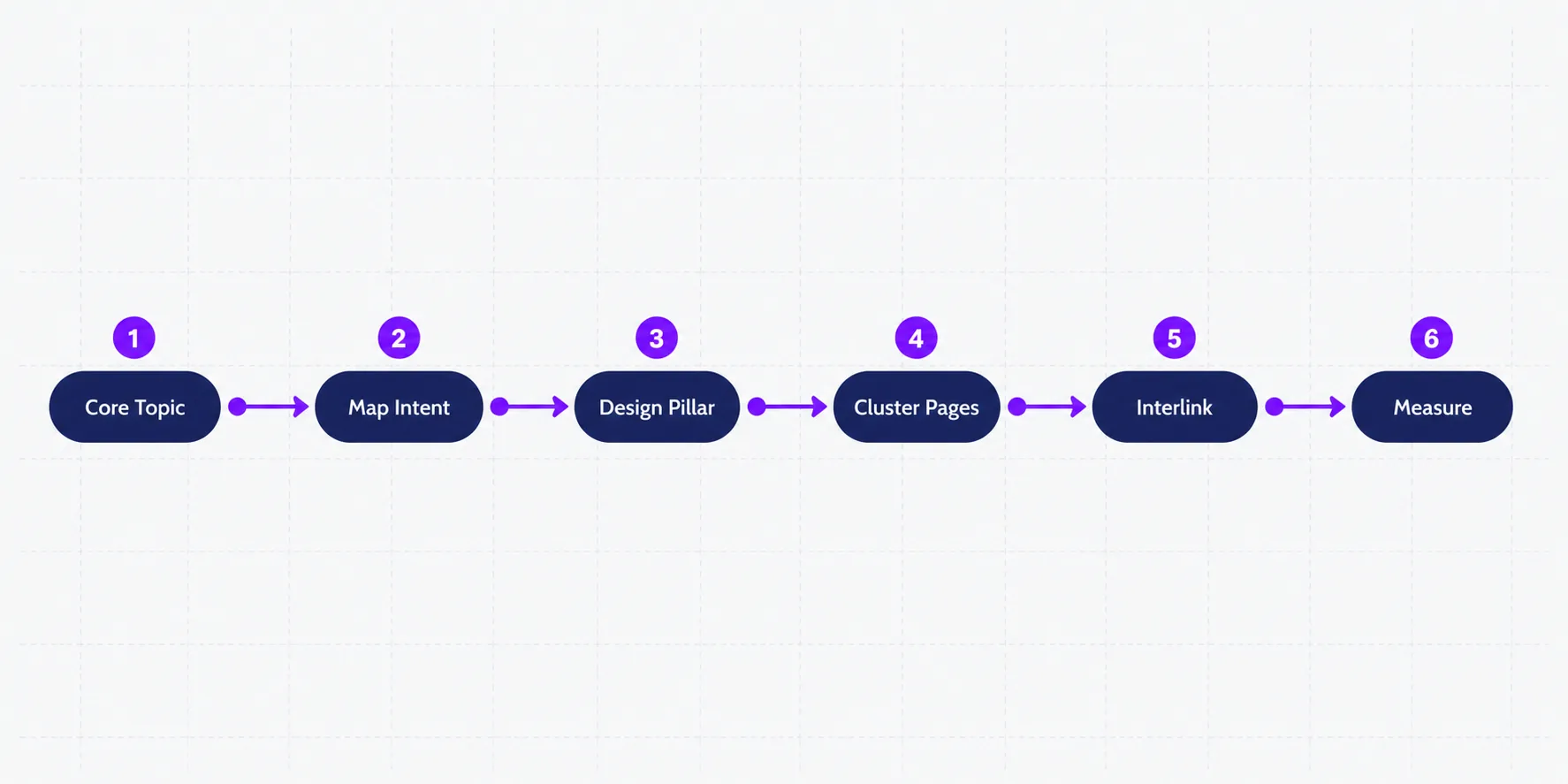
These six steps are the build itself. They take a cluster from an idea to a measurable asset that AI engines can find, retrieve, and cite.
Step 1: Choose a core topic with business and search value
Anchor the cluster on a topic you can realistically win and that maps to revenue, not just search volume. A high-volume head term you have no chance of ranking for is a poor foundation. A startup founder is better served building a focused seo for startups cluster than chasing a generic “marketing” pillar, and a trades business will get further with a tightly scoped local seo for electricians cluster than a broad “digital marketing” one. The test: can you plausibly become one of the most complete resources on this subject, and does ranking for it bring in the right customers?
Step 2: Map subtopics to real search intent
Enumerate the subpages by studying how people actually search. People Also Ask boxes, related queries, and the follow-up questions AI engines suggest all reveal the questions your cluster needs to answer. Group them by intent stage: awareness questions (“what is a topic cluster”), consideration questions (“pillar page vs cluster page”), and decision questions (“how to build one” or “who can build one for me”). Each distinct question with genuine search interest becomes a candidate cluster page.
Traditional topic clusters are usually built from keyword relationships. You pick a main keyword (pillar page), then create supporting articles …
Step 3: Design the pillar page
Build the pillar as a broad, comprehensive, scannable overview that introduces the whole subject and targets the head term, then link out from it to every cluster page as the natural next step. It should read as a complete resource on its own while working as the hub that routes readers, crawlers, and AI retrieval to the deeper pages, the arrangement that signals coverage of a full topic rather than a single article. Think of it as the table of contents and the executive summary combined.
Step 4: Build cluster pages that each own one subtopic
Each cluster page goes deep on a single question and does not wander. It links back to the pillar and to sibling pages where the connection is genuine. A worked example makes this concrete: a single-service page built for a trade vertical, such as Webtec’s guide on SEO for plumbers and how AI search is reshaping local visibility, shows what one focused cluster page looks like in practice. It answers one audience’s questions thoroughly rather than diluting itself across every service. Replicate that focus for each subtopic in your map.
Step 5: Interlink with intent, not by count
Internal linking is where clusters are won or lost. Use descriptive, keyword-relevant anchor text that reflects the destination page, not “click here.” Build a hub-and-spoke structure (pillar to clusters and back) and add lateral links between related cluster pages where the relationship is real. Audit for orphan pages: any cluster page with no internal links pointing to it is effectively invisible to both crawlers and readers.
Step 6: Structure content so AI can extract it
The final build step is what makes a cluster visible in AI answers: format every page so a machine can lift a clean answer from it. Use clear headings, lead with direct answer-first passages, define entities and terms explicitly, and apply structured data where it fits. Marking up articles, FAQs, and how-to content using the vocabulary published at Schema.org helps search and answer engines parse what a page is about and which passage answers which question. This is not a footnote to the process; it is the step that turns a well-built cluster into a set of citable sources an AI engine can quote.
Use schema, structured data, topic modeling, co-occurring keywords. Create content that builds authority around topic clusters. Use tools to …
4. Pillar Page vs. Cluster Page: Roles at a Glance
The two page types do different jobs inside a cluster, and getting each one right is what makes the structure legible to AI search. Confusing them is a common reason clusters underperform.
| Dimension | Pillar Page | Cluster Page |
|---|---|---|
| Purpose | Broad overview and hub for the topic | Deep answer to one specific subtopic |
| Keyword target | Head term / core topic | Long-tail, intent-specific query |
| Depth vs. breadth | Wide coverage, moderate depth | Narrow focus, high depth |
| Word count guidance | Longer and comprehensive | Sized to fully answer one question |
| Linking role | Links out to all cluster pages | Links back to pillar and relevant siblings |
| Update cadence | Reviewed as the topic evolves | Updated when its specific answer changes |
5. A Cluster Build Timeline and What It Takes
Building a topic cluster for AI search visibility is a multi-week to multi-month program, not a single post, and the visibility compounds as pages mature and interlink. Planning the build around that reality up front prevents the common failure of publishing a pillar, running out of momentum, and never building the cluster pages that make it work.
| Phase | Realistic duration | Primary owner | Client input needed |
|---|---|---|---|
| Research and topic mapping | 1–2 weeks | Strategist | Business goals, target customers |
| Pillar page build | 1–2 weeks | Copywriter + strategist | Subject-matter review |
| Cluster batch 1 (3–5 pages) | 2–4 weeks | Copywriter | Product/service specifics |
| Interlinking and technical setup | 1 week | Developer + SEO | Access to CMS |
| Measurement baseline | Ongoing from launch | SEO analyst | Analytics access |
| Expand (further batches) | Recurring | Full team | Priorities and feedback |
Building a cluster that AI engines will surface takes both writing and development resource: someone to research and write pages that genuinely answer questions, and someone to implement the internal linking, structured data, and templates that make those answers retrievable at scale. Pairing content and development capability is what keeps a cluster from stalling between the draft and the live page.
6. How to Measure AI Search Visibility and Cluster Performance
Once you have built a cluster, the question that matters is whether AI engines are actually surfacing it, and citations get mentioned far more often than they get measured. Measuring AI search visibility means separating the metrics you can track from the ones that actually signal whether your cluster is earning citations.
| Metric | What it measures | Tool category | AI-search relevance |
|---|---|---|---|
| AI Overview inclusion | Whether your pages appear in AI-generated answers | AI-visibility trackers | Direct signal of AI surfacing |
| Citation frequency in LLM answers | How often engines attribute answers to you | Prompt-monitoring tools | Direct signal of trust |
| Topical ranking spread | How many cluster keywords rank, not just one | Rank trackers | Breadth of authority |
| Internal-link equity | Link distribution across the cluster | Site crawlers | Structural health |
| Assisted conversions | Cluster pages’ role in the path to conversion | Analytics platforms | Business outcome |
AI Overview inclusion tracking reveals actual search visibility more accurately than single-keyword position monitoring, because a page can be cited in an answer without ranking first for any one term. For the traditional side of the picture, Google Search Console’s Performance report remains the primary source for tracking impressions and the spread of queries a cluster earns over time, which is the clearest early signal that topical authority is building.
7. Common Mistakes That Keep Clusters Out of AI Answers
Clusters that never make it into AI answers usually share the same handful of build problems. Thin cluster pages that repeat the pillar without adding depth give an engine nothing new to cite. Overlapping pages that target the same query cannibalize each other. Missing internal links leave pages orphaned and context-free. Content with no clear, answer-first passage is hard to extract. Chasing search volume over intent produces pages nobody actually searches for. And clusters that are never updated slowly fall behind the questions people are now asking. Each of these is fixable, and fixing them is usually cheaper than starting over.
8. Build In-House or Work With a Specialist Team
A small cluster on a familiar topic is a reasonable in-house project, especially if you have a writer who knows the subject and someone comfortable in the CMS. The trade-offs shift as scale grows. Larger clusters, the technical build (templates, structured data, link architecture), and ongoing measurement of AI visibility often warrant a dedicated team, simply because the coordination between strategy, writing, and development is where in-house efforts tend to stall.
Webtec’s model combines SEO strategy, copywriting, and development in one place, which suits startups, local service firms, and ecommerce businesses that want a cluster genuinely built and measured rather than half-finished. A free SEO trial is a low-risk way to see the approach applied to your topic before committing. No guarantees of specific rankings, no hype, just the work done properly.
Frequently asked questions
How many cluster pages does a topic cluster need?
How long until a topic cluster improves AI search visibility?
What is the difference between a topic cluster and a content cluster?
Do topic clusters still matter if I already rank well?
Can a small startup or local business build topic clusters affordably?
Next Steps for AI-Ready Topical Authority
Building topic clusters for AI search visibility comes down to a repeatable sequence: choose a core topic with real business value, map subtopics to genuine intent, design a comprehensive pillar, build cluster pages that each own one question, interlink with descriptive anchors, structure everything for clean extraction, then measure citations and AI Overview inclusion rather than a single keyword position. The clearest next step is to audit your existing content for cluster potential: which topics already have scattered coverage that a pillar could unify?