
The short answer is no: AEO will not replace traditional SEO, it extends it. Answer engines like ChatGPT, Google AI Overviews, and Perplexity do not invent facts from nothing. They pull from indexed, crawlable, authoritative web pages, which is exactly what search engine optimization produces. So the real question behind will AEO replace traditional SEO is about layering, not deletion.
The business challenge behind the anxiety is real. Click-through rates on some informational queries are falling as AI answers resolve the question on the results page itself. Marketing leads and founders see impressions climb while clicks flatten, and they are unsure where to put the next dollar. This guide sorts it out. You will get plain definitions of AEO and traditional SEO, the differences that actually matter, where the two overlap, a decision framework tied to your business type, and a practical way to measure both. The goal is a defensible plan, not a hot take.
Why the “Will AEO Replace Traditional SEO” Question Feels Urgent Right Now
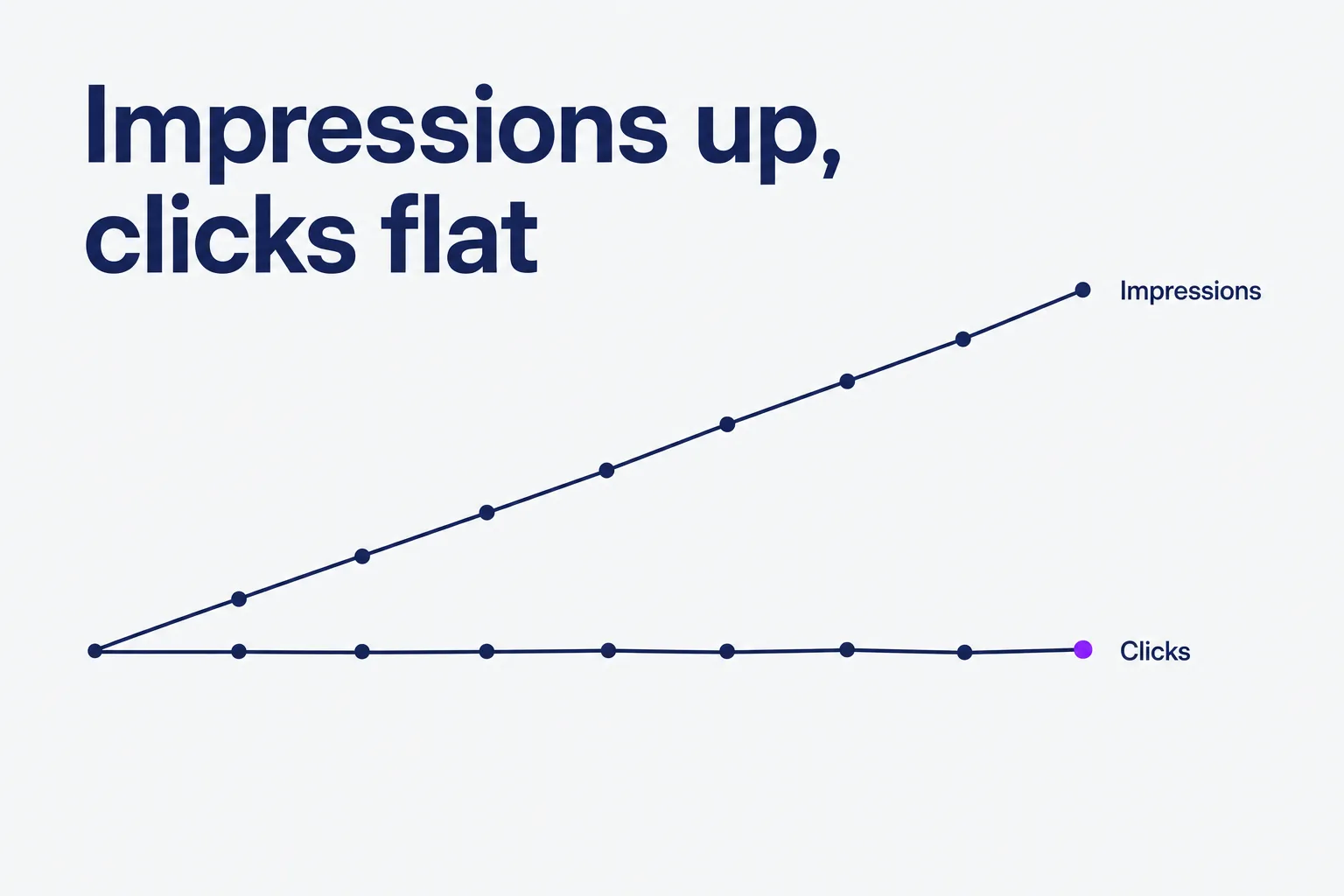
The reason the replacement question feels pressing is a measurable change in behavior, not just industry chatter. Zero-click searches, where the user gets what they need without visiting a website, have climbed for years, and generative answer boxes have accelerated the trend. When an AI Overview summarizes five sources at the top of the page, the informational click that used to land on your blog post may never happen. Teams watching their analytics see the gap, strong impression counts and softer click counts, and read it as early proof that AEO is displacing SEO.
That is a real change worth planning around, but it is not the death of search. People still research, compare, and buy, and they still click through when they need depth, proof, or a transaction. The Pew Research Center’s work on internet and search behavior shows how varied and intent-driven search use remains across audiences, which is why blanket “SEO is over” claims tend to collapse under scrutiny.
Why is traditional SEO no longer enough on its own? Because visibility is no longer only about ranking a page. It is also about being the source an answer engine chooses to quote. Traditional SEO gets you eligible. It no longer guarantees you capture the full moment of attention, because part of that moment now happens inside an AI response. That is the gap AEO fills, not replaces.
What Is Answer Engine Optimization (AEO)?
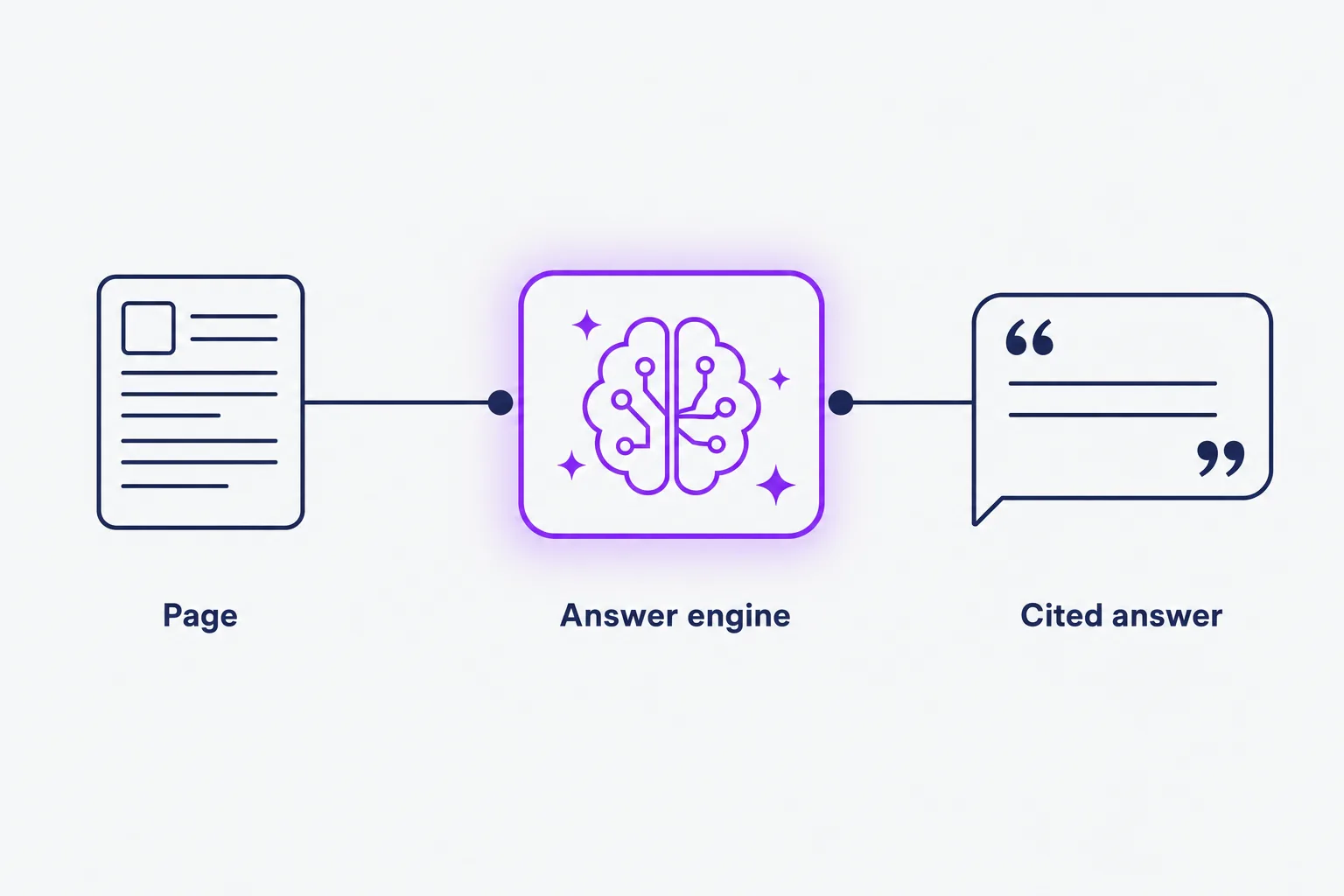
Answer Engine Optimization is the practice of structuring your content so it becomes the cited, quoted, or summarized answer inside AI-generated responses and answer boxes. It is the discipline people picture when they ask whether AEO will replace traditional SEO, so it pays to be precise about what it actually does. Instead of only competing for a blue-link position, you compete to be the passage an assistant extracts when a user asks a natural-language question.
AEO visibility works through a different mechanism than classic ranking. Answer engines parse content for clear, self-contained statements, match them to conversational queries, and favor sources with recognizable structure: descriptive headings, concise definitions, question-and-answer formatting, and machine-readable context. Structured data helps engines understand what an entity is and how facts relate. Using the Schema.org vocabulary to mark up FAQs, articles, products, and organizations gives answer engines cleaner signals about your content’s meaning.
The mental model shifts from “rank this page for this keyword” to “be the trustworthy, extractable answer to this question.” A page can rank modestly in traditional results and still be cited often by AI tools if it answers clearly. The reverse is also true, which is why the two disciplines complement rather than cancel each other.
The real insight here is that AEO fundamentally changes content strategy from being discoverable to being quotable. Traditional SEO content can …Read on LinkedIn ↗
What Is Traditional SEO, and What Does It Still Do?
Traditional SEO is the work of earning crawlable, ranked positions in the classic results page through technical health, authority, and relevance. It covers site architecture, indexation, page speed, internal linking, quality content, and the backlinks and trust signals that tell search engines you deserve to rank.
Crucially, traditional SEO is the foundation layer AEO depends on. An answer engine cannot cite a page it cannot crawl or index. It is unlikely to quote a source with weak authority when stronger ones exist. The E-E-A-T signals (experience, expertise, authoritativeness, trustworthiness) that SEO practitioners have built for years are the same signals that make content citation-worthy.
Is SEO getting replaced by AI? Reframe the question: AI reads the same web that SEO builds. The models summarizing answers are trained and grounded on crawlable content. Remove the SEO foundation and you remove the material answer engines draw from.
Rather than replacement, this is dependency.
AEO vs. Traditional SEO: The Real Differences
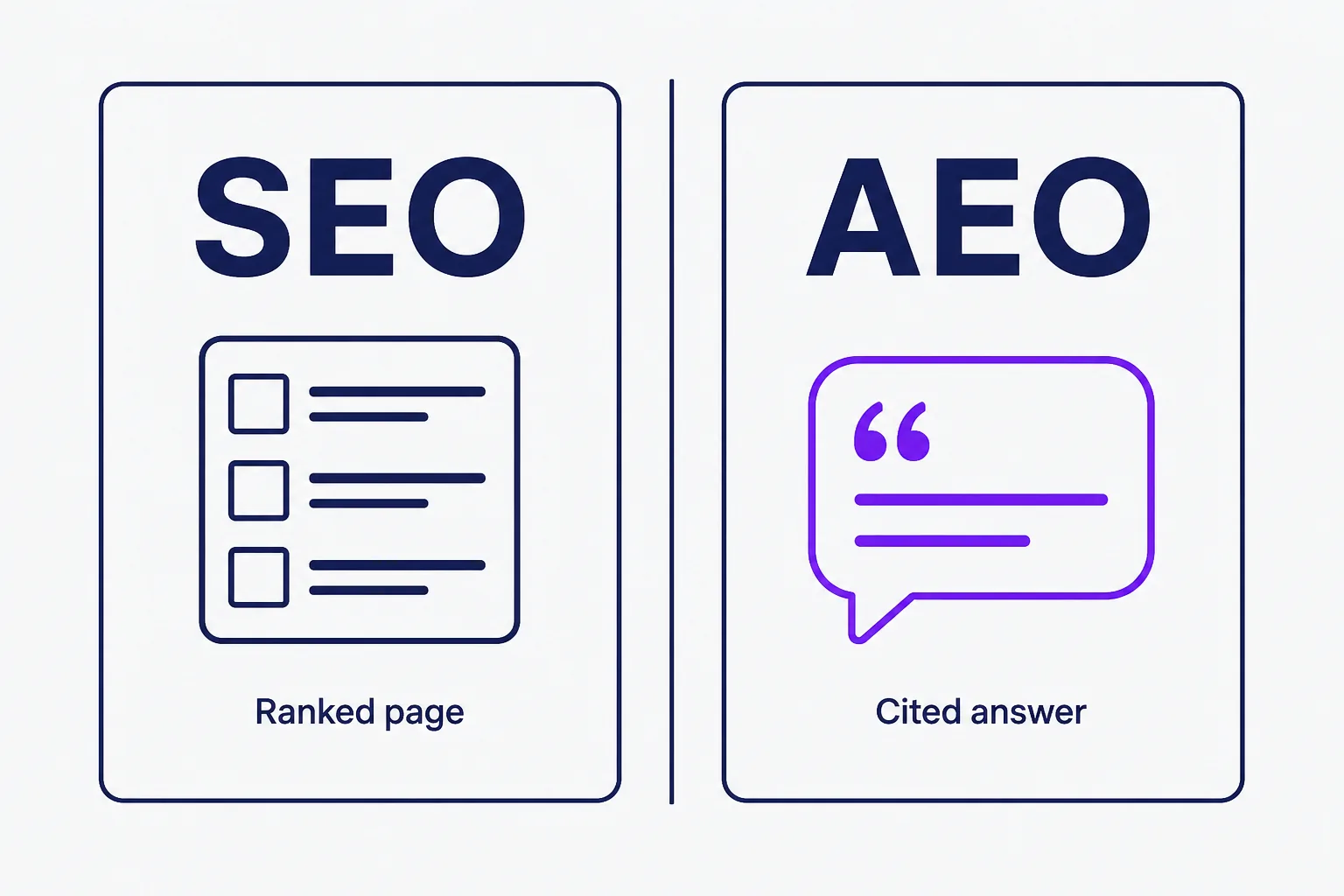
The two disciplines share DNA but optimize for different endpoints, and seeing exactly where they diverge is what settles the replacement question. This comparison makes the distinctions concrete.
| Dimension | Traditional SEO | AEO |
|---|---|---|
| Primary goal | Rank a page in search results | Become the cited answer in AI responses |
| Unit of visibility | Ranked page (blue link) | Quoted or summarized answer |
| Query type | Keywords and phrases | Natural-language questions |
| Key signals | Backlinks, technical health, relevance | Structure, clarity, entities, authority |
| Content format | In-depth pages and posts | Concise, self-contained answers plus depth |
| Measurement | Rankings, organic sessions, CTR | Citations, mentions, share of answer |
| Time to impact | Weeks to months | Weeks to months, dependent on SEO base |
Each row connects to a business outcome. Ranking still drives qualified sessions and conversions. Citation drives brand presence at the exact moment a prospect asks an assistant for a recommendation. For resource-constrained teams, this matters: a founder weighing SEO for startups does not have budget to chase every tactic, so understanding which signal maps to which outcome is how startup SEO stays efficient rather than scattered.
Will AEO Replace Traditional SEO Completely? The Evidence Says No
Directly: no, AEO will not replace traditional SEO completely. Three structural reasons hold this up.
First, answer engines source from the indexed web. Without crawlable, indexed pages, there is nothing for an assistant to summarize or cite. SEO builds that corpus. Second, the authority and trust signals that decide which sources get quoted come from SEO fundamentals: backlinks, reputation, consistent entity information, and demonstrated expertise. Third, traditional search still drives the majority of qualified, transactional traffic. High-intent commercial and local queries continue to produce clicks, because people want to compare options, read reviews, and complete purchases on real pages.
Honesty requires acknowledging where AEO genuinely erodes SEO value. Top-of-funnel informational clicks, the quick “what is” and “how does” queries, are increasingly answered without a visit. If your traffic model depended heavily on that category, you will feel it. Research from usability specialists like the Nielsen Norman Group on how people read and interact with AI-generated answers shows users often accept a summarized response for simple questions while still clicking through for complex, high-stakes decisions. The strategic response is to shift informational content toward being the cited source, and to keep investing in the mid- and bottom-funnel pages that still earn the click.
Is AEO replacing traditional SEO? Is SEO dead or evolving in 2026? It is evolving. The discipline is absorbing a new visibility surface, the same way it absorbed mobile, featured snippets, and local packs in earlier eras.
AEO without SEO is just rolling the dice. Search has expanded, but it hasn’t been replaced by AI; LLMs and traditional search engines co-exist …Read on LinkedIn ↗
How AEO and Traditional SEO Work Together
The productive frame is one integrated discipline, not an either-or choice. Think in layers. Technical SEO and authority make you eligible to be seen and trusted. AEO structuring makes you the answer once you are eligible. Skip the first layer and the second has no foundation. Skip the second and you leave the AI surface to competitors.
| Funnel stage | SEO role | AEO role | Shared foundation |
|---|---|---|---|
| Awareness | Rank informational pages | Earn citations in AI answers | Crawlable, authoritative content |
| Consideration | Rank comparison and guide pages | Be quoted in “best option” answers | Clear structure and entities |
| Decision | Rank commercial and local pages | Surface in assistant recommendations | Trust signals and reviews |
The dependency runs deeper than content, which is another reason AEO cannot stand on its own. Site architecture and clean, fast code make pages easy to crawl and extract, which is why sound web development underpins both disciplines. Reliable web hosting and strong performance affect crawl efficiency and user experience, both of which feed rankings and eligibility for citation. None of the answer-layer work pays off if the infrastructure below it is shaky.
Niche authority wins in both channels. A deep, specialist resource earns links and trust while also being the obvious source for an assistant to quote. Consider an industry-specific SEO strategy such as our guide to SEO for criminal defense lawyers: the same depth that ranks it also makes it the kind of authoritative, well-structured content an answer engine prefers to cite.
While doing SEO, you also need to do AEO. The era of traditional SEO is changing. Traditional SEO gets you visibility, But AEO gets you …Read on LinkedIn ↗
A Decision Framework: Where Should You Put Your Effort?
Since the honest answer to the replacement question is “run both,” the real work is deciding how to split effort, and “do both” on its own is not a plan. Priorities should shift with your business type and stage. Use this matrix as a starting point, then adjust to your data.
| Business situation | SEO priority | AEO priority | First move |
|---|---|---|---|
| Early-stage startup | High | Medium | Build crawlable foundation and core content |
| Local service business | High | Medium-High | Nail local listings, then structure FAQs |
| Ecommerce | High | Medium | Product and category depth, then structured data |
| Established B2B | Medium-High | High | Structure existing authority for citation |
Examples make this real. A startup pursuing SEO for startups should get the foundation right before chasing citations, because there is little authority for an answer engine to draw on yet. A local trade optimizing for local seo for electricians or electrician local seo benefits from AEO sooner, since voice and assistant queries like “who fixes wiring near me” reward clearly structured local answers, and the same logic applies to ai seo for plumbers. An online retailer working on seo for fashion ecommerce should prioritize product and category depth first, because transactions still happen on the page.
Local service businesses often have the most to gain from combining both. If you run a local practice, a definitive local legal SEO playbook shows how ranking and structured answers reinforce each other for near-me intent. And when the goal is revenue rather than raw traffic, the discipline of turning high-intent searches into booked, high-value clients is a reminder that both SEO and AEO are means to conversions, not ends in themselves.
How to Measure Success Across SEO and AEO
The clearest sign that AEO extends SEO rather than replaces it shows up in measurement: you cannot retire the old metrics, so you need two dashboards that talk to each other. This is where competitor coverage tends to thin out.
Traditional metrics stay relevant: keyword rankings, organic sessions, conversions, and assisted revenue from organic touchpoints. AEO introduces newer measures: how often your brand or pages are cited in AI answers, lift in branded search after AI exposure, referral traffic arriving from AI tools, and your share of answer for priority questions.
| Goal | SEO KPI | AEO KPI | Tooling approach |
|---|---|---|---|
| Visibility | Rankings, impressions | Citation and mention frequency | Search Console plus AI-answer monitoring |
| Traffic | Organic sessions | AI-tool referral traffic | Analytics referral segmentation |
| Authority | Backlinks, branded queries | Share of answer | Rank and brand tracking |
| Conversion | Organic conversions | Assisted brand lift | Attribution modeling |
Because AEO is built on top of SEO rather than swapped in for it, structured data and site performance sit under many of these measures, and Google Search Central’s structured data documentation explains how to implement and validate the markup that makes content both eligible for rich results and easier for engines to interpret. On timelines, set honest expectations: meaningful movement usually takes weeks to months, not days, and it depends on client participation. The best results come when the business supplies subject-matter input, real customer questions, and prompt content approvals.
How to Prepare for the AEO Shift Without Abandoning SEO
A prioritized sequence keeps effort focused.
1. Shore up technical SEO and crawlability first, because nothing downstream works without it. 2. Structure content as clear answers: descriptive headings, concise definitions up front, and FAQ sections that map to real questions. 3. Build entity and topical authority so engines trust you as a source. 4. Add structured data to articles, FAQs, products, and your organization profile. 5. Monitor AI-answer visibility for your priority questions and iterate.
Expect steady progress rather than instant results, and expect SEO to keep pulling weight instead of fading out. Anyone promising overnight citation dominance is overpromising. The realistic path is compounding: a strong SEO foundation makes each new piece of structured, authoritative content more likely to rank and to be quoted.
This integrated approach, SEO, development, and content working as one system rather than separate line items, is how a partner like Webtec helps small and mid-sized businesses stay visible as the surface evolves. The value is in the coordination: fast, crawlable sites, authoritative content, and clean structured data all pulling in the same direction.
Frequently asked questions
Is AEO replacing traditional SEO?
Is SEO dead or evolving in 2026?
Why is traditional SEO no longer enough?
Is SEO getting replaced by AI?
Do I need to do both AEO and SEO?
Will AEO replace traditional SEO for local businesses?
The Verdict and Your Next Steps
Hold onto the mental model: foundation plus evolution. Traditional SEO builds the crawlable, authoritative base; AEO structures that base so you become the answer inside AI responses. That is why the honest verdict on will AEO replace traditional SEO stays firmly no. One depends on the other.
The practical next step is sequential, not dramatic. Audit your current SEO foundation for crawlability, authority, and technical health. Then layer AEO structuring on top: clear answers, strong entities, and validated structured data. Measure both surfaces, give the work months rather than days, and let the two disciplines compound. Done in that order, the AI shift becomes an opportunity to widen your visibility, not a threat that erases the work you have already done.