
The search engine in 2026 is not what it used to be. AI tools like Google AI Overviews, ChatGPT, and Perplexity now answer questions before users ever click a link.
Knowing what answer engine optimization is, becomes one of the clearest ways to protect your business’s visibility right now.
This guide breaks down how AEO optimization works, why it matters for your bottom line, and the practical steps to start without rebuilding your website from scratch.
What Is Answer Engine Optimization and Why Does It Matter
AEO is the practice of structuring your content so that AI-powered platforms can extract it and present it as a direct answer to a user’s question. These include platforms like ChatGPT, Google AI Overviews, Perplexity and voice assistants. For nonprofits, this matters more than ever — AI search is how donors, volunteers, and community members now discover organizations. Our nonprofit website redesign service builds AEO-ready sites that help mission-driven organizations get found and chosen.
Traditional SEO gets your page into search results, but AEO optimization gets your content selected as the answer itself.
Instead of relying only on rankings, AEO makes your content easy for AI systems to read, understand, and cite.
So even if your content is not on the first page of search results, you still have the chance of getting mentions in Large Language Models.
The goal shifts from “be found” to “be chosen.” That is a meaningful change in how you write, format, and organize every page on your website. The same philosophy applies to how we run Webtec — we believe clarity, intentionality, and calm decision-making lead to better outcomes for clients and our team alike. Learn more about the mindfulness practices that inform our work culture and why we think focused thinking produces better digital strategy.
| Content Type | How It Appears | User Action Required |
| Traditional search result | Blue link in a results list | User must click and read the page |
| Featured snippet | Answer box above organic results | User may or may not click |
| AI answer (ChatGPT, Perplexity) | Synthesized response with cited sources | User rarely needs to click |
| Voice response | Spoken answer from a device | No screen, no click at all |
Where Answer Engines Show Your Content
AEO optimization is relevant across several platforms that are now central to how people find information every single day.
- Google AI Overviews
Google AI Overviews sit at the top of search results and pull answers from multiple web sources, as they now appear in roughly 15–30% of all search queries, depending on the dataset and query type.
- ChatGPT
ChatGPT handles over 2.5 billion prompts per day. When someone asks a business or product question, it pulls from content across the web and cites its sources.
- Perplexity
Perplexity operates as a direct Google alternative and consistently favors well-structured, recent content from credible pages.
- Voice Assistants
Voice assistants, such as Siri, Alexa, and Google Assistant, deliver spoken answers. They rely entirely on concise, structured content to do so.
| Answer Engine | User Base | What It Favors |
| Google AI Overviews | Billions of Google users | Structured, authoritative content with strong E-E-A-T signals |
| ChatGPT | 400M+ weekly active users | Comprehensive, well-sourced pages |
| Perplexity | Research-focused users | Recent, clearly formatted content |
| Voice assistants | Mobile and smart device users | Short, direct, conversational answers |
Two years ago, most marketing teams had never used the phrase “answer engine optimization”.
Today it comes up in nearly every serious SEO conversation because of a direct shift in how search behavior works.
Users now expect direct answers and AI platforms deliver them. Those platforms select content based on structure and clarity, not just rankings.
For small and mid-sized businesses that depend on organic search to bring in leads, this shift has a real effect on how many people actually find them — and what those users do next.
Why Answer Engine Optimization Matters Now
According to Semrush’s 2025 click-stream analysis, 58.5% of US searches and 59.7% of EU searches now end without a single click to any website.
Users are getting answers directly from the search results page and stopping there.
This is not a trend coming in the next few years. It is already the default search experience for most users today.
| Year | Zero-Click Rate (Approx.) | Key Driver |
| 2020 | ~50% | Featured snippets, knowledge panels |
| 2022 | ~54% | Voice search expansion, local packs |
| 2024 | ~58% | Google AI Overviews launched widely |
| 2025 | 58.5%+ (US) | AI Overviews now cover 27%+ of all searches |
The shift is not about users losing interest in your content. It is about AI answering the question before users ever reach your website.
7 Steps to Optimize Content for Answer Engines
These steps are practical and actionable. You do not need to rebuild your website. You need to rethink how your content is written, structured, and formatted on the pages that matter most.
| Step | Purpose | AEO Benefit |
| Front-load concise answers | Give AI the answer at the top | Increases extraction probability |
| Use question-based headings | Match real user search patterns | AI can map your content to actual queries |
| Add proof and entity signals | Build credibility and specificity | AI systems favor verifiable content |
| Add structured elements | Tables, FAQs, schema | Easier for both humans and AI to parse |
| Match format to intent | Right format for each query type | Stronger relevance signals for AI retrieval |
| Strengthen topical coverage | Address related sub-questions | Builds the topical authority AI systems trust |
| Update existing pages first | Refresh pages with existing reach | Fastest path to AEO visibility gains |
Step #1: Front-Load Concise Answers in the First 2 Lines
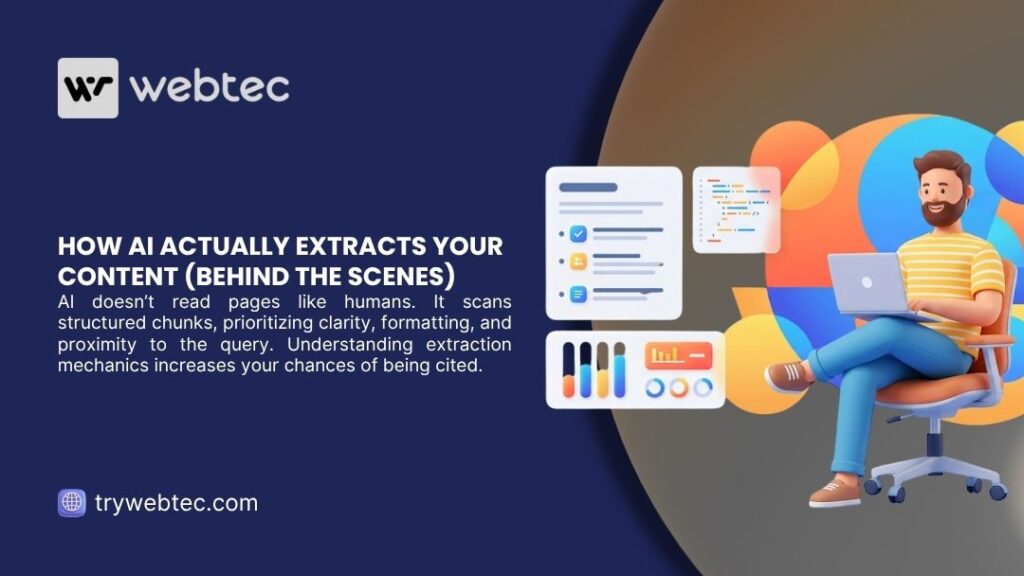
AI systems using Retrieval-Augmented Generation pull content in chunks of roughly 200 to 400 words. They look for content that answers the question right at the top — before any supporting detail appears.
If your opening paragraph takes three sentences to reach the actual answer, AI will often skip your content for a competitor who led with it.
A simple test: read the first two sentences of your page. Do they already answer the main question? If not, rewrite them so they do. Add the supporting detail underneath.
| Before (SEO-First Writing) | After (AEO-First Writing) |
| “In this guide, we will walk you through everything you need to know about…” | “Answer Engine Optimization is the practice of formatting content so AI systems can pull it as a direct answer.” |
| “Many businesses today are looking for ways to improve their search visibility…” | “58.5% of searches now end without a click — which is why AEO optimization directly protects your lead flow.” |
Step #2: Make Headings Question-Based and Specific
Most headings are written for topic coverage, not for user queries. AEO optimization requires a shift toward headings that reflect how people actually search.
Vague headings like “Our SEO Approach” or “Content Strategy Overview” tell AI very little about what question is being answered.
Question-based headings like “How Does AEO Affect Organic Traffic?” directly map to user intent — and make it far easier for AI systems to match your section to a real-world query.
| Vague Heading | Question-Based Heading |
| “SEO vs AEO” | “What Is the Difference Between SEO and AEO?” |
| “Content Tips” | “What Types of Content Perform Best for AEO?” |
| “Why It Matters” | “Why Does AEO Matter for Small Businesses?” |
| “Measurement” | “How Do You Measure AEO Performance?” |
Step #3: Use Proof, Clarity, and Entity Signals
AI systems skip vague claims.
Research from Erlin, analyzing over 500 tracked brands, found that brands with 8 or more structured attributes get cited 4.3x more than brands with fewer than 3.
Each additional structured attribute added 8.3% median citation coverage.
Specificity wins every time. When a page says “our approach improves conversions,” AI has nothing citable.
When it says “clients saw a 34% increase in conversion rates over 90 days, based on campaign data,” AI has a verifiable, specific claim it can actually use.
For AEO optimization, this means:
- Name your sources — cite studies, reports, and data by their origin
- Use clear definitions — explain every key term without assuming prior knowledge
- Back every major claim with a number, a date, or a named reference
- Use consistent terminology throughout so AI can identify your content as relevant to the topic
Step #4: Add Structured Elements That Help Extraction
The format of your content matters just as much as the words inside it.
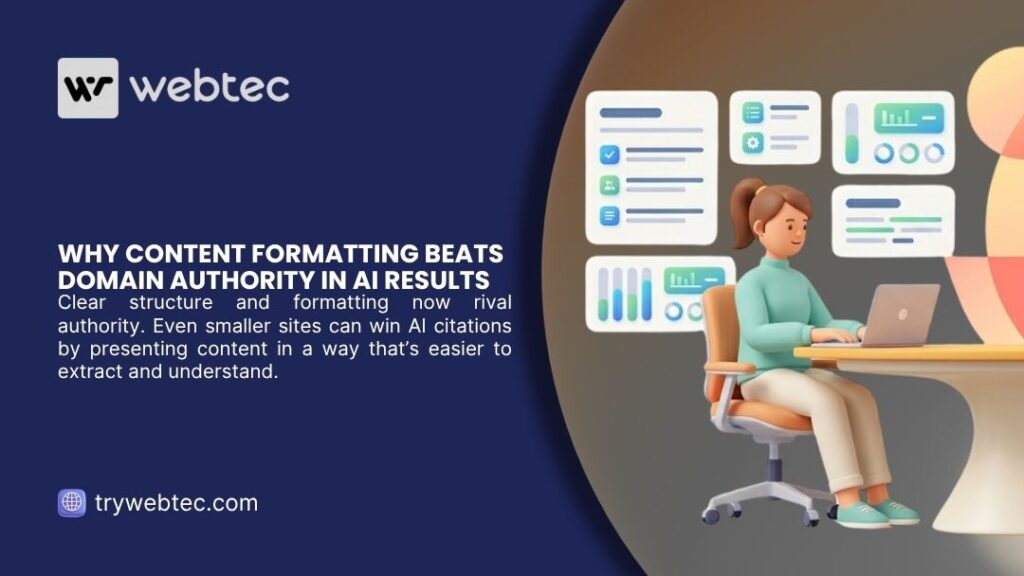
Data from Erlin shows that static HTML pages with schema markup achieve a 94% AI parsing success rate, compared to only 23% for JavaScript-rendered content without schema.
Structured content is easier for AI to read, process, and cite.
The elements that help most include FAQ blocks at the end of sections, comparison tables with clear headers, short paragraphs of 2 to 4 sentences, numbered steps for how-to content, and FAQPage schema in JSON-LD format.
Pages with FAQPage markup are 3.2x more likely to appear in Google AI Overviews compared to pages without it. Yet only 12.4% of websites currently implement any structured data, which is a significant gap that early movers can close quickly.
| Element | Why It Helps AEO | Effort to Add |
| FAQ blocks | Mirrors how AI retrieves question-answer pairs | Low — add to the bottom of any page |
| Comparison tables | Gives AI structured, scannable data to cite | Low — standard HTML tables work |
| Short paragraphs | Easier for AI to extract clean content chunks | Low — editorial discipline required |
| FAQPage schema (JSON-LD) | Tells AI exactly what question you answer | Medium — requires code implementation |
| Question-based H2/H3 headings | Maps sections to real search queries | Low — rewrite existing headings |
Step #5: Match Content Format to User Intent
Not every query should be answered the same way. AEO optimization works best when the format of your content matches what the user actually needs from that specific type of query.
A user asking “what is AEO optimization” needs a definition block. A user asking “how do I optimize a service page for AI search” needs numbered steps. A user asking “AEO vs SEO” needs a side-by-side comparison table.
When format matches intent, both the reader and the AI system find your content easier to use — and easier to cite.
| Query Type | Best Content Format | AEO Advantage |
| “What is…” | Definition block + short paragraph | AI can extract the definition cleanly |
| “How do I…” | Numbered steps | AI cites step-by-step content frequently |
| “X vs Y” | Comparison table | Strong match for nuanced evaluation queries |
| “Best [option] for…” | Criteria-based content with context | High relevance for decision-stage searches |
Step #6: Strengthen Topical Coverage with Supporting Subpoints
AI systems favor sources that cover a topic in depth, not just at the surface level. A page that answers the main question but ignores related sub-questions will lose citations to a page that addresses both.
After writing your main answer, ask yourself: what would a reader logically need to know next? Address that. Then the question after that.
This also directly improves getting your business cited by AI search engines, because AI platforms treat topically comprehensive pages as higher-authority sources.
The broader and deeper your coverage, the more queries your content becomes eligible to answer — and the more frequently it gets cited.
Step #7: Update Existing Pages Before Creating New Ones
Before building new content, look at what you already have. Pages that already rank or attract impressions are the fastest path to real AEO wins.
According to AirOps research, pages not refreshed on a quarterly basis are 3x more likely to lose AI citations compared to recently updated pages.
Freshness is a real ranking signal, not just for traditional search, but for AI citation behavior too. Freshness is only one input, though, and our breakdown of what makes ChatGPT cite a website covers the full set of factors at play.
A simple prioritization order:
- Find pages that get impressions but low clicks in Google Search Console
- Check if the first two sentences directly answer the main question the page targets
- Add a FAQ block and at least one comparison table to each priority page
- Update outdated statistics, references, and dates
- Resubmit each updated page for indexing through Search Console
| Page Type | Priority for AEO Update | Reason |
| Service pages | High | These are the pages that generate direct leads |
| Existing FAQ pages | High | Already structured for AI extraction |
| Blog posts with existing impressions | Medium-High | Fastest path to citation improvement |
| New pages with zero traffic | Low | Update existing pages before building new ones |
If you want a broader strategy for optimizing your website for ChatGPT and Perplexity and other major AI platforms, Webtec can audit your highest-value pages and identify exactly where AEO optimization will have the most impact on your lead flow.
AEO vs SEO: What Changes and What Does Not
What AEO and SEO Share
If you already invest in SEO, a large part of the foundation you need is already in place. AEO optimization builds on the same principles that make traditional SEO work.
Both care about:
- Content that directly matches what users are searching for
- Clear writing that demonstrates authority and trust
- Strong site structure that makes pages easy to find and crawl
- Credibility signals like backlinks, citations, and demonstrated expertise
- Technical health so pages load fast and get indexed properly
The difference between SEO and AEO is not that one replaces the other. AEO adds a new layer on top — optimizing how your content is structured for extraction, not just for discovery.
What AEO Changes in the Content Strategy
AEO optimization changes how you write and format your content. The shift is mainly about making information easier for AI systems to pull out and present as a direct answer.
That means answers come first, not buried at the end of long paragraphs. Headings are written as specific questions, not vague topic labels. Definitions are clear and self-contained.
Every major claim is backed by a named source. FAQ sections, tables, and structured blocks become more important than long unbroken prose.
The difference between SEO and AEO at the content level comes down to this: SEO gets your page in front of people. AEO optimization gets your content selected once the page is found.
| Element | Traditional SEO Focus | AEO Optimization Focus |
| Content goal | Rank for target keywords | Get cited as the direct answer |
| Heading style | Topic-based labels | Question-based, query-matched headings |
| Answer placement | Anywhere in the content | First two sentences of each section |
| Content format | Long-form prose | Structured blocks, tables, FAQ sections |
| Success metric | Rankings and clicks | AI citations, impressions, branded search lift |
| Optimization focus | Keywords and backlinks | Entity clarity, structured data, direct answers |
What Should Stay the Same
Not everything changes with AEO optimization. The fundamentals of quality content still apply — and AI systems reward them.
Authority still matters. AI platforms favor content from sources that are credible, well-referenced, and consistent across the web. Technical site health still matters.
Content that loads slowly or has crawlability issues will not get retrieved by AI systems. Topical depth still matters. Shallow pages that skim the surface rarely get cited.
AEO optimization does not replace quality. It builds directly on top of it.
| What to Keep | What to Change | What to Add |
| High-quality, well-researched writing | Long intros that delay answers | Direct answer sentences at the top |
| Topical depth and coverage | Vague, unsupported claims | FAQ blocks with schema markup |
| Authority and credibility signals | Topic-only heading labels | Question-based H2 and H3 headings |
| Technical site health | Keyword stuffing | Structured comparison tables |
Common Mistakes, Measurement, and First Steps
The biggest mistake is not ignoring AEO, but it’s applying old SEO habits to an environment that operates differently and expecting different results.
| Mistake | Why It Hurts AEO | What to Do Instead |
| Long intros that delay the answer | AI skips content that buries answers | Put the core answer in line one or two |
| Vague headings like “Our Approach” | AI cannot map vague labels to real queries | Rewrite headings as specific questions |
| No direct answer sentence | AI needs a clean, extractable statement | Open every section with one clear answer |
| Claims without evidence or sources | AI favors specific, verifiable content | Include stats, sources, and defined terms |
| No structured data implemented | Very low AI parsing success rate | Add FAQPage or HowTo schema |
| Content left stale for months | Pages actively lose AI citations over time | Refresh key content at least once per quarter |
Frequently Asked Questions
What is Answer Engine Optimization and why does it matter?
AEO is the process of structuring content in a way that allows AI-powered platforms such as ChatGPT, Google AI Overviews, and Perplexity to easily interpret it and use it as a direct answer to user queries.
What is the difference between SEO and AEO?
Traditional SEO focuses on ranking in search results and driving clicks. AEO optimization focuses on being selected as the cited answer within AI-generated responses. Both share the same content quality foundations, but AEO requires a more structured, answer-first format.
Does AEO replace SEO?
No, AEO optimization builds on top of SEO, not instead of it. Strong organic rankings still increase the chances of your content being cited by AI systems. The most effective strategies run both in parallel.
Why does AEO matter for small businesses?
Small businesses can compete for AI citations just as effectively as large brands because clear, well-structured content performs well regardless of domain size. The window to establish that early visibility is still open.
What types of content work best for AEO?
FAQ sections, comparison tables, step-by-step guides, service pages with direct answer openings, and definition-based content tend to perform well. These formats are easy for AI systems to parse and cite.
The Businesses That Move First on AEO Win the Citations.
If you want to stop losing organic leads to AI answers your competitors are getting cited in, and start showing up where your buyers actually look for solutions, you need more than just rankings.
Webtec works with small and mid-sized businesses to build SEO and AEO optimization strategies that keep your brand visible in both traditional search and AI-driven results.
Our approach is built around the pages and content types that generate not only traffic numbers, but also real leads.
We know what it takes to get a business cited by AI search engines, and we know how to make that work for companies without enterprise-level budgets.Ready to find out which pages on your site are already close to winning AI citations? Get a free consultation with us today and let’s build a strategy that actually moves your pipeline.