Is your website built to rank on Google, but invisible when someone asks ChatGPT or Perplexity for a recommendation in your space?
Optimizing websites for ChatGPT and Perplexity is no longer an advanced tactic. It is a baseline requirement for any business that depends on organic search for growth.
If you are just getting familiar with the concept, answer engine optimization is the strategic foundation behind everything covered in this guide.
7-Step Playbook to Optimize Your Website for ChatGPT and Perplexity
Here is the exact sequence that makes optimizing websites for ChatGPT and Perplexity easier to implement than most guides suggest. Each step builds directly on the one before it.
Step 1: Make the Page Easy for AI Systems to Access
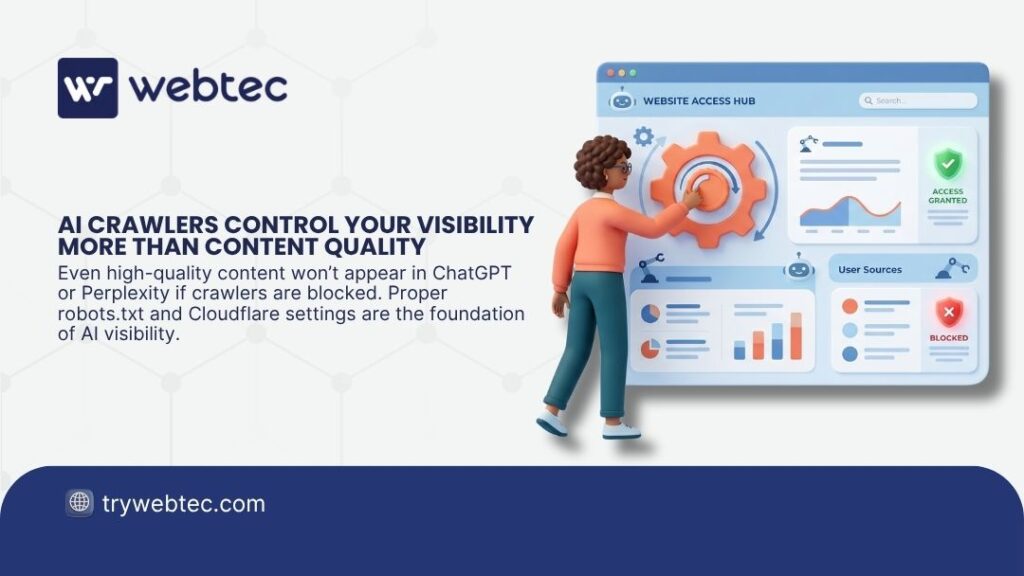
Nothing else in this guide matters if AI bots cannot read your pages.
On July 1, 2025, Cloudflare changed its default setting to block all AI bots on every new domain added to its platform.
Cloudflare protects roughly 20% of all websites, meaning a large share of the internet shifted from AI-accessible to AI-blocked overnight, with no action required from site owners.
Check your Cloudflare settings first. Then check your robots.txt file.
Fewer than 8% of sites have any AI-specific crawler rules in their robots.txt. Most are running defaults that were written before AI search existed.
| Crawler | Platform | Action Needed |
| OAI-SearchBot | ChatGPT Search results | Allow in robots.txt |
| PerplexityBot | Perplexity answers and citations | Allow in robots.txt |
| GPTBot | OpenAI model training only | Block if training consent matters |
| Googlebot | Google Search and AI Overviews | Allow |
The distinction here is important. You can block GPTBot (used for training data) while still allowing OAI-SearchBot (used for ChatGPT search citations).
Blocking OAI-SearchBot removes your site from ChatGPT citations entirely, regardless of how well-written your content is.
Step 2: Write Answer-First Introductions That Can Stand Alone
AI platforms do not read your full page before deciding whether to cite it.
If your introduction takes long paragraphs and too many supporting sections before reaching the core answer, AI will often skip your content for a competitor who led with it directly.
Research from Growth Memo analyzed millions of LLM citations and found that 44.2% come from the first 30% of a page’s content.
| Weak Opening | Answer-First Opening |
| “In this guide we walk through everything about…” | “To optimize your site for ChatGPT, start by allowing OAI-SearchBot in your robots.txt file.” |
| “Many businesses today are struggling with visibility…” | “44.2% of AI citations come from the first 30% of a page, so your opening sentence is your highest-leverage edit.” |
The fix is simple. Lead with the answer and then support it with context and detail.
Keep your opening paragraph under 80 words. Make it standalone. A reader who sees only those two sentences should leave with a clear, usable answer.
Step 3: Use Question-Based Headings
Most pages are organized around topics. AI search favors pages organized around questions.
When a user asks Perplexity “how does X work,” it looks for a section on your page that directly addresses that phrasing.
A heading that reads “How Does X Work?” maps to that query. A heading that reads “Our Approach to X” maps to nothing.
Pages with well-organized, question-based headings are 2.8x more likely to earn citations in AI search results.
Three practical rewrites:
- “Content Strategy” becomes “What Content Gets Cited by ChatGPT and Perplexity?”
- “Why It Matters” becomes “Why Does AI Search Visibility Matter for Small Businesses?”
- “Our Process” becomes “How Does Optimizing Websites for ChatGPT and Perplexity Actually Work?”
The goal is not to force questions into every heading. The goal is to make each section match how a real person would phrase what they are trying to find out.
Step 4: Add Schema, Entities, and Source Clarity
AI systems do not guess about your content. They favor pages that explicitly communicate who you are, what you offer, and what your content covers.
Schema markup is how you do that clearly.
SE Ranking’s research found that fast-loading pages with a First Contentful Paint under 0.4 seconds average 6.7 AI citations, while slower pages drop to just 2.1.
Page speed is a citation factor, not just a user experience metric.
| Page Element | What It Tells AI | Priority |
| FAQPage schema (JSON-LD) | Exact question-answer pairs | High |
| Organization schema | Who you are as a business entity | High |
| Article schema with author | E-E-A-T signals and publication date | Medium |
| Page speed under 0.4s FCP | Content is reliable and maintained | High |
| Named sources inside content | Specific, verifiable claims | High |
Entity clarity goes beyond schema. Use consistent terminology across all pages, name your services the same way every time and reference your brand and location consistently across every page on the site.
Step 5: Add Proof Blocks, Examples, and Original Detail
Vague content does not get cited. AI platforms extract and attribute specific, verifiable claims, not general statements.
Research from Stacker found that distributing content to external publications can increase AI citations by up to 325% compared to publishing only on your own domain.
AI trusts content that appears in multiple credible places.
For the content itself, these proof formats work well:
- A specific data point with a named source and date
- A before-and-after example showing a change and its outcome
- A step-by-step process that shows how something is done
- A comparison table with named criteria and clear outcomes
The practical difference between SEO and AEO comes down to this: SEO rewards topical relevance, while AI search rewards citable specificity.
A page that says “we help businesses grow” is invisible to AI compared to another which says “clients averaged a 34% increase in organic sessions within 90 days”.
This gives AI something concrete to use.
Step 6: Strengthen Internal Links and Topical Authority
A single well-optimized page does not build enough topical authority on its own.
AI platforms favor sources that cover a topic across multiple connected pages, not just one strong article. Your internal link structure signals that depth.
A guide on optimizing websites for ChatGPT and Perplexity should connect to a page on content structure, a service page, a related FAQ resource, and at least one supporting explainer.
A simple cluster structure that works:
- Main guide covering the full topic (this article)
- Supporting explainer on a sub-topic (e.g., schema implementation)
- FAQ page covering the common questions in your niche
- Service page with a clear, specific offer
- Related how-to guide on an adjacent topic
Getting your business cited by AI search engines happens through this kind of connected topical depth far more reliably than through one-off page optimization.
Step 7: Refresh, Monitor, and Improve Visibility Over Time
Optimizing websites for ChatGPT and Perplexity is not a one-time task. Make sure to refresh, monitor and improve visibility of a page after publishing.
50% of Perplexity citations come from content published in 2025 alone (Seer Interactive). Both platforms favor recent content, and outdated pages are progressively deprioritized as newer sources become available.
A realistic refresh schedule:
- Service pages: every 60 to 90 days
- Evergreen guides: every quarter
- Statistics-heavy pages: as soon as a key data point becomes outdated
| Metric | Where to Track | What It Tells You |
| AI referral sessions | GA4 custom channel (chatgpt.com, perplexity.ai) | How much traffic AI platforms send |
| Impressions growth | Google Search Console | Whether AI surfaces your content more often |
| Branded search volume | GSC and Google Trends | Whether AI mentions build brand awareness |
| Assisted conversions | GA4 conversion paths | Whether AI-referred visits lead to sales |
What ChatGPT and Perplexity Reward Differently
These tools overlap in many ways, but they do not surface content through the same process. Optimizing websites for ChatGPT and Perplexity requires understanding how each platform behaves on its own terms.
| Feature | ChatGPT | Perplexity |
| Retrieval method | Live web search on ~31% of queries | Real-time retrieval on every single query |
| Freshness weight | Moderate | High — stale content is deprioritized quickly |
| Citation style | Selected sources, sometimes shown | Inline citations on most responses |
| Traffic share | 87.4% of all AI referral traffic | ~4-5% of AI referral traffic |
| Content preference | Comprehensive, well-sourced guides | Recent, clearly structured pages |
Write for selection, not just ranking. That mindset applies to both platforms, but the execution differs.
Perplexity Visibility Signals
Perplexity performs real-time retrieval on every query it processes. That makes freshness its strongest citation signal by far.
For any time-sensitive topic, updating key pages monthly rather than quarterly produces a measurable difference in citation frequency.
Perplexity also ties claims to a specific source in 78% of complex research questions. Your content needs named sources, real data points, and clear attribution to appear in those answers.
ChatGPT Visibility Signals
ChatGPT drives nearly 90% of all AI referral traffic across industries, making it the platform that deserves the most attention first (Conductor, 2026).
What surprises most site owners: only 12% of URLs cited by ChatGPT rank in Google’s top 10 results. A well-structured, authoritative page can earn ChatGPT citations without a top organic ranking. Structure and specificity matter more than position here.
Common Mistakes That Keep Pages Out of AI Answers
Most pages do not fail because the content is poor. They fail because the content is hard to extract.
| Mistake | Why It Hurts | Fix |
| Long scene-setting intros | AI skips past buried answers | Put the answer in sentence one |
| Topic-based headings | AI cannot match sections to queries | Rewrite headings as direct questions |
| No named sources or data | AI skips unverifiable claims | Add stats with clear attribution |
| Outdated statistics and examples | Perplexity deprioritizes stale pages | Set a quarterly content refresh |
| Blocked AI crawlers in robots.txt | Content is invisible to citation systems | Audit robots.txt and Cloudflare settings |
- Writing for Keywords Instead of Questions
Keywords show you what people search. Questions show you what they need to know. These are not the same thing.
A page optimized for “AI search optimization tips” may rank. A section with the heading “What Are the Most Effective AI Search Optimization Tips for Small Businesses?” gets cited.
- Hiding the Answer Too Late
Long introductions that build context before delivering the answer are the most common reason content loses AI citations. The rewrite is simple: move the direct answer to the first sentence, then expand below it with evidence and detail.
- Publishing Without Proof or Freshness
Generic statements carry no citation weight with AI systems. Specific, sourced claims do. If a page has not been updated in over three months and contains no data from 2025 or later, it is competing against fresher, more current sources for every citation it could have earned.
How to Measure Success and Keep Improving
If you cannot measure it, you cannot improve it. This applies directly to optimizing websites for ChatGPT and Perplexity.
Start with these four metrics before anything else:
- AI referral sessions in GA4 — set up a custom channel for chatgpt.com and perplexity.ai as distinct sources
- Impressions in Google Search Console — growth here, even with flat clicks, signals AI content extraction
- Branded search volume — AI citations frequently drive branded searches before a conversion is recorded
- Assisted conversions in GA4 — AI-referred visits often influence a sale attributed to another channel
ChatGPT referral traffic converted 31% higher than non-branded organic search across 94 brands in a 2025 study by Visibility Labs. The volume is smaller, but the buyer’s intent is sharper.
Only 16% of brands currently track AI search performance in any systematic way (McKinsey, 2025). Setting this up now puts you ahead of the large majority.
How Often to Refresh Pages
For evergreen content, a quarterly review catches most issues. For pages targeting competitive or fast-moving queries, monthly updates are worth the time.
Each refresh should update at least one statistic, verify the answer-first opening still holds, and confirm schema markup remains valid and implemented correctly.
Frequently Asked Questions
How to optimize my website for ChatGPT and Perplexity?
Start with crawl access. Make sure OAI-SearchBot and PerplexityBot are allowed in your robots.txt and not blocked at the Cloudflare level. Then audit your most important pages for answer-first structure, question-based headings, and FAQPage schema markup.
Is optimizing websites for ChatGPT and Perplexity different from traditional SEO?
The key difference is content structure. AI platforms need answers at the top of the page, question-based headings, and named sources. Traditional SEO can function effectively without these.
Does schema markup help with AI search visibility?
Yes. FAQPage schema in JSON-LD format is one of the most effective technical signals for AI citation. It creates explicit question-answer pairs that directly mirror how AI platforms retrieve and present information to users.
Do backlinks still matter for AI answer engines?
Domain authority remains the top predictor of AI citations. SE Ranking’s study of 2.3 million pages found that high-traffic sites earn 3x more AI citations than low-traffic ones. Backlinks drive that authority, so they still matter, just indirectly through the trust and domain strength they build.
Stop Being Invisible in the Search Results That Actually Convert.
If you want to stop losing organic visibility to AI answers your competitors are getting cited in, and start showing up where your buyers actually search for solutions, you need a strategy built for how search works right now.
Webtec works with small and mid-sized businesses to build SEO and content strategies that keep brands visible in both traditional and AI-driven search.
From technical audits to full content restructuring, we identify exactly which pages are closest to earning AI citations and what needs to change first.
We know what optimizing websites for ChatGPT and Perplexity looks like in practice, and we know how to deliver that for companies without enterprise-level budgets.
Ready to find out where your site stands? Get a free consultation with us today and let’s build a strategy that actually moves your pipeline.