
AI search engines like ChatGPT, Google AI Overviews, and Perplexity don’t just list results. They read, evaluate, and cite specific sources.
If you want to know how to get your business cited by AI search engines, the answer comes down to three things:
- How clearly your content answers questions
- How trustworthy your brand appears across the web
- How well your pages are structured for extraction
How to Get My Business Cited By AI Search Engines: 7 Practical Ways
Here are the exact ways to turn your content into something AI systems actually select and cite.
| Method | What to Do | Why It Works | Difficulty |
| Answer first | Lead every section with a direct answer | 44.2% of LLM citations come from the first 30% of text | Low |
| Structure content | Use headings, bullets, short sections | Reduces friction for AI parsing | Low |
| One topic per page | Avoid multi-topic pages | Improves intent matching | Medium |
| Add proof and data | Include stats, named sources, examples | Builds citation confidence | Medium |
| Build entity signals | Consistent business info, schema, about pages | Helps AI identify your brand clearly | Medium |
| Get off-site mentions | Reviews, press, community platforms | 85% of AI mentions come from third-party sources | High |
| Refresh regularly | Update pages at least every 90 days | Freshness is a top-tier citation signal | Ongoing |
1. Answer Questions Immediately and Clearly
44.2% of all LLM citations come from the first 30% of a page’s text (Growth Memo, February 2026). That tells you exactly where your best material belongs.
Lead every section with the answer. Not the context, not a transition sentence. The answer itself. The rest of the section can support it with evidence and examples.
2. Structure Content for Easy Extraction
When it comes to writing content that AI Overviews will cite, format matters as much as substance. Use question-based headings, short paragraphs, comparison tables, and FAQ sections throughout.
GEO-structured content with FAQ schema receives 3x more ChatGPT citations than plain prose (Authoritas, 2025).
Comparison tables with clear column headers are especially useful because AI can extract them as standalone units without losing context.
3. Focus Each Page on One Clear Topic
Multi-topic pages create intent confusion. AI systems are built to match specific queries to specific answers. A page that covers five loosely related topics is harder to cite accurately than one built around a single question.
Map each page to one search intent. Use H2 and H3 headings to explore that topic in depth, rather than branching into unrelated areas.
4. Add Proof, Data, and Real Examples
Early-discovery content containing 5 to 7 statistics earns a 20% higher citation likelihood (AirOps, April 2026).
Pages with at least one named-source citation in the body are cited 2.1x more than pages without (Digital Applied, 2026).
Treat every key claim as a citation opportunity:
- Include the source name alongside the stat
- Use a specific number rather than a vague estimate
- Keep each point short and self-contained
5. Build Strong Entity and Brand Signals
Only 12.4% of brands currently have a full Organization schema that includes sameAs properties, founder details, and contact points (Fuel Online, March 2026).
Without it, AI systems are essentially guessing which business a page belongs to.
Complete your structured data. Make sure your business name, description, and contact information are consistent across your website, Google Business Profile, and any directory profiles you maintain.
6. Get Mentioned Beyond Your Website
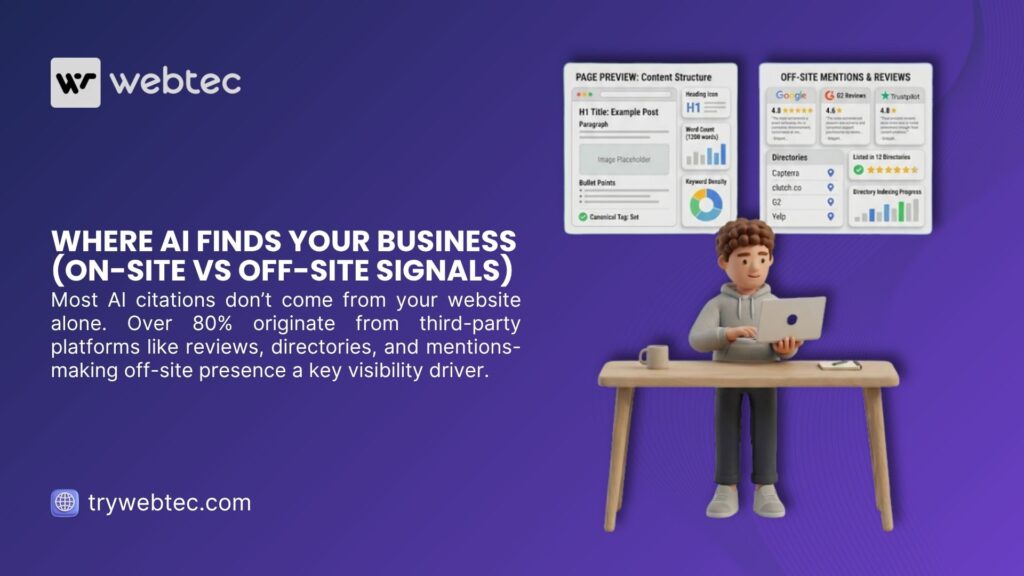
85% of brand mentions in AI answers originate from third-party pages, not owned domains (AirOps/Kevin Indig, 2025). Publishing on your own site is necessary but not sufficient.
Distributing content across external publications can increase AI citations by up to 325% compared to publishing only on your own domain (Stacker, December 2025).
Domains with active profiles on platforms like G2, Trustpilot, and Capterra show 3x higher citation probability compared to those without off-site presence (Fortis Media, 2025).
7. Continuously Refine Based on Real Queries
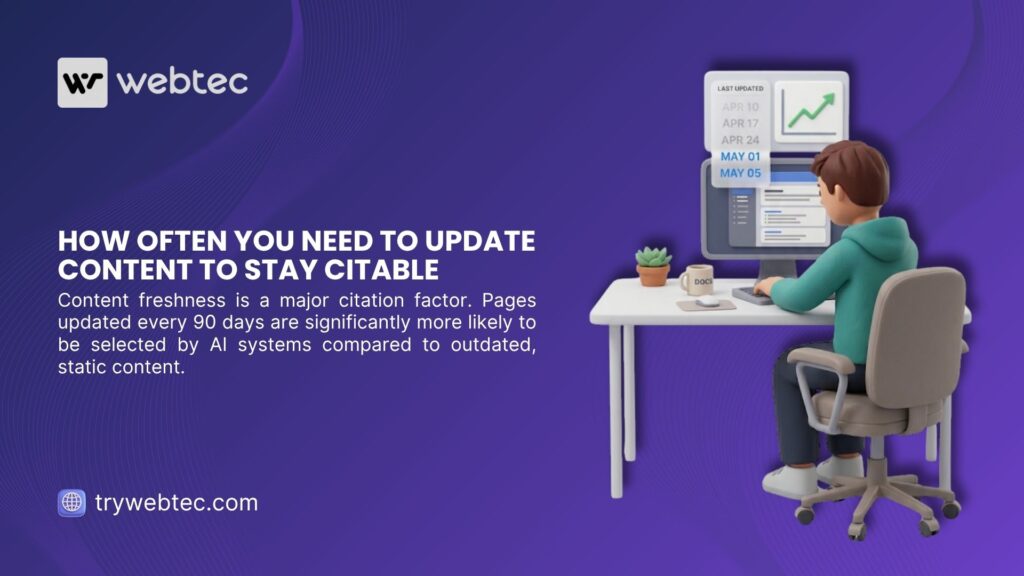
Pages not updated quarterly are 3x more likely to lose AI citation visibility (Semrush, 2025). Build a simple refresh schedule:
- Review top-performing pages every 90 days
- Add new questions based on what users are actually searching
- Update statistics and replace outdated examples
- Improve sections that open with vague or slow-starting sentences
What “Getting Cited by AI Search Engines” Actually Means
Before you change anything on your site, you need to understand what you’re actually working toward.
An AI citation happens when a platform like ChatGPT or Google’s AI Overview reads your content and selects it as a source inside a generated answer. That’s different from ranking.
You can rank in position 3 and never appear in a single AI response. You can also rank outside the top 10 and still be cited regularly.
| Term | What It Means |
| Ranking | Your page appears in the list of traditional search results |
| Being cited | AI selects your page as a source inside a generated answer |
| Being mentioned | Your brand appears in an AI response without a direct link |
The business impact is significant. Brands cited in AI Overviews earn 35% more organic clicks and 91% more paid clicks compared to non-cited pages (Digital Applied, Q1 2026). That makes citation the new competitive objective for any brand publishing content online.
Why Ranking Alone Is No Longer Enough
Google AI Overviews now appear in over 25% of all searches, based on Conductor’s analysis of 21.9 million queries. When an AI Overview is present, only 8% of visits result in a click to any external page.
That means the majority of users reading AI-generated answers never visit the cited sources at all. Visibility shifts from traffic to presence. Being cited signals that your brand is credible and worth knowing, even when no one clicks through.
How AI Decides What to Cite
AI systems don’t select pages the same way Google ranks them. Three factors consistently determine whether a page gets selected:
- Content structure — clear headings, self-contained answers, logical flow
- Domain and brand trust — authority signals built on and off your site
- Freshness — pages updated in the past 90 days consistently outperform stale content
This is the core principle behind answer engine optimization: the goal shifts from ranking high to being the clearest, most credible answer available for a given question.
Why Most Businesses Fail to Get Cited by AI
If your content isn’t being cited, it usually isn’t random. There are structural reasons behind it.
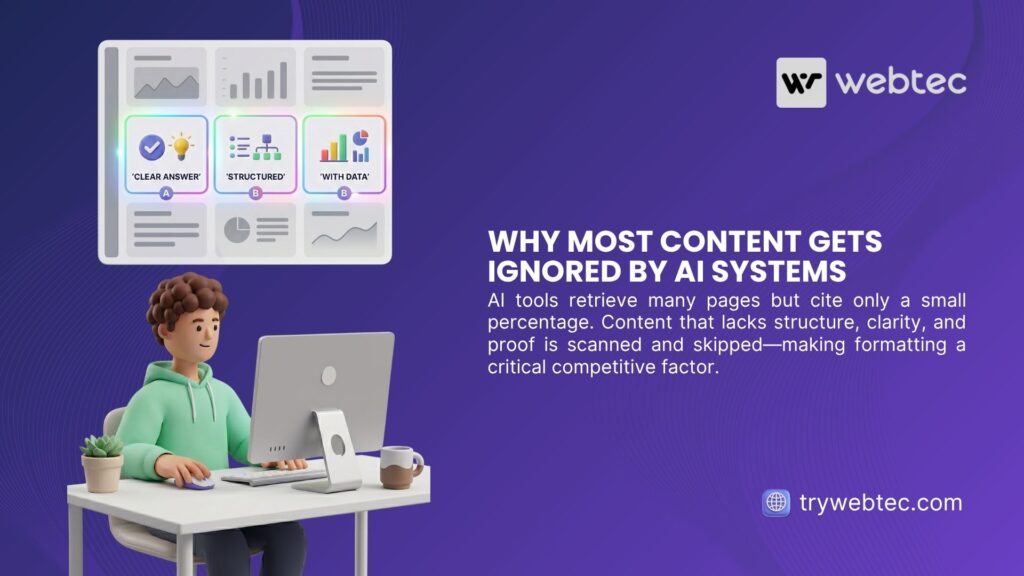
ChatGPT retrieves many pages during a search session but only cites 15% of them. The other 85% are scanned and discarded (AirOps, March 2026). Most businesses fall into that discarded group for one of three reasons.
| What Businesses Do | What AI Actually Needs |
| Write for keyword density | Write direct, clear answers |
| Use vague, generic claims | Use specific, verifiable statements |
| Publish long narrative text | Use structured, extractable formats |
| Set and forget content | Refresh pages at least quarterly |
Writing for Rankings Instead of Answers
Most content is written to rank, not to answer. That means burying the actual response under paragraphs of introduction and background. AI systems scan for the clearest answer quickly. If it’s not near the top, they’ll move on to a page where it is.
A practical check: read the first two sentences of each major section. Do they answer something specific? If not, rewrite them so they do.
Lack of Proof and Specificity
Generic content doesn’t get cited. AI systems skip claims that aren’t concrete or verifiable.
- Weak: “We help businesses improve their online presence.”
- Strong: “AI-cited content is 25.7% fresher than traditional organic results, based on Ahrefs’ analysis of 17 million citations.”
The second gives AI something real to work with: a named source, a specific number, and a clear claim. That’s what separates citable content from ignored content.
Poor Structure and Extractability
Long, unbroken paragraphs make extraction difficult. AI systems prefer short, self-contained blocks that answer one question completely without requiring surrounding context.
Pages organized into sections of 120 to 180 words between headings receive 70% more ChatGPT citations than pages with fragmented or inconsistent structure (SE Ranking, 2025).
How to Measure If Your Business Is Getting Cited by AI Search Engines
You can’t improve what you don’t track, and AI visibility isn’t always obvious in standard analytics.
| Signal | Where to Check | What It Means |
| Direct AI appearance | Manually test queries in ChatGPT, Perplexity, AI Overviews | Your content is being selected |
| Branded query growth | Google Search Console | Users are searching your brand by name |
| AI referral traffic | GA4, filtered by AI source | Users clicking through from AI-generated answers |
| Off-site brand mentions | Brand monitoring tools | Third-party citation growth over time |
Signs Your Content Is Being Cited
The clearest signal is appearing inside a generated answer when you test your target queries manually. Do this across multiple platforms.
The same page can perform very differently between ChatGPT and Google AI Overviews due to each platform’s distinct retrieval logic.
Tracking whether AI engines are mentioning your brand is also visible through branded search growth in Google Search Console.
When AI systems repeatedly cite a business, more users tend to search that brand name directly afterward.
What to Do If You’re Not Seeing Results
Start with a simple diagnostic:
- Are your key pages opening with direct, specific answers?
- Do your most important pages have FAQ sections and comparison tables?
- Is your business information consistent across your site and off-site platforms?
- When were your top pages last meaningfully updated?
Most citation gaps trace back to structure, freshness, or missing brand signals. Fixing one often produces visible improvement within weeks.
How Long Does It Take to Get Cited by AI Search Engines?
Initial citation visibility can appear within 2 to 4 weeks of implementing structural changes, which is faster than the typical 3 to 6 month timeline most associated with traditional SEO (Milwaukee Web Designer, February 2026).
Building consistent, durable citation authority takes longer. It depends on your content freshness, domain trust signals, and how regularly your brand is mentioned across third-party sources.
Frequently Asked Questions
How to get my business cited by AI search engines?
Focus on clear, direct answers structured for extraction, strong brand signals on and off your site, and regular content updates. These three areas account for the majority of citation outcomes across ChatGPT, Perplexity, and Google AI Overviews.
Why is my content not being cited by AI tools?
The most common reasons are vague content, poor page structure, and the absence of off-site credibility signals. AI systems discard 85% of the pages they retrieve. Structured, answer-first content significantly reduces the chance of being in that group.
Do I need to rank on Google to get cited by AI?
Not always. Around 28.3% of ChatGPT’s most-cited pages have zero organic visibility in Google search (Ahrefs, October 2025). That said, strong organic rankings do improve citation probability on Google AI Overviews specifically.
What type of content gets cited most often?
FAQ sections, comparison tables, definition blocks, and pages that open with direct, self-contained answers consistently earn more citations than narrative-heavy or keyword-focused content across AI platforms.
How Webtec Helps Small Businesses Win AI Citations
If your pages exist but your brand isn’t appearing in AI-generated answers, the issue is usually structure and off-site signals rather than content quality.
Webtec works with small and mid-sized businesses that want to stay visible in both traditional search and AI-driven results, without rebuilding everything from scratch. Three things make the approach different:
- Competitive pricing designed for businesses without enterprise-level budgets
- Specialized GMB optimization that directly feeds AI citation visibility for local queries
- A process built for founders and marketing leads who need results without a slow agency relationship
Schedule a call today with Webtec and find out exactly which of your pages are already close to earning AI citations.