For small and mid-sized businesses that depend on organic search to generate leads, it raises a question most marketing teams are now asking: what is the difference between SEO and AEO in 2026, and which one should I actually focus on?
Difference Between SEO and AEO in 2026
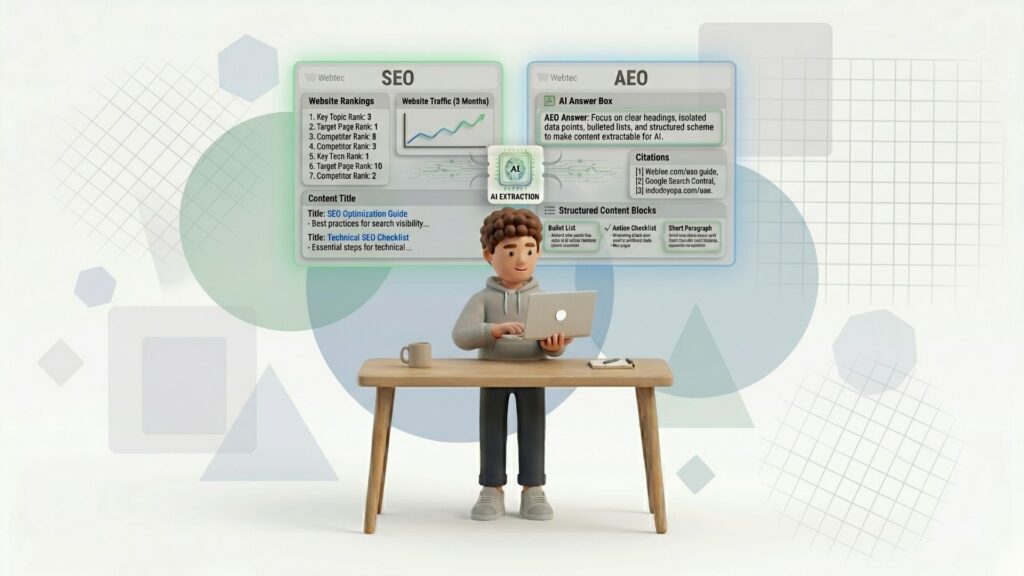
The difference between SEO and AEO is that SEO helps your page rank in search results, while AEO helps your content get selected and cited inside AI-generated answers.
SEO (Search Engine Optimization) is the practice of improving your website so it ranks higher in traditional search results and earns more clicks from those rankings.
AEO (Answer Engine Optimization) is the practice of structuring your content so AI-powered platforms can extract it and deliver it as a direct answer to a user’s question. These include Google AI Overviews, ChatGPT, Perplexity, and voice assistants.
The difference between SEO and AEO in 2026 is not about which one matters more. It’s about what each one is built to do.
| SEO | AEO | |
| Purpose | Rank in search results and earn clicks | Be selected as the cited answer inside AI responses |
| Visibility surface | Google SERP blue links | AI Overviews, ChatGPT, Perplexity, voice |
| Primary goal | Organic traffic | AI citations and answer presence |
| Content style | Keyword-optimized, topically broad | Direct, structured, answer-first |
| Success metrics | Rankings, CTR, organic traffic | Citation frequency, AI mentions, branded search |
AEO is an extension of SEO, not its replacement. Understanding the difference between SEO and AEO matters because both are now part of the same visibility strategy in 2026.
What SEO Is Designed to Do
SEO is built around discoverability. The goal is simple: help search engines understand your content, confirm it’s relevant to a user’s query, and rank it high enough to earn a click.
A blog post ranking for “affordable website redesign for small businesses” is a clean SEO win. The user searches, finds the page, clicks, and the business has a real shot at converting.
| SEO Signal | What It Does |
| Keyword optimization | Matches content to search queries |
| Backlinks | Signals credibility to search engines |
| Technical SEO | Ensures pages are crawlable and fast |
| Content depth | Covers a topic thoroughly enough to rank |
| Internal linking | Builds topical authority across the site |
For startups and businesses building their first online presence, SEO is the starting point. Every future visibility layer, including AEO, is built on top of it.
If you’re at that stage, we built a guide on SEO for startups to break down exactly where to begin.
What AEO Is Designed to Do
AEO focuses on answer visibility. The question shifts from “can this page rank?” to “can AI extract a clean answer from this page and present it to someone who may never visit the site?”
Platforms like Google AI Overviews, ChatGPT, and Perplexity don’t just rank pages. They read them, pull out key information, and synthesize a response.
Answer engine optimization is what makes your content suitable for that extraction process.
| SEO Output | AEO Output | |
| Where you appear | Organic search results | AI-generated answers |
| User action required | Click to your page | May not click at all |
| How you’re measured | Rankings and traffic | Citations and mentions |
| What signals matter most | Backlinks, keywords | Structure, entity clarity, E-E-A-T |
According to Acquia research, 70% of organizations believe AEO will significantly impact their digital strategy within one to three years. Only 20% have started. That gap is a real opportunity for businesses that move now.
Why SEO Still Matters Even When AI Search Is Growing
The concern that AI is making traditional SEO irrelevant is understandable. The data doesn’t support it.
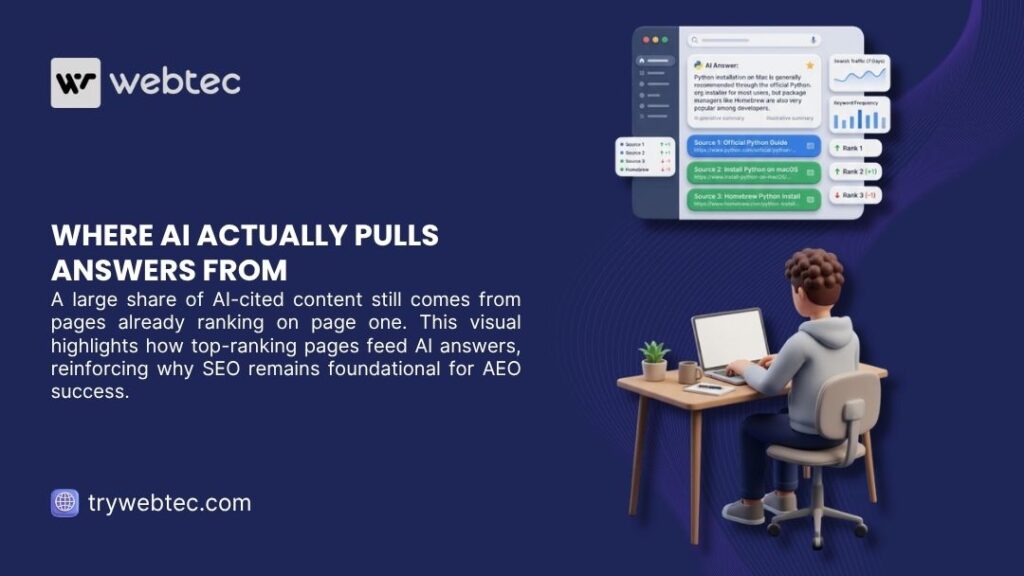
Google’s AI Overviews draw from the exact same index as traditional search results. There is no separate AI ranking system.
One analysis found that nearly 92% of successful AI Overview citations came from domains already ranking in the top 10 organic positions.
| SEO Foundation | Why It Still Matters for AI Answers |
| Content quality | AI systems only cite content they can trust |
| Technical health | Slow or unindexed pages don’t get retrieved |
| Backlink authority | One of the strongest predictors of AI citation selection |
| Search intent match | AI uses the same intent signals Google does |
| E-E-A-T signals | Google’s stated basis for AI Overview source selection |
As Google Search Advocate John Mueller said at Search Central Live NYC in 2025:
“If you’re doing the right thing for search, then you’re automatically doing the right things for AI.”
The Parts of SEO That Still Drive Visibility
Some SEO fundamentals carry more weight in the current environment than others. These are the ones that matter most right now:
- Content quality: Thin or generic pages rarely earn rankings or citations.
- Search intent alignment: Your page needs to directly match what the user is actually asking for.
- Topical relevance: Deep coverage of a subject builds the kind of authority AI systems look for.
- Internal linking: Connecting related pages signals breadth and depth to both Google and AI.
- Page clarity: Confusing structure costs you in rankings and in citations alike.
| Factor | Still Relevant in 2026? | Reason |
| Content quality | Yes | Core signal for both ranking and citation |
| Search intent match | Yes | AI and Google both use intent to surface content |
| Backlinks | Yes | Authority signal across traditional and AI search |
| Internal linking | Yes | Builds topical authority AI systems recognize |
| Page speed | Yes | Slow pages don’t get retrieved at all |
| Structured headings | Yes | Helps Google and AI parse your content cleanly |
What Changed in 2026 for SEO and AEO
Three specific shifts have changed how search visibility actually works this year.
1. AI Overviews
Google AI Overviews now appear on informational queries 39.4% of the time, according to WebFX data. When they appear, the impact on clicks is significant.
Ahrefs found in February 2026 that AI Overviews reduce organic click-through rates by 58%.
For the top-ranked page, that means 58 out of every 100 potential clicks now stay inside Google’s interface.
For brands that publish educational or comparison content, writing content that AI Overviews will cite has moved from optional to essential.
2. Answer Extraction
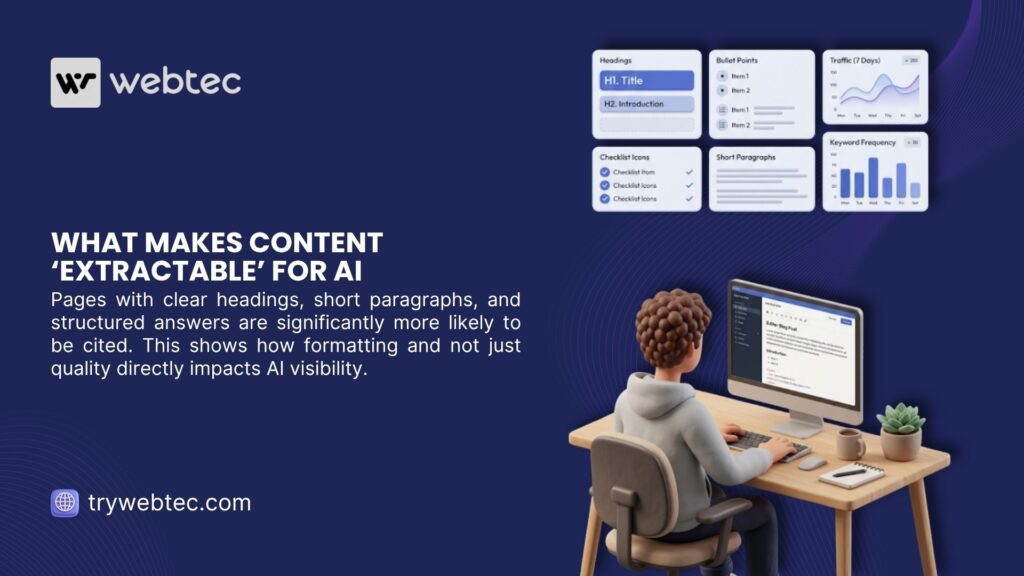
AI systems scan for specific and extractable claims, differently from the way humans read the entire content.
Pages that follow a clean H1 to H2 to H3 heading structure see 2.8x higher citation likelihood.
Content formatted for LLM extraction is 3x more likely to be cited than content that lacks that structure.
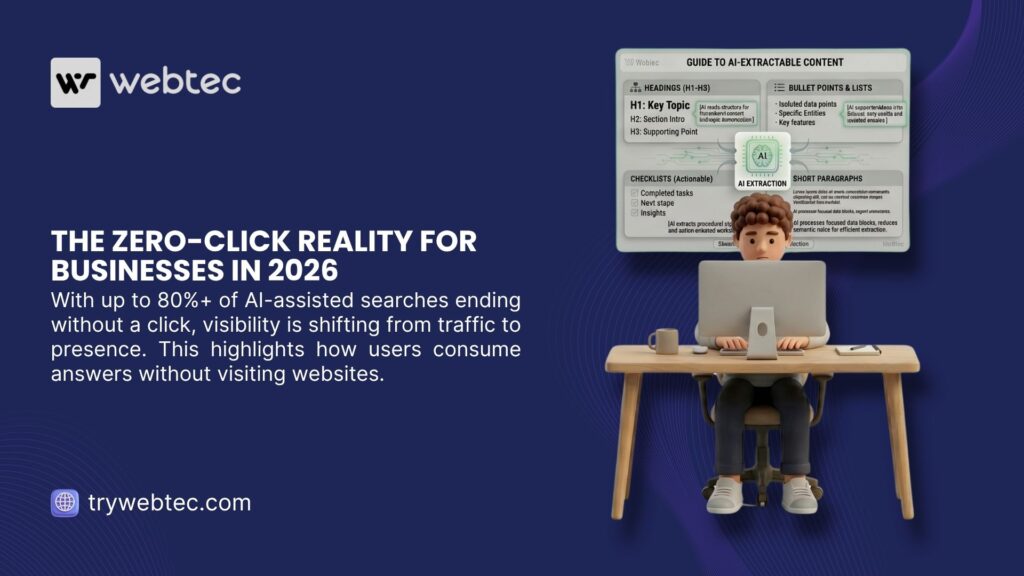
3. Zero-Click Behavior
Rand Fishkin of SparkToro, who first formalized the concept, defines zero-click searches simply as “those that end without clicking on any of the results presented.”
In 2026, that behavior is the default.
According to Workshop Digital, searches triggering AI Overviews now show an average zero-click rate of 83%, compared to around 60% for traditional results.
That means 8 out of 10 users reading an AI-generated answer never visit any of the cited pages.
| Behavior | Classic Search | AI-Assisted Search (2026) |
| How users get answers | Click a result and read the page | Read the AI summary directly on the SERP |
| Click-through rate | Around 15% at position 1 | Around 8% when AI Overview is present |
| Where brands get visibility | Rankings on page 1 | Citations inside AI answers |
| How success is measured | Traffic and rankings | Citations, mentions, branded search growth |
What AEO Changes in Content Strategy
AEO rewards content that’s structured, direct, and easy to summarize. The shift isn’t about writing more. It’s about writing in a way that makes extraction easier for AI systems.
| Traditional SEO Content | AEO-Friendly Content |
| Answer appears mid-page after context | Answer appears in the first 1 to 2 sentences |
| Topic-label headings (“Our Approach”) | Question-based headings (“How does X work?”) |
| Long narrative paragraphs | Short paragraphs with one clear point each |
| Keyword density as the focus | Entity clarity and direct definitions |
| CTA-driven structure throughout | Answer-driven structure with supporting detail |
- Answer-First Formatting
The best answer should appear early and not buried halfway down the page.
Open every major section with a direct answer sentence, then follow it with supporting detail and examples. If the first two lines of a section don’t address the main question it implies, AI will often use a competing page that does.
A practical check: read the opening sentence of each H2 section. Does it answer something specific? If it doesn’t, rewrite it so it does.
The rest of the section can expand from there.
- Structured Content and Extractable Passages
FAQ sections, comparison tables, definition blocks, and numbered steps are the content formats AI cites most frequently. They clearly signal what question is being answered and what the answer actually is.
| Content Block | Why It Helps AEO |
| FAQ sections | Directly mirrors how AI retrieves question-answer pairs |
| Comparison tables | Structured, scannable data AI can extract and cite |
| Definition blocks | Clean answers for “what is” queries |
| Numbered steps | Frequently cited for how-to and process queries |
| Short paragraphs | Easy to extract without losing context |
Schema markup plays a direct role here. Sites using structured data see up to 30% higher AI Overview visibility, and pages with FAQPage schema are significantly more likely to be cited in AI answers.
- Trust and Clarity Signals
Vague content doesn’t get cited. AI systems skip claims that aren’t specific or verifiable. Compare these two examples:
- Weak: “We help clients improve their online presence.”
- Strong: “Ahrefs data from February 2026 shows AI Overviews reduce position-1 click-through rates by 58%.”
The second gives AI something concrete to work with. A named source, a specific number, and a clear claim. That’s what makes content citable rather than ignored.
SEO vs AEO
Here is the practical comparison most readers are looking for.
The Difference Between SEO and AEO in 2026
| Factor | SEO | AEO |
| Goal | Rank and earn clicks | Get cited inside AI-generated answers |
| User behavior | User clicks the result | User reads AI summary; may not click |
| Content style | Broad, keyword-optimized | Direct, structured, answer-first |
| Visibility surface | Google SERP | AI Overviews, ChatGPT, Perplexity |
| Key signals | Keywords, backlinks, authority | Entity clarity, structure, E-E-A-T |
| Success metrics | Rankings, traffic, CTR | Citations, AI mentions, branded search |
| Best use cases | Service pages, commercial queries | How-to content, definitions, comparisons |
Search Intent and User Behavior
SEO typically serves click-driven search behavior. A user searches for a service, finds a ranked result, and clicks through to learn more.
AEO serves answer consumption. The user asks a question, reads the AI response, and either stops there or clicks one of the cited sources if they want more detail.
| Query Type | SEO Behavior | AEO Behavior |
| “Website redesign near me” | User clicks 2 to 3 results and compares | Less AI involvement; user clicks directly |
| “What is the difference between SEO and AEO” | User scans page 1 and clicks | AI answers directly; click is optional |
| “How to optimize a blog post for AI” | User reads a full blog post | AI summarizes with citations |
Measurement and Success Metrics
SEO is measured through rankings, traffic, CTR, and conversions. These are consistent and well-established.
The difference between SEO and AEO becomes very clear at the measurement level. AEO is harder to track because success doesn’t always generate a click.
Tracking whether AI engines are mentioning my brand is now becoming a standard part of reporting alongside the traditional metrics most teams already use.
| SEO Metrics | AEO Metrics |
| Keyword rankings | AI citation frequency |
| Organic traffic | Share of voice in AI answers |
| Click-through rate | Branded search growth |
| Conversion rate from organic | AI-assisted traffic and conversions |
| Backlink growth | Entity mentions across AI platforms |
Content Format Differences
SEO often benefits from longer, comprehensive content that covers a topic end to end. AEO benefits from concise answer blocks inside that same content.
Specific sections that AI can lift and cite on their own, without needing the surrounding paragraphs to make sense of them.
The strongest pages do both. They’re comprehensive enough to rank and structured enough to get cited.
Should You Prioritize SEO, AEO, or Both?
Most businesses don’t have unlimited time or budget. The real question is where to focus first.
When SEO Should Be the Priority
If your site is relatively new, hasn’t built domain authority, or isn’t ranking for your core service keywords, SEO should come first.
AI systems favor established domains. Without that foundation, AEO improvements won’t deliver results regardless of how well the content is structured.
Signs you need SEO first:
- Low organic rankings for your main service and location queries
- Weak backlink profile relative to your competitors
- Technical issues like slow load times, unindexed pages, or crawl errors
- No real topical authority built around your subject matter yet
When AEO Should Be Added Early
If you already have pages that rank or attract impressions, and your content covers informational or comparison topics, adding AEO optimization now is a smart move.
Informational queries, how-to content, service explanations, and comparison pages are the content types AI surfaces most.
Getting your business cited by AI search engines is a genuine competitive edge for brands that publish this kind of content consistently.
AEO for a local business matters too.
When AI Overviews appear for local queries, they pull from Google Business Profiles and structured local page content. A well-organized local page with direct answers can earn citations even without a top-3 ranking.
How to Combine Both Without Wasting Effort
The same page can support both SEO and AEO if it’s structured correctly.
As Lily Ray, VP of SEO Strategy and Research at Amsive, explained in her 2025 year-end analysis:
“The smartest move right now isn’t to choose AEO or SEO, but to double down on a user-focused approach that serves both.”
That’s exactly what the framework below is built around.
| What to Include | SEO Benefit | AEO Benefit |
| Target keyword in H1 and intro | Signals relevance to search engines | Helps AI match content to user queries |
| Direct answer in first 2 sentences | Strong featured snippet potential | Extractable by AI for direct responses |
| Clean H2 and H3 structure | Easier for Google to crawl and index | 2.8x higher citation likelihood |
| FAQ section at the end | Captures People Also Ask queries | AI-friendly question-answer format |
| Comparison tables | Visual engagement signal | Structured data AI can extract and cite |
How to Optimize Content for Both SEO and AEO
This is the practical part. Here is a working process for pages that both rank and get cited.
| Step | What to Do | Why It Matters |
| 1. Define the intent | Know if the query is informational, commercial, or navigational | Determines the right format and structure |
| 2. Write the direct answer first | Draft the answer in 2 sentences before anything else | Sets the anchor for both AEO extraction and featured snippets |
| 3. Build supporting sections | Add context, evidence, examples, comparisons | Depth for SEO; citation signals for AEO |
| 4. Use structured headings | H2 for main topics, H3 for sub-questions | Parsing clarity for both Google and AI |
| 5. Add FAQ section | Write 4 to 6 questions users actually search | Captures PAA queries and signals answer-readiness |
| 6. Add schema where relevant | FAQPage or HowTo schema | Up to 30% higher AI Overview visibility |
| 7. Review before publishing | Does every section open with a direct answer? | Ensures AEO readiness across all sections |
Start With a Direct Answer
The first one to two sentences after any heading should answer the main question that heading implies.
Here is what a clean, answer-first opening looks like:
“SEO is focused on getting your pages to rank and attract clicks from search results, while AEO is focused on making your content clear and structured enough to be picked up, summarized, or referenced in AI-generated answers.”
That statement is extractable. Any AI system reading that page has something specific and concrete it can actually use.
Support the Answer With Proof and Structure
Statistics, named sources, and comparison tables give AI systems the confidence to cite your content over a competitor’s.
When optimizing your website for ChatGPT and Perplexity specifically, original data and named citations are among the strongest trust signals available.
Where to place evidence inside a page:
- Right after the opening answer sentence in each section
- Inside comparison tables with clear column headers
- In FAQ answers where a specific number reinforces the response
- In body paragraphs where a stat directly supports a key point
Add FAQs That Match Real Search Behavior
FAQ sections capture People Also Ask queries and give AI systems a format they pull from frequently. The difference between SEO and AEO shows up here too:
SEO benefits from keyword-rich questions, while AEO benefits from questions that mirror how people actually phrase things out loud.
Write each FAQ answer in two to three sentences. Skip keyword stuffing. Natural phrasing matches real search behavior better than a sentence built around a target phrase.
Frequently Asked Questions
Is AEO replacing SEO in 2026?
AEO is an extension of SEO but not a replacement. SEO still provides the discoverability and authority signals that AI systems depend on when selecting which sources to cite. Without strong SEO, AEO rarely produces results.
What is the main difference between SEO and AEO?
The main difference between SEO and AEO in 2026, is that SEO is designed to help pages rank and earn clicks and AEO is designed to help content get selected and cited inside AI-generated answers.
Do I need both SEO and AEO?
For a complete visibility strategy, you need both Search Engine Optimization SEO and AEO. This is because SEO builds the technical foundation to rank in traditional, link-based search results, while AEO optimizes content for AI-driven answers (like ChatGPT or Google AI Overviews) to get your brand cited as the direct answer.
How do you measure AEO success?
AEO success is typically tracked from AI citation frequency, branded search growth, AI-assisted traffic, share of voice inside AI responses, and engagement signals from pages that appear in AI answers.
What kind of content works best for AEO?
The content which works best for AEO are FAQ sections, comparison tables, definition blocks, numbered steps, and service pages with answer-first openings.
How Webtec Helps You Stay Visible in Search and AI Without Starting Over
If your pages already rank but your brand isn’t showing up inside AI answers, the issue is usually structure rather than quality. The content exists. It just isn’t formatted in a way AI systems can extract and cite.
Webtec works with small and mid-sized businesses that want to stay visible in both traditional search and AI-driven results, without rebuilding everything from scratch.
Three things that make our approach different:
- Competitive pricing designed for businesses without enterprise-level marketing budgets
- Specialized GMB optimization that most agencies overlook, and that directly feeds AI citation visibility for local queries
- A streamlined process built for founders and executives who need results without managing a slow-moving agency
Get a free SEO consultation with Webtec today and find out exactly which of your pages are already close to winning AI citations.