
If a customer asks an AI tool for a local plumber, dentist, HVAC company, or restaurant, does your business show up? Or does the AI quietly recommend someone else?
Knowing how to do AEO for a local business means understanding what AI systems evaluate before they recommend a business, then building those signals in the right order. This guide walks through five practical steps.
How to Do AEO for a Local Business
Before you optimize anything, you need to understand what AI engines are actually looking for when they decide to recommend a local business.
Answer engine optimization is the practice of structuring your business data and content so that AI systems can identify, understand, and trust you enough to recommend you.
For a local business, this is a practical discipline with a clear starting point: make your business unambiguous.
Traditional local SEO helps you rank in a list. AEO helps you become the specific answer an AI system names when a customer asks for a recommendation. The two goals look similar on the surface but require different levels of data clarity.
Is AEO Just Local SEO with a New Name?
They overlap significantly, but they are not the same discipline.
A dentist with strong Google Maps rankings might rank well in traditional local results yet still be invisible in AI answers. The gap usually comes down to a lack of explicit clarity, not a lack of effort.
| Area | Local SEO | AEO | Shared? |
| Google Business Profile | Core signal | Also essential | Yes |
| NAP consistency | Important | Critical for entity trust | Yes |
| Reviews | Ranking factor | Proof of real-world trust | Yes |
| Schema markup | Helpful | Important for classification | Yes |
| Answer-first content | Not required | Essential | No |
| Clear entity definition across the web | Background signal | Foreground priority | No |
AEO builds directly on local SEO. It does not replace it.
What You Need in Place Before Doing AEO for a Local Business
AI engines do not recommend the most popular option. They recommend the most trustworthy and clearly defined one.
Before an AI system cites your business, it needs to:
- Confirm a consistent business identity: name, type, location, and specific services
- Find that same information repeated across multiple sources
- See evidence of real customer trust through reviews and external mentions
- Read content that directly answers the question being asked
The first step in AEO for any local business is closing the gap between passive online presence and active, verifiable trust.
Fix the Local Trust Signals First
If your business information is incomplete or inconsistent, AI systems have less reason to recommend you. This is where AEO work begins for most local businesses. The foundation is not content. It is data quality.
Make Your Google Business Profile Complete and Consistent
Your Google Business Profile is the single most important data source for local AI recommendations.
Google’s AI Overviews draw directly from GBP, and 86% of GBP impressions come from category-based searches rather than branded queries (Birdeye, 2026).
Most people who find your profile do not already know your name, so your categories and services need to do the work.
Get the basics exactly right:
- Business name: Use your real, registered name with no keyword stuffing
- Primary category: Choose the most specific one that fits your actual service
- Service areas: List every area you serve, not just your physical address
- Services: Add individual listings with short, clear descriptions
- Hours: Keep them current and update for public holidays
- Photos: Upload genuine images of your business, team, and completed work
| GBP Element | What to Check | Why It Matters |
| Business name | Matches all other platforms exactly | Entity trust and consistency |
| Primary category | Specific to your actual service | Relevance signal for AI classification |
| Service listings | Complete with descriptions | AI can read specific service data |
| Photos | Recent and relevant | Activity signal and trust indicator |
| Hours | Current, holiday-updated | Avoids inaccurate AI recommendations |
Clean Up Your NAP and Business Details Across the Web
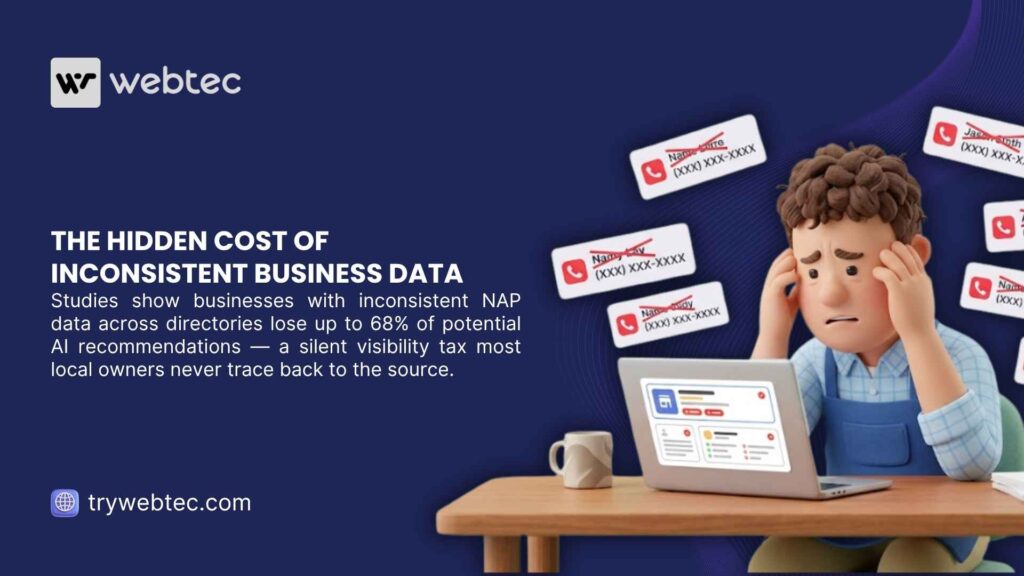
NAP stands for name, address, and phone number. Consistency across every platform where your business appears is not optional in 2026.
For AI models, conflicting data signals a reliability problem.
A business listed as “Steve’s Plumbing” on Google and “Steve’s Plumbing Services Ltd” on Yelp introduces the kind of ambiguity that causes AI systems to skip you and recommend a competitor with cleaner records.
Run a citation audit using BrightLocal, Moz Local, or Semrush Listing Management. Fix mismatches on high-authority directories first.
| Consistent NAP | Inconsistent NAP |
| Same business name everywhere | Name variations across platforms |
| Full address matching GBP | Abbreviations that differ by source |
| One canonical phone number | Multiple numbers, no clear primary |
Use Reviews as Proof, Not Decoration
Reviews are among the clearest signals AI systems use to evaluate real-world trust. According to BrightLocal’s 2026 survey, 97% of consumers read reviews before choosing a local business, and 41% always read them when browsing, up from 29% the year before.
What AI engines actually evaluate:
- Recency: Fresh reviews from the past 90 days signal an active business
- Volume: 47% of consumers will not use a business with fewer than 20 reviews
- Star rating: 31% of consumers in 2026 will only consider businesses rated 4.5 or above
- Review language: Reviews that mention specific services, locations, or outcomes give AI systems richer classification signals
Ask every satisfied customer for a review. Send a direct link. Do not script what they write.
Make Your Website and Location Pages Easy for AI to Understand
Your website should not make AI engines guess what you do, where you serve, or why you are credible. Every key page should answer those questions before a reader even scrolls.
Build a Clear Local Service Page Structure
Each service in each location you cover deserves its own dedicated page. A single catch-all page listing every service is useful for navigation but gives AI systems no specificity to work with.
Research on LLM citation patterns shows that 44.2% of all citations come from the first 30% of a page’s text (Victorino Group). The most important information must be at the top.
Structure every local service page like this:
| Page Section | What to Include |
| Opening paragraph | Service name, location, and direct answer to what you offer |
| Services detail | Specific services, each described individually |
| Service area | Named towns, neighborhoods, or postcodes |
| Trust signals | Qualifications, years in business, relevant credentials |
| FAQs | Common local questions answered in plain language |
| CTA | One clear action: call, book, or contact |
A page built around “emergency plumber in Manchester” or “family dentist in Leeds” will consistently outperform a generic services page because AI systems can extract a precise, location-matched answer from it.
Add Schema Markup That Matches the Real Business
Schema markup tells AI systems and search engines exactly what your page represents. For a local business, the schema types that deliver real value are the ones aligned with what you genuinely offer.
Use these where they apply:
- LocalBusiness or a specific subtype (Plumber, Dentist, LegalService): Identifies your business category explicitly
- Service schema: Describes individual services with name, description, and area served
- FAQPage schema: Structures Q&A content for direct AI retrieval
- Review schema: Makes review data machine-readable
One firm rule: only add schema that matches what the page actually says. Google’s detection of misleading structured data became sharper after the February 2026 Core Update.
Inaccurate markup risks a manual penalty. Your NAPW data in schema must match your GBP and all other listings exactly, down to how you abbreviate street names.
Strengthen Entity Signals with About, Contact, and Service Details
AI systems recommend businesses they can identify clearly as a distinct, verifiable entity. Your website should make that identification straightforward.
- A detailed About page with business name, history, team, and credentials
- A Contact page with full address, phone number, and service area
- Consistent business name across every page title and heading
- Staff or practitioner profiles for professional and regulated services
- Internal links connecting service pages to your About and Contact pages
When every page reinforces the same identity signals, AI systems have far less ambiguity to resolve before recommending you.
Publish Local Content That AI Can Confidently Cite
If your content answers local questions better than anyone else in your area, AI tools are more likely to use it. Knowing how to do AEO for a local business includes building a content layer on top of your trust foundation, not as a separate project, but as the next logical step.
To get your business cited by AI search engines, the pages that work hardest are the ones answering real questions with specific, local detail.
Answer Local Intent Questions Directly
AI Overviews appeared for 92% of informational-intent local queries in a Whitespark analysis (2025), including questions like “how long does an eye exam take near me” and “what is included in an annual boiler service.”
These are queries your prospective customers are already running.
Each one is a content opportunity. Write a page or FAQ section that answers it clearly and early, with local context woven in.
| Local Intent Type | Example Query | Content Format |
| Process questions | “How long does a roof repair take?” | Short explainer with steps |
| Cost questions | “Average dental implant cost in [city]” | Range with factors explained |
| Comparison questions | “HVAC service vs replacement?” | Side-by-side guide |
| Urgency queries | “Emergency electrician near me” | Service area + direct contact |
Use Location-Specific Examples, FAQs, and Comparisons
Generic content that could apply anywhere is less useful to AI systems than content grounded in a specific place. Mention service areas, describe local conditions relevant to your work, and write FAQs that reflect what customers in your actual area ask.
- Include your city or region in page titles and H1 headings
- Reference local neighborhoods, postcodes, or landmarks where natural
- Use the language customers use, not internal industry terms
Write for Natural Language Prompts, Not Just Keywords
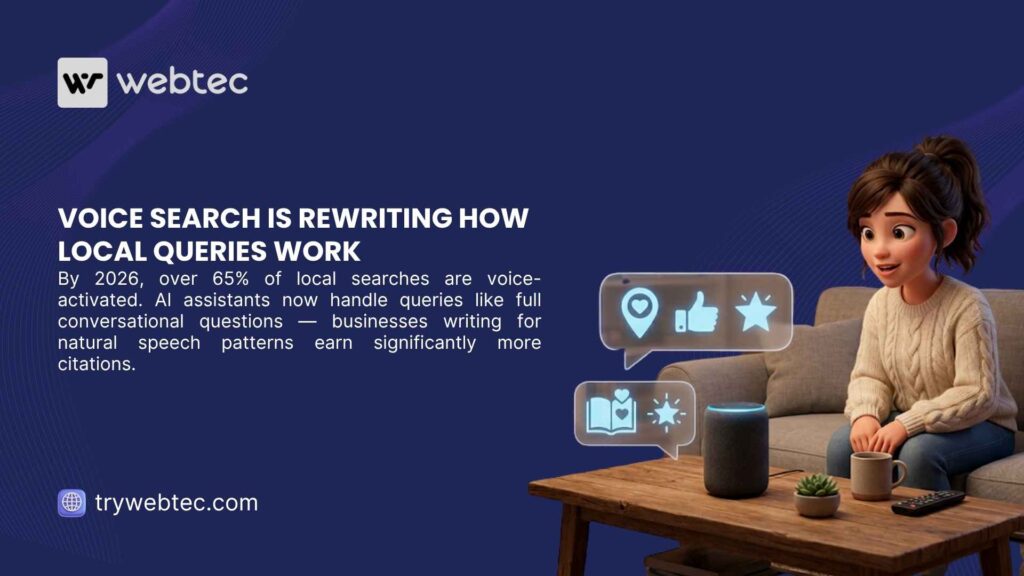
Over 65% of local searches are now voice-activated, and 76% of smart speaker users perform local voice searches at least weekly (2026 Consumer Search Report). Voice queries are almost always full questions, not keyword fragments.
Content written the way people actually speak is more likely to match the prompts AI systems receive. Write short, declarative answer blocks. Lead with the answer. Expand with supporting detail after.
Earn External Authority and Local Proof
AI engines trust businesses that are mentioned, referenced, and validated beyond their own websites. Research shows that 85% of brand mentions in AI answers originate from third-party pages, not owned domains. Your content alone is rarely enough.
Get Mentioned in Local Directories, Associations, and Community Sources
The goal is credible presence across a range of external sources that matter to your area and industry. Quality and relevance count for more than volume.
| External Source | Why It Matters | Example |
| Local directory | Validates business identity and location | Yell, Thomson Local |
| Industry association | Confirms professional credibility | NICEIC, Law Society |
| Community site | Builds local relevance signal | Nextdoor, local news site |
| Partner or supplier mention | External corroboration of entity | Supplier directory listing |
Focus on chambers of commerce, trade bodies, local press, and neighborhood platforms. Each consistent mention strengthens the web of signals AI systems use to trust your business.
Build Review Volume and Recency Without Spammy Tactics
The ethical path to reviews is also the most effective one. Ask real customers after real positive experiences, and make the process simple.
Do this:
- Follow up after a completed job with a direct review link
- Train your team to mention reviews naturally at the point of service
- Respond to every review, positive and negative, with a thoughtful reply
Do not do this:
- Offer incentives, discounts, or gifts in exchange for reviews
- Ask customers to post reviews from your premises or devices
- Use services that produce fake or template responses
Consistent new reviews arriving over months signal an active, trusted business to both customers and AI systems.
Use Testimonials, Citations, and Third-Party References That AI Can Trust
Case studies, named testimonials, and press mentions add layers of external corroboration. A quote from a named client describing a specific outcome is far more useful to AI than a generic star badge.
Where possible, link back to the original source. If a local newspaper featured your business, reference and link to the article. If an industry body lists you as a member, display that clearly with a link to the listing.
Track Whether Your AEO Work Is Actually Working
AEO only matters if you can tell whether your visibility is improving. A regular testing and logging process is what turns a one-time effort into a compounding visibility strategy.
Check Mentions in AI Engines on a Repeatable Schedule
Run a structured set of prompts across your target AI platforms each week. Include branded queries, category queries for your services, and comparison queries for your market.
| Prompt | AI Engine | Mentioned | Cited | Competitor Shown | Notes | Action |
| “Best plumber in [city]” | ChatGPT | Yes/No | Yes/No | |||
| “Emergency HVAC near me” | Google AI Overview | Yes/No | Yes/No | |||
| “[Business name] reviews” | Perplexity | Yes/No | Yes/No |
AI responses are not static. The same prompt can return different results across sessions. A single check tells you almost nothing.
The pattern over six to eight weeks reveals whether your optimizations are producing results.
For the complete tracking process, the guide on how to track if AI engines are mentioning your brand covers prompt building, log templates, and analytics setup in full.
Measure Calls, Clicks, Branded Searches, and Lead Quality
AI visibility does not always appear immediately in standard analytics. Watch for indirect signals first.
| Metric | What It Indicates |
| Growth in branded search volume | AI exposure prompting follow-up name searches |
| Referral traffic from AI platforms | Direct evidence of AI-driven clicks in GA4 |
| Increase in calls or contact completions | Conversion of AI visibility into real inquiries |
| Improvement in lead quality | AI-referred visitors arrive with specific service intent |
AI search visibility typically improves within 8 to 12 weeks of implementing the core signals covered in this guide (GrowthPro AI, 2026). Set a review point at that interval and compare against your baseline.
Know What to Fix When Results Are Not Improving
If your checks consistently show competitors instead of your business, the issue usually falls into one of four areas:
- Profile trust: Your GBP is incomplete or your NAP data is inconsistent across platforms
- Website clarity: Your service pages do not answer local questions directly enough
- Entity signals: AI systems cannot confidently identify your business as a distinct entity
- External proof: Your business is not referenced enough outside your own website
Work through this list in order. Profile and NAP issues are the fastest to resolve and often produce the most immediate improvement.
FAQs
Is AEO different from local SEO?
They overlap significantly but are not identical. Local SEO focuses on ranking in map packs and organic results. AEO focuses on becoming the source AI systems cite in generated answers.
Both rely on the same foundational signals, but the right approach to AEO for a local business requires additional clarity around entity identity and answer-first content structure.
What should a local business do first for AEO?
Start with Google Business Profile completeness and NAP consistency. If AI systems cannot reliably identify your business or trust your data, content optimization alone will not compensate. Fix the data layer first, then move to website structure and local content.
Does Google Business Profile matter for AEO?
Yes, GBP remains one of the strongest data sources for local AI recommendations. Google’s AI Overviews draw directly from GBP data when generating local answers, and profiles that are complete, accurate, and actively maintained are significantly more likely to be cited.
Can schema markup alone improve AI visibility?
No, schema helps AI systems classify your content accurately, but it works as part of a broader signal stack. Schema without accurate business data, consistent NAP, strong reviews, and answer-friendly content produces limited results on its own.
How do I know if AI engines are mentioning my business?
Run targeted prompts in Google AI Overviews, ChatGPT, Perplexity, and Gemini using category, branded, and comparison queries for your service area. Log the results consistently. Repeated checks over time reveal the pattern that one-off tests cannot.
The Takeaway
Knowing how to do AEO for a local business is not about chasing a single tactic. It is about building the trust signals, page clarity, and external proof that AI systems need before they confidently recommend you.
The five steps in this guide build on each other. Data accuracy creates the foundation. Website structure makes you readable. Local content makes you citable. External proof makes you credible. Tracking makes everything measurable.