
Search has evolved in ways that make the difference between human-readable and machine-readable content very important.
AI systems from Copilot to ChatGPT are making decisions every day about which content to surface, cite, and trust. How clearly machines can read your content has moved from optional to essential.
This guide explains what is schema markup and how does it help AI search, covers the schema types that deliver real results and gives you an honest look at what the research actually confirms about schema’s impact on AI-driven discovery.
What Is Schema Markup?
Schema markup in SEO is code added to a webpage that helps search engines understand what content means, not just what it says.
That shift from words to defined meaning is the core value of structured data. It reduces the interpretive work search engines have to do and increases the precision of how your content gets classified and displayed.
Vocabulary used in schema markup comes from schema.org, a shared framework built by Google, Microsoft, Yahoo, and Yandex.
It defines thousands of entity types and properties that search engines and AI systems recognize across the web.
| Without Schema | With Schema Markup in SEO |
| “Clara founded the company in 2015” | Person + Organization + founding date (defined) |
| “Available for $29.99” | Product + Offer + Price (structured) |
| “Published April 2026” | Article + datePublished (machine-readable) |
Schema Markup vs Structured Data vs Rich Results
These three terms appear in most articles as if they mean the same thing. They describe different layers of the same process.
| Term | What It Is | What It Does |
| Schema Markup | Code vocabulary based on schema.org | Tells search engines what content means |
| Structured Data | Any machine-readable formatted information | Organizes data for system parsing |
| Rich Results | Visual SERP features (stars, prices, FAQs) | The outcome when markup is valid and eligible |
Schema markup is the input. Rich results are a possible output, never a guaranteed one.
Pages that earn rich results through schema markup in SEO consistently show 20 to 40% higher click-through rates compared to plain organic listings. Book a call with Webtec and our team will walk through exactly how schema and structured data improvements can be applied to your site.
In the Google case study, pages shown as rich results saw an 82% higher CTR than non-rich result pages. Rotten Tomatoes saw a 25% higher CTR for pages with schema versus those without.
That lift only happens when implementation is complete and valid. Broken or partial markup produces nothing.
What Is Schema Markup and How Does It Help AI Search?
There are two common mistakes in how this question gets answered. Some sources overclaim (schema will boost your AI citations), and others dismiss it entirely (schema only matters for classic SERP features).
The accurate position sits between both.
How AI Search Engines Interpret Schema Markup
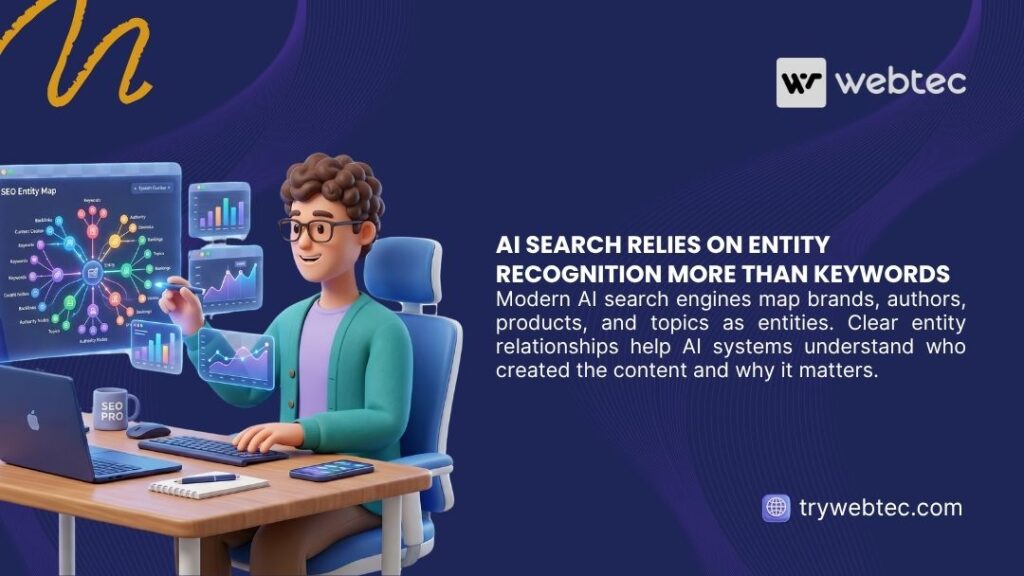
AI search systems do not just scan text. They construct a model of what a page represents.
To do that accurately, they need to:
- Identify entities: people, brands, products, topics
- Understand the relationships between those entities
- Determine the content type and intent of the page
- Contextualize content within a broader knowledge graph
Schema markup in SEO contributes directly to all four steps. AI systems receive explicit structured signals rather than inferring meaning from narrative text alone.
Microsoft Bing’s principal product manager, Fabrice Canel, confirmed in March 2025 that schema markup helps Microsoft’s LLMs understand content for Copilot.
Google’s Search team separately acknowledged in April 2025 that structured data gives an advantage in search results.
Google also states clearly that there are no special technical requirements for AI Overviews beyond standard SEO and indexing practices.
For brands building a broader content strategy around AI-driven visibility, answer engine optimization covers how entity signals and structured content work together at the foundation level.
Does Schema Markup Directly Improve AI Search Rankings?
As a short answer, schema markup does not directly improve AI Search Rankings.
A May 2026 Ahrefs study tracked 1,885 pages that added JSON-LD, matching each against control pages.
Citation changes were measured across Google AI Overviews, AI Mode, and ChatGPT.
No platform showed meaningful uplift:
- Google AI Overviews: -4.6% (small but statistically notable decline)
- Google AI Mode: +2.4% (within random variation)
- ChatGPT: +2.2% (within random variation)
If your SEO fundamentals are already solid, JSON-LD alone is unlikely to increase citations. If fundamentals are weak, schema will not compensate for them.
One important caveat to keep in mind: the Ahrefs study only measured pages already receiving heavy AI citations.
For pages not yet visible to AI systems, schema markup may still support initial crawling, parsing, and indexing.
The correlation between schema and AI visibility is real. AI-cited pages are almost three times more likely to have JSON-LD than non-cited pages. That reflects overall site quality, not schema as an isolated cause.
Why Schema Helps AI Understand Content Better
The practical value of schema markup in SEO sits in comprehension, not citation ranking.
| Schema Function | Traditional SEO Benefit | AI Search Relevance |
| Entity definition | Clearer indexing of people, brands, topics | Helps AI identify and attribute content |
| Content type classification | Rich result eligibility | Matches content to query intent |
| Relationship mapping | Connects author, org, and topic | Supports entity graph understanding |
| Ambiguity reduction | Accurate page categorization | Reduces misinterpretation in answer generation |
Schema markup works as a clarity layer. It doesn’t push pages into AI answers. It makes content easier to classify, attribute, and trust once it is already in consideration by an AI system.
6 Schema Types That Matter Most for AI Search Visibility
After Google’s March 2026 core update, 31 schema types retain active rich result support.
FAQ, Review, and How-To schema on non-primary content pages saw reduced eligibility. Clean entity schema on intent-matched pages held its value and in several cases improved.
These six types deliver the strongest results for content-driven SEO.
1. Article and BlogPosting Schema
Article schema in SEO identifies editorial content with a defined headline, author, publication date, and publisher.
For informational pages, it establishes content type cleanly and helps AI systems attribute information to the correct source at the correct time.
This is the baseline for any site publishing regular content.
2. Organization and Person Schema
Organization schema builds entity identity. It tells search engines who you are, what your business does, and how your brand connects to your published content.
Only 12.4% of brands currently have a full Organization schema that includes sameAs properties, founder details, and contact points. Without those fields, AI systems often cannot reliably identify which business a page belongs to.
BrightEdge data shows websites with author schema are three times more likely to appear in AI-generated answers.
3. FAQPage Schema
FAQPage schema in SEO structures question-and-answer content in a machine-readable format. It aligns closely with how AI systems retrieve answers to direct queries and remains one of the stronger schema types for capturing featured placements.
After the March 2026 update, FAQPage schema applies only to pages where Q&A content is the primary purpose, not supplementary content. Adding it elsewhere no longer qualifies for rich results and risks demotion.
4. Product Schema
Product schema in SEO defines pricing, availability, and review data in a structured format. For commercial pages, it feeds directly into shopping results and product knowledge panels.
For AI systems, it provides explicit product identity signals without requiring inference from unstructured descriptions.
5. HowTo Schema
The “HowTo schema” breaks instructional content into defined steps with titles and descriptions. That structure maps closely to how AI systems retrieve and present procedural answers.
For tutorials and step-by-step guides, it significantly improves machine readability and extract quality.
6. Breadcrumb Schema
Breadcrumb schema communicates site hierarchy. For AI systems building a model of topical authority and content organization, breadcrumb markup clarifies where a page sits within the broader structure of a site.
It supports navigation understanding and helps establish topical relationships between related pages.
| Schema Type | Primary Use Case | AI Search Value |
| Article / BlogPosting | Blog posts, editorial content | Defines content type and authorship |
| Organization / Person | Brand pages, author profiles | Establishes entity identity |
| FAQPage | Dedicated Q&A pages | Structures answers for AI retrieval |
| Product | E-commerce product listings | Provides structured commercial signals |
| HowTo | Step-by-step guides and tutorials | Breaks procedures into parseable format |
| Breadcrumb | All page types | Communicates site structure and hierarchy |
For a deeper look at how content structure affects what AI systems decide to cite, how to write content that AI overviews will cite covers the formatting and structural principles that drive selection beyond schema alone.
How to Add Schema Markup Correctly
Correct implementation is where most sites fail. That April 2026 audit of 5,000 production websites found 49% in a deployed-but-broken state. Schema present, but not qualifying for a single rich result.

Choosing the Right Schema Type for Your Page
Match schema to the primary purpose of the page.
- A product page needs Product schema
- A step-by-step guide needs HowTo schema
- A company about page needs Organization schema
- An editorial article needs Article or BlogPosting schema
Applying a schema that doesn’t reflect the page’s main purpose is treated as deceptive markup, which risks a manual penalty, not just a missed opportunity.
Using JSON-LD for Implementation
JSON-LD is Google’s preferred format for schema markup in SEO. It runs as a standalone script block in the page head, completely separate from your HTML structure.
That separation makes it easier to add, update, and debug without touching page layout.
Missing any required field (headline, datePublished, or author for Article schema) disqualifies the page from rich results entirely. Partial markup produces zero measurable improvement.
Validating Your Schema Before Publishing
Validation is where most implementations fall apart. Unvalidated schema is the primary reason deployments end up broken and producing nothing.
| Tool | Purpose | When to Use |
| Google Rich Results Test | Checks rich result eligibility | Before publishing and after updates |
| Schema Markup Validator (schema.org) | Validates against schema.org standards | During implementation and QA |
| Google Search Console | Monitors live performance and errors | Ongoing after publishing |
Run every implementation through at least the Google Rich Results Test before it goes live.
Keeping Schema Aligned With Visible Content
Schema must match what users actually see on the page. If your Article schema lists a publication date that differs from the date visible on the page, Google’s validator and AI crawlers will flag it.
This applies to every field. Markup that misrepresents visible content is a policy violation, not a formatting error, and is handled accordingly.
What We Don’t Know About Schema Markup and AI Search
Most content on this topic skips this section entirely. It is worth reading.
Whether AI Systems Use Schema During Answer Generation
A searchVIU experiment tested five AI systems (ChatGPT, Claude, Perplexity, Gemini, and Google AI Mode) on whether they used schema markup when fetching pages in real-time.
Every system extracted only visible HTML. JSON-LD was ignored during direct retrieval.
This doesn’t invalidate schema markup in SEO. It suggests structured data works earlier in the pipeline, at the crawling and indexing stage, rather than at query time.
How Consistently Schema Is Preserved Across AI Pipelines
It is not publicly confirmed whether structured data survives intact through crawling systems, indexing pipelines, and retrieval-augmented generation (RAG) processes. Different platforms treat schema differently, and no standardized behavior is documented.
Whether Schema Improves Ranking, Retrieval, or Just Interpretation
Current evidence points toward interpretation improvement. Whether schema also affects content selection in AI retrieval systems, or only improves understanding after content is already selected, remains unconfirmed.
How Much Weight Schema Carries Against Other Signals
No transparent weighting system shows how schema markup in SEO compares to content relevance, authority signals, backlinks, or engagement metrics. That makes its real-world impact difficult to quantify in isolation.
Understanding how schema fits within a broader shift in search is worth the time.
The difference between SEO and AEO in 2026 offers useful context on how structured content and entity optimization serve different objectives in the current search environment.
FAQ
What is schema markup and how does it help AI search?
Schema markup is structured code added to webpages that tells search engines what content means, not just what it contains.
For AI search, it helps systems identify entities, classify content types, and attribute information to the correct sources. It does not guarantee inclusion in AI-generated answers.
Does schema markup help AI search results?
Schema markup can improve how AI systems classify and understand content. A May 2026 Ahrefs study of 1,885 pages found no meaningful citation increase from adding JSON-LD to pages already visible in AI results.
The benefit appears primarily at the comprehension and indexing layer, not at the citation ranking layer.
Which schema types are most important?
Article, Organization, FAQPage, Product, HowTo, and Breadcrumb schema are the highest-impact types for content-driven SEO and AI search visibility in 2026.
Is schema markup necessary for SEO?
Schema markup is not mandatory for SEO, but it improves content clarity, supports rich result eligibility, and contributes to entity recognition. Pages with valid rich results consistently show higher click-through rates than plain organic listings at the same ranking position.
Can schema guarantee citations in AI answers?
Schema markup does not guarantee citations in AI answers. Google’s official documentation states there are no special technical requirements for AI Overviews beyond standard SEO practices. Schema supports comprehension and entity verification.
Citation decisions are driven by content relevance, topical authority, and semantic clarity, not by markup presence alone.

The Takeaway on Schema Markup in SEO
Schema markup in SEO is not a citation shortcut. Adding JSON-LD to an already-performing page is unlikely to change your AI visibility metrics in the short term.
What it does do: makes your content cleaner to classify, your entities more identifiable, and your pages eligible for rich results that still drive real click-through rates.
The 49-point gap between sites that deploy schema and sites that deploy it correctly is a measurable opportunity.
Closing that gap through clean implementation, correct schema types, and proper validation remains one of the best-value technical SEO improvements available right now.