Are AI search results mentioning your brand, or are they quietly skipping you while showing competitors instead?
This guide covers how to track if AI engines are mentioning my brand, from a simple manual check you can run today to an analytics setup that turns AI visibility into a measurable business signal.
How to Track If AI Engines Are Mentioning My Brand
Most people assume they need expensive software before they can start. The fastest way to understand your AI visibility is to begin with a structured search process you can run yourself.
For brands thinking beyond tracking and toward growing that presence, a deeper look at how to get your business cited by AI search engines is the strategic goal that monitoring feeds into.
But before you can improve, you need to know where you currently stand.
What Counts as a Real AI Mention?
Not every reference to your brand carries the same weight. AI search engines can surface your brand in three distinct ways, and knowing the difference changes how you interpret what you find.
| Type | What It Looks Like | Value |
| Plain mention | Brand name appears in the generated answer | Low to medium — no source link, no attribution |
| Cited mention | Brand named as a source, example, or recommendation | Medium — signals relevance to the AI system |
| Linked citation | Brand name plus a URL returned as a source | High — drives referral traffic and reinforces authority |
A plain mention confirms awareness. A linked citation confirms trust. When you run your checks, always record which type you find.
That distinction tells you how deeply AI systems trust your content, not simply that they know your name.
Which AI Engines Should You Check First?
Start with the four platforms that cover the majority of AI search activity in 2026:
- Google AI Overviews (surfaces directly inside standard search results)
- ChatGPT with web search enabled (not the base model without browsing)
- Perplexity AI (favored by research-oriented and professional users)
- Google Gemini (widely used on mobile and within Google Workspace)
These four platforms pull from different source pools. Your brand may appear in one and be completely absent in another, even for the same query. That gap is exactly what you are mapping.
- Run a Controlled Set of Prompts and Check the Results Manually
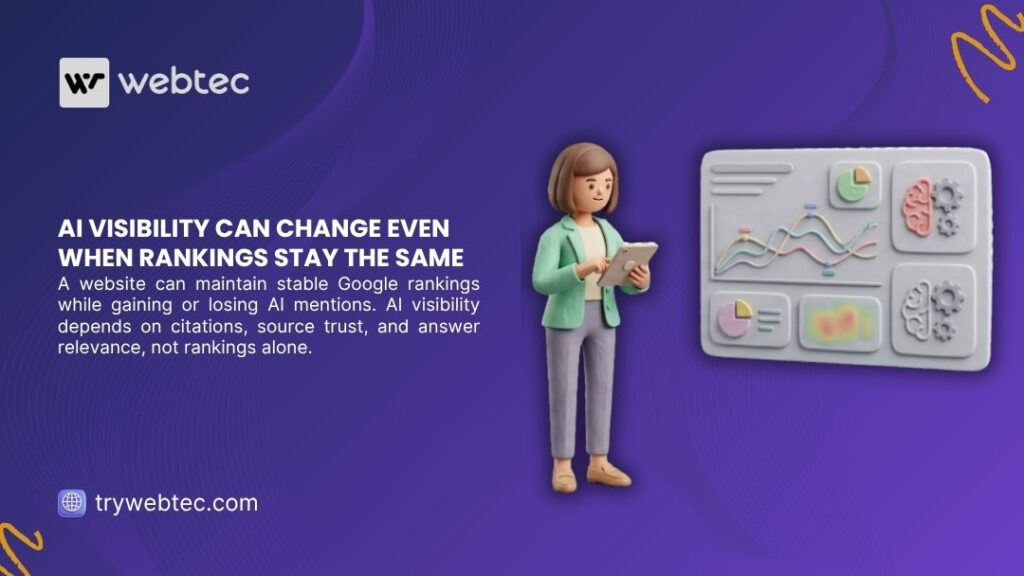
If you search once and stop, you are not tracking visibility. You are taking a single snapshot on a single day. AI responses change based on query phrasing, platform updates, and the content landscape, sometimes within the same week.
The right approach is to build a small, repeatable prompt set and run it on a consistent schedule.
How Do You Build a Prompt Set That Is Not Biased?
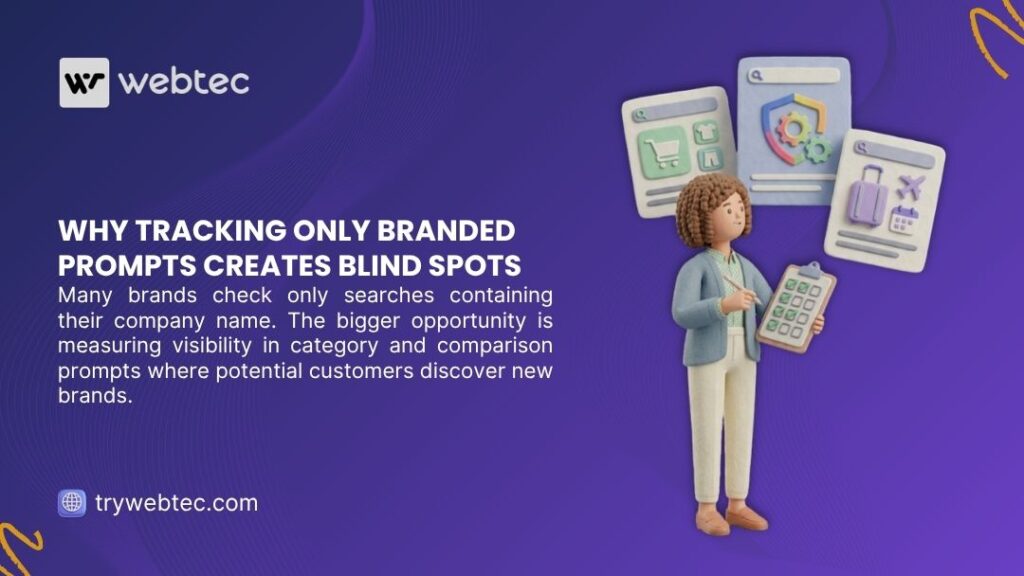
The most common mistake is running only branded queries. That gives you an inflated picture. You need to see whether AI engines mention your brand when someone has not already searched by your name, because that is where real discovery happens.
Build your prompt set across three types of queries:
- Branded queries: questions that include your company or product name directly, such as “What does [Brand] offer?”
- Category queries: questions a buyer might ask before knowing your name, such as “Best SEO agencies for small businesses in Europe”
- Comparison queries: questions that set up a choice within your category, such as “Agency SEO vs in-house SEO for growing companies”
Each type reveals something different. Branded queries show how accurately AI engines describe you. Category queries show whether you are being recommended at all. Comparison queries show whether you appear when buyers are actively evaluating options.
Once your prompt set is ready, run each prompt in the target AI engine, copy the full response, and log it exactly. Do not summarize. The specific phrasing AI systems use matters when you revisit results later.
| Prompt | AI Engine | Brand Mentioned | Citation Present | Sentiment | Notes |
| “Best SEO agencies for small businesses” | ChatGPT | Yes / No | Yes / No | Positive / Neutral / Negative | |
| “How to improve website visibility in 2026” | Perplexity | Yes / No | Yes / No | ||
| “[Brand name] services” | Google AI Overview | Yes / No | Yes / No |
Keep the log simple. You are building a pattern over time, not analyzing one result in isolation.
How Often Should You Track If AI Engines Are Mentioning Your Brand?
Frequency depends on how actively your brand or content is changing, but a practical baseline for most teams looks like this:
| Frequency | What to Track |
| Weekly | Core branded terms and your top 3 category queries |
| Monthly | Wider topic set and comparison queries |
| After major content updates | Any pages refreshed or published in the past 30 days |
AI responses are non-deterministic. The same prompt can return different results across sessions and platforms. That is why repeated sampling over time gives you a far more reliable picture than any single check ever could.
- Use an AI Visibility Tracker to Monitor Mentions at Scale
Manual checks work well when you have a small prompt set and one brand to follow.
Once you are tracking dozens of prompts across multiple platforms, or reporting results to clients, manual processes become inconsistent and slow.
That is when an AI visibility tool earns its place.
Before selecting one, it helps to understand what answer engine optimization means and why it matters as a discipline, since the metrics these platforms track are rooted in AEO principles and many of the optimization decisions flow from the same foundation.
| Tracking Method | Time Required | Scalability | Trend Visibility | Reporting Ease |
| Manual search and log | High | Low | Difficult | Manual only |
| Spreadsheet tracking | Medium | Medium | Possible if consistent | Manual only |
| Dedicated AI visibility tool | Low | High | Automated over time | Dashboard ready |
Platforms like OtterlyAI, Peec AI, Semrush, and Ahrefs Brand Radar run prompts automatically across multiple engines, aggregate mentions and citations, and show how results shift week over week.
They also benchmark against competitors at a scale that would take hours to replicate manually.
What Metrics Tell You If AI Engines Are Mentioning My Brand?
Visibility dashboards surface a lot of numbers. These five are the ones that drive decisions.
| Metric | What It Tells You |
| Mention frequency | How often your brand appears across your tracked prompt set |
| Citation rate | How often a mention includes a link or source attribution to your content |
| Sentiment | Whether AI engines describe your brand positively, neutrally, or negatively |
| Prompt coverage | What percentage of your tracked queries return any brand mention at all |
| AI share of voice | Your brand mentions as a share of total mentions in your category |
Share of voice is the metric most teams undervalue early on. A mention count of 20 sounds reasonable until you discover a competitor has 80 for the same prompts. The ratio tells the competitive story that raw numbers never reveal.
- Compare Your Mentions Against Competitors and Topic Leaders
A single brand mention tells you almost nothing on its own. The useful signal comes from knowing who else appears in the same responses, in what context, and which sources AI engines are pulling from to produce those answers.
Start by running your category and comparison prompts, then log every brand that appears, not just your own. Note the position, the context, and whether a citation link is included.
Do this consistently for your top three to five competitors.
| Brand | Appears in AI Search | Citation Quality | Positioning | Notes |
| Your brand | ||||
| Competitor A | ||||
| Competitor B | ||||
| Category leader |
When you fill this in over several weeks, patterns emerge. If a competitor appears consistently across category queries while you do not, the next question is what sources the AI uses when it cites them.
That points directly to the content type and third-party presence driving their visibility.
If you want to close that gap at the page level, a focused guide on writing content that AI Overviews consistently choose as sources covers the structural and trust signals that make the difference.
- Turn AI Mentions Into Action
Tracking visibility is only useful when it tells you what to do next. The output of any monitoring process should be a short action list, not just a report.
| Situation | What It Means | What to Do Next |
| Mention without citation | AI recognizes your brand but not your content as a source | Strengthen answer pages, guides, and FAQ sections |
| Neutral or negative sentiment | AI is drawing from outdated or weak sources | Audit which pages and third-party mentions feed the result |
| Competitor appears instead | They have stronger source coverage or topical authority | Identify which sources cite them and build presence there |
| No mention at all | Your brand is invisible to AI engines in this topic area | Build content around the query and grow third-party mentions |
What Should You Do If Your Brand Is Mentioned But Not Cited?
A plain mention is a starting point, not a destination. If AI engines know your name but do not point to your content as a source, the pages likely exist but lack the structural and trust signals that earn extraction.
Three practical actions help close this gap:
- Check the pages covering the topic where you are mentioned and confirm they answer the query directly within the first two to three paragraphs
- Look for self-contained sections such as definition blocks, FAQ content, or short structured answers that AI systems can lift and attribute without surrounding context
- Confirm those pages carry visible authorship, publication dates, and supporting credentials
The problem is almost never a lack of content. It is content that exists but is not structured to be trusted or extracted.
- Monitor Referral Traffic From AI Platforms in Your Analytics
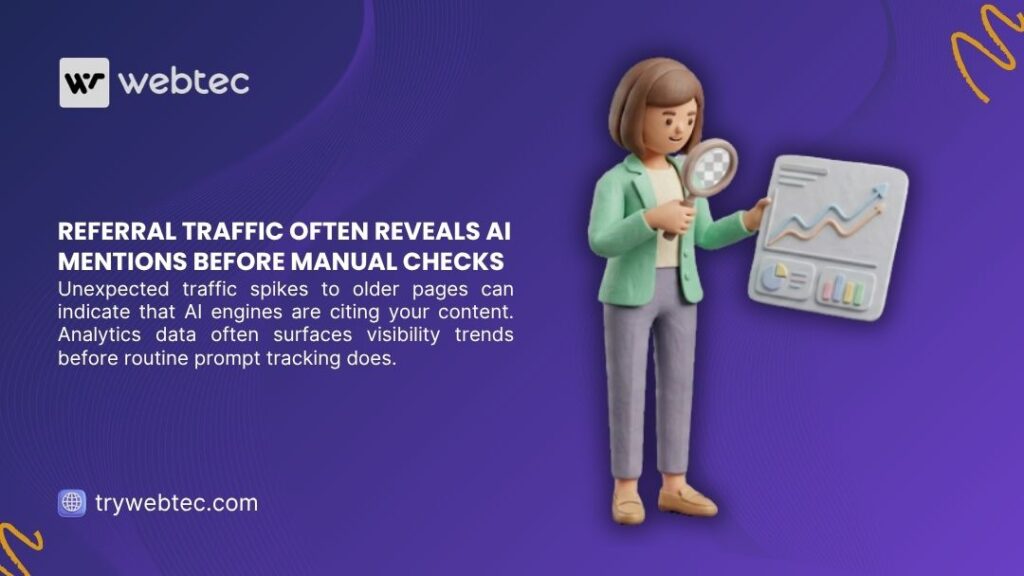
Your brand may be getting mentioned in AI answers even when you never see the mention yourself. Referral traffic from AI platforms is one of the clearest confirmations that visibility is producing real website activity.
| Signal | What It May Indicate |
| Increased referrals from AI platform domains | More active citations or recommendations |
| Growth in branded search volume | AI exposure triggering follow-up direct searches |
| Traffic spikes on older or specific pages | AI engines actively surfacing that content |
| Longer session durations from new referral sources | Higher-intent visitors arriving via AI recommendations |
Setting this up in GA4 requires creating a custom channel group under Admin, then adding a regex condition covering the major AI platforms: chatgpt.com, perplexity.ai, claude.ai, gemini.google.com, and copilot.microsoft.com.
ChatGPT began appending “utm_source=chatgpt.com” to citation links from June 2025, making some traffic attributable automatically.
Other platforms pass referrer headers inconsistently, so the AI traffic visible in your default reports is almost certainly an undercount of what is actually arriving.
Which Traffic Sources Could Indicate AI-Driven Visibility?
Not all AI-driven traffic appears as a direct referral. Some of the strongest signals come from patterns already sitting in your existing analytics data.
| Metric | Why It Matters |
| Referral traffic from AI platform domains | Direct, traceable evidence of AI-driven clicks |
| Growth in branded search queries | Suggests AI mentions are prompting follow-up name searches |
| Traffic to content you have not actively promoted | AI engines are surfacing that content independently |
| Conversion rate from new referral sources | Measures the business value of AI visibility |
Cross-reference what you find in analytics with your manual prompt tests. If a page starts receiving traffic you cannot explain, run a few prompts around that topic and check whether AI engines are citing it.
Once you have that confirmation, the natural next step is to go deeper on how to optimize your website specifically for platforms like ChatGPT and Perplexity so you can build on what is already producing results.
FAQs
How can I tell if AI Search Overviews are mentioning my brand?
Run targeted prompts using branded, category, and comparison queries across Google AI Overviews, ChatGPT, Perplexity, and Gemini.
Log whether your brand appears, what type of mention it is, and what language is used. Repeating this weekly gives you trend data that a single check cannot produce.
How often should I check AI mentions?
A weekly cadence for core branded and category terms is a reliable starting point. Broader topic sets can be reviewed monthly. After any significant content update, run a focused check within a few days to see whether AI engines have picked up the change.
What is the difference between an AI mention and a citation?
A mention means your brand name appears in the generated response. A citation means your content is used as a named source, often with a link back to your site.
Citations reflect a higher level of trust and are the ones that drive referral traffic and reinforce authority.
Do AI Search Overviews show the same results every time?
No, AI responses are non-deterministic, meaning the same prompt can return different results across sessions and platforms. That variability is why consistent, repeated tracking matters more than any single check.
What should I do if a competitor appears instead of my brand?
Look at the sources AI engines cite when your competitor appears. Those sources reveal the content type, the domains, and the authority signals driving their visibility.
Closing the gap requires improving your own content structure and earning mentions from similar third-party sources.
The Takeaway
The five methods in this guide build on each other. Manual prompts give you a starting point. Repeatable tracking gives you a trend. Competitive comparison gives you context. Analytics tie visibility to real traffic. Action planning turns all of it into decisions.
Knowing how to track if AI engines are mentioning my brand is now a baseline requirement for any business that depends on organic discovery. The brands that start measuring today are already ahead of those treating AI search as a future problem.
Webtec helps businesses move through this process with a clear strategy, from an initial AI visibility audit to building the content and authority signals that earn consistent citations over time.
If you want to understand where your brand stands in AI search today, that conversation is the right place to start.