
SEO for Plumbers: How to Get More Leads From Search
SEO for plumbers helps plumbing companies appear when potential customers search for services, compare solutions, research plumbing problems, and decide who to hire. A strong strategy connects service-page SEO, technical performance, useful content, authority, AI search visibility, and conversion tracking to one outcome: more qualified leads and booked jobs.
A burst pipe and a planned water heater replacement create very different search journeys. One customer may need help now. Another may spend several days comparing systems, reading about repair costs, checking companies, and deciding whether replacement makes more sense than another repair.
That difference matters.
A plumbing SEO strategy shouldn’t treat every search as though the customer is at the same stage. Commercial service searches need strong service pages. Cost and comparison queries need useful decision-making content. Technical problems can stop either type of page from ranking. And once the visitor arrives, the website still has to earn the enquiry.
In this guide, we’ll cover how SEO for plumbers works across keyword research, service pages, on-page and technical SEO, content, backlinks, AI search visibility, conversion optimization, measurement, and campaign prioritization. We’ll also explain where local SEO fits and point you to the dedicated strategy for Maps and Google Business Profile visibility.
SEO for Plumbers: What It Is and How It Works
SEO for plumbers is search engine optimization tailored to plumbing companies that want their websites and content to appear when potential customers research plumbing services and problems.
That could mean visibility for searches around water heater replacement, sewer line repair, repiping, commercial plumbing, drain problems, repair costs, or comparisons between different systems.
Plumber SEO normally connects several disciplines. Keyword research identifies the opportunities worth targeting. Service pages match commercial intent. Technical SEO helps search engines access and understand the site. Content captures informational and comparison searches. Backlinks strengthen authority. Conversion rate optimization helps turn visits into enquiries.
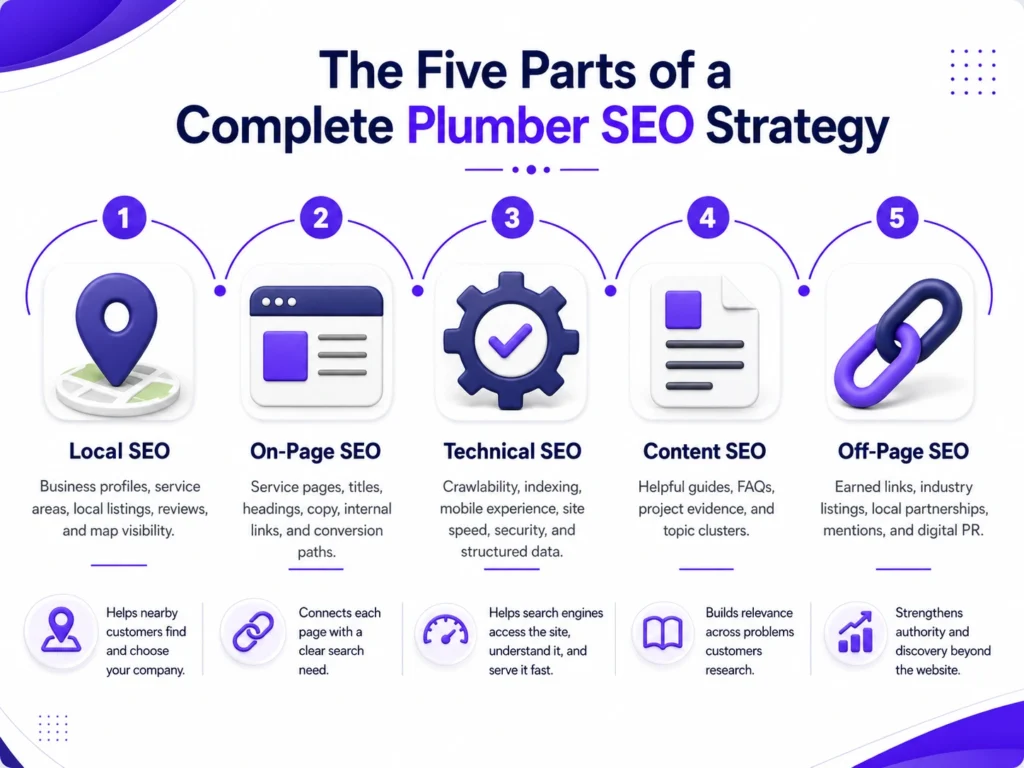
Paid search works differently. Google Ads and Local Services Ads can quickly generate sponsored visibility, while organic SEO builds website assets that continue to attract search demand over time.
For many established plumbing companies, the two channels work best together rather than as substitutes.
Local SEO Is a Core Part of Plumbing SEO
Plumbing is still an inherently local service, so local visibility remains one part of the larger SEO strategy.
Searches such as “plumber near me,” emergency queries, Google Maps results, Google Business Profile visibility, service areas, reviews, city targeting, and proximity all require a more specialized local-search approach.
Google explains that local results are primarily influenced by relevance, distance, and prominence in its official local ranking guidance.
Those factors matter enormously, but they are not the focus of this broader plumber SEO guide.
The split is easier to see at the query level. Searches like “plumber near me,” “emergency plumber [city],” and “24 hour plumber” have strong local intent, where Google Maps, Google Business Profile visibility, proximity, reviews, and other local signals can play a major role. Those searches belong primarily to the local SEO strategy.
Searches like “tankless water heater installation,” “sewer line repair cost,” and “repair or replace water heater” lean more heavily on organic service pages, comparison content, and informational resources. Those are the searches covered in this broader SEO guide.
Keeping those search intents clearly separated gives each page a distinct purpose and reduces the risk of the two Webtec articles competing for the same queries.
For the complete Maps, Google Business Profile, review, service area, city page, and near-me strategy, see Webtec’s local SEO for plumbers guide.
Here, we’ll concentrate on the broader website and organic search system that supports those local efforts.
Plumbing Keyword Research: Find Searches That Can Become Jobs
Keyword research shouldn’t begin with the biggest number in a search-volume column.
The first question is more useful: What service or decision does this search represent?
A plumbing company may want more water heater replacements, commercial work, repiping projects, sewer repairs, or recurring service agreements. Keyword priorities should reflect those business goals.
Service and Commercial Plumbing Keywords
Commercial-intent terms describe work the company can actually sell. Examples include water heater replacement, tankless water heater installation, sewer line repair, whole-home repiping, leak detection, drain cleaning, commercial plumbing services, and similar revenue-producing jobs.
Not every service deserves equal SEO investment. A lower-volume term tied to an expensive, profitable service may be commercially more useful than a broad plumbing term with thousands of searches and weak intent. Search volume is useful context. It shouldn’t make the decision by itself.
Ahrefs makes a similar distinction in its keyword-intent guidance, noting that attractive search volume alone doesn’t make a keyword strategically valuable if the intent doesn’t align with something the business can realistically serve and convert.
Problem-Based Plumbing Keywords
Customers don’t always know the name of the service they need. They may search for:
- why does my drain keep backing up?
- Why is my water heater leaking from the bottom?
- Why did my water pressure suddenly drop?
Those queries describe symptoms rather than services.
Useful content can answer the immediate question, help the homeowner understand the likely causes, and connect the problem naturally to the appropriate professional service when necessary.
Comparison and Decision Keywords
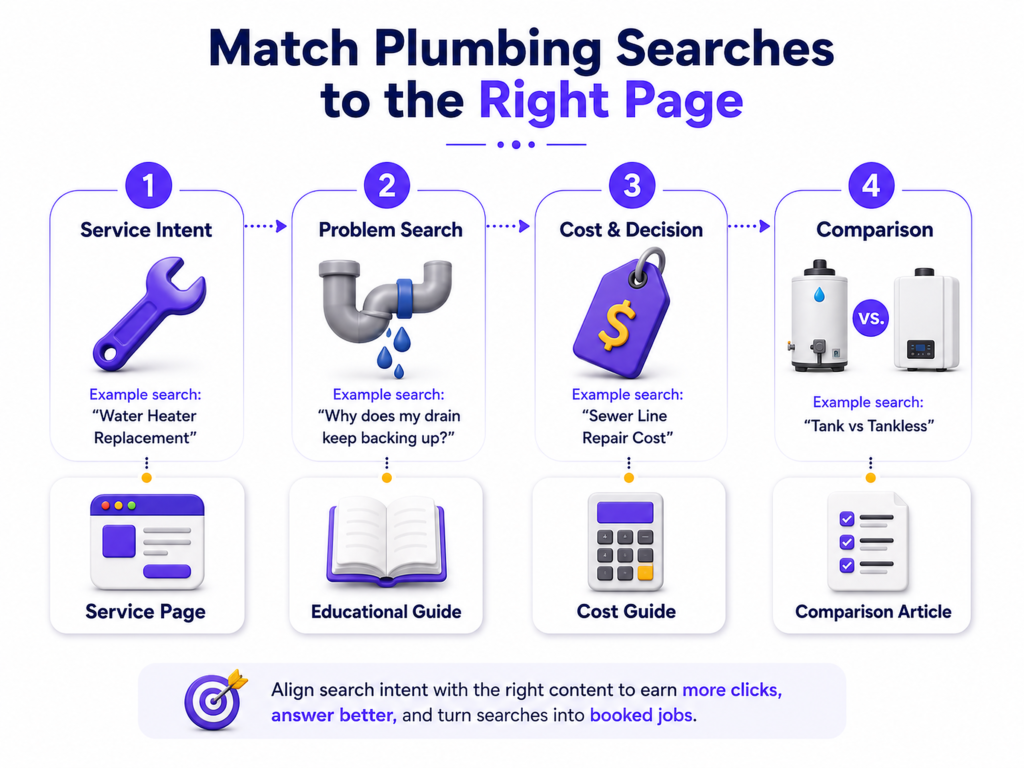
Another valuable group sits between informational and transactional search. Someone comparing tank versus tankless water heaters, repair versus replacement, copper versus PEX, or different sewer repair approaches may already be considering a significant purchase.
|
Query Type |
Example Query |
Best Content Type |
Typical Commercial Value |
|
Service |
drain cleaning |
Dedicated service page |
Low to medium |
|
High-value service |
water heater replacement |
Dedicated service page |
Often High |
|
High-value service |
whole-home repiping |
Dedicated service page |
Often High |
|
Emergency |
emergency plumber [city] |
Emergency landing page |
Medium to high |
|
Problem |
why does my drain keep backing up |
Educational guide |
Varies |
|
Cost |
sewer line repair cost |
Cost and decision guide |
Often High |
|
Comparison |
tank vs tankless water heater |
Comparison article |
Often High |
|
Commercial |
commercial plumbing services |
Commercial service page |
High, recurring |
Those searches deserve content designed around decision-making rather than generic definitions.
Map Keywords to Pages Before Creating Content
The most common keyword mistake is assigning too many intentions to one URL. A water heater service page shouldn’t also try to become the definitive article about tankless comparisons, repair costs, maintenance schedules, common fault codes, and every water heater question customers might ask.
Give each page a clear purpose.
- The service page captures commercial demand.
- Supporting articles answer specific research questions.
- Comparison content helps customers evaluate choices.
- Internal links then connect those pieces into a useful topic cluster.
That structure is much stronger than putting every plumbing keyword on one giant page.
Plumbing Search Demand Is Seasonal. Your Content Calendar Should Be Too.
Plumbing demand does not remain flat throughout the year. Some problems are strongly tied to weather, while planned projects often follow broader homeowner renovation cycles. Frozen-pipe and winterization topics become more relevant as temperatures fall, while renovation-related plumbing can become more active during busier remodeling periods.
That pattern should influence when content is published, not only what gets published.
A page usually needs time to be crawled, indexed, linked internally, and establish search visibility. Instead of waiting until demand has already increased, review historical performance in Google Search Console and compare search interest in Google Trends several months beforehand. Google Trends allows marketers to compare current interest with previous periods and identify recurring seasonal patterns.
For example, if historical data shows that frozen-pipe searches rise each winter in a plumbing company’s market, the supporting guides and emergency-service content should be published or refreshed well before the first sustained freeze.
A practical rhythm looks like this:
- Spring: Review planned service content, such as repiping, water line replacements, and renovation-related plumbing, based on historical demand.
- Summer: Prepare winter resources early, including frozen-pipe prevention, cold-weather plumbing issues, and emergency-support content.
- Autumn: Refresh winter pages, strengthen internal links, and confirm important conversion paths work properly on mobile.
- Winter: Maintain high-demand cold-weather pages while preparing spring and planned-project content for the next demand cycle
Refreshing existing content can be more valuable than publishing another page on the same subject. If a frozen-pipe guide performed well last winter, review its accuracy, add useful new information, improve internal links, and update genuinely time-sensitive details rather than rewriting it simply to change the publication date.
Seasonality should also affect prioritization. If historical data indicate that an important demand period is approaching, strengthening the relevant commercial pages and supporting content may take priority over publishing unrelated informational articles.
Build Plumbing Service Pages That Match Search Intent
Service pages should be one of the strongest assets on a plumbing website. If a company offers drain cleaning, water heater repair, water heater replacement, sewer repair, leak detection, repiping, commercial plumbing, and other specialist work, one broad “Plumbing Services” page rarely provides enough depth for every service.
Each important service should have enough information to answer the questions a serious customer has before making contact.
A drain-cleaning prospect may want to understand recurring blockage symptoms, what can cause the problem, whether the issue could involve the sewer line, what the plumber may inspect, and what happens during the appointment.
Someone considering repiping has different concerns: existing pipe materials, corrosion, pressure problems, project scope, disruption, expected lifespan, and cost factors. Those are different search intents and different buying decisions. Separate pages allow the website to match them properly.
A strong plumbing service page usually follows the same structure:
- H1 naming the service plainly
- Symptoms that tell the customer this is the service they need
- What the service covers, in specifics rather than categories
- The diagnostic process, so the visitor knows what happens when you arrive
- What determines cost, without necessarily quoting a price
- Repair versus replacement guidance where both are genuine options
- Proof relevant to that service, not generic company proof
- FAQs covering the objections that stop people calling
- One CTA matched to the urgency of the service
Focus Each Service Page on One Main Job
A strong plumbing service page should make its primary purpose obvious through the title, H1, copy, supporting headings, internal links, and CTA. That does not mean repeating the exact keyword every few sentences. It means staying focused.
If the page is about sewer line repair, explain sewer problems thoroughly. If the page is about tankless water heater installation, answer the questions people considering tankless systems actually have.
Specificity creates relevance. It also helps conversion because the visitor sees evidence that the company understands their particular problem rather than plumbing in general.
Location Pages Need Their Own Local Strategy
Location pages may be appropriate for genuine service markets, but they sit primarily within a local SEO strategy. They should not become a second copy of each service page with a city name inserted throughout.
The local SEO guide should own the detailed decisions around city architecture, service areas, proximity, location relevance, and avoiding doorway-style pages.
The broader SEO site’s job is simpler: make sure strong service pages exist for the local strategy to support.
Use Internal Links to Build Topic Relationships
Internal links help connect commercial pages with the research customers do before reaching them. A guide about recurring drain backups can link naturally to sewer or drain services. A comparison of tank and tankless water heaters can point toward installation services.
A repiping article can connect to the main repiping service page when the reader reaches the point where professional assessment becomes relevant. Internal links should make the website easier to explore rather than exist solely for search engines.
On-Page SEO for Plumbing Service Pages
On-page SEO makes the meaning of a page easier to understand. That starts with the title. A title such as:
Tankless Water Heater Installation | Company Name
is clear. A title stuffed with “best,” “cheap,” several unrelated services, and every keyword variation is not. The same principle applies to headings.
One focused H1 should tell the visitor what the page covers. Supporting headings should answer meaningful subtopics rather than repeat slightly different keyword combinations.
The copy itself should address the questions that affect the hiring decision.
What does the service cover? What problems indicate it may be needed? What does the diagnostic process involve? What determines price? When is repair appropriate, and when might replacement make more sense?
Meta descriptions are search result copy, not keyword storage. Keep them to 140 to 160 characters, lead with the benefit, and end with a reason to click.
The rest of on-page SEO comes down to a short list of rules that are easy to check:
- Title tag: 50 to 60 characters, primary keyword near the front, unique on every page
- H1: one per page, contains the service, not identical to the title tag
- Headings: H2 for subtopics, H3 for supporting points, never skip a level
- First 100 words: include the primary keyword naturally
- Image alt text: describe the image, do not stuff the keyword
- Internal links: at least three to five per page, with anchor text that says where the link goes
- URLs: lowercase, hyphenated, no dates, no parameters
Technical SEO: Make the Plumbing Website Easy to Use and Easy to Crawl
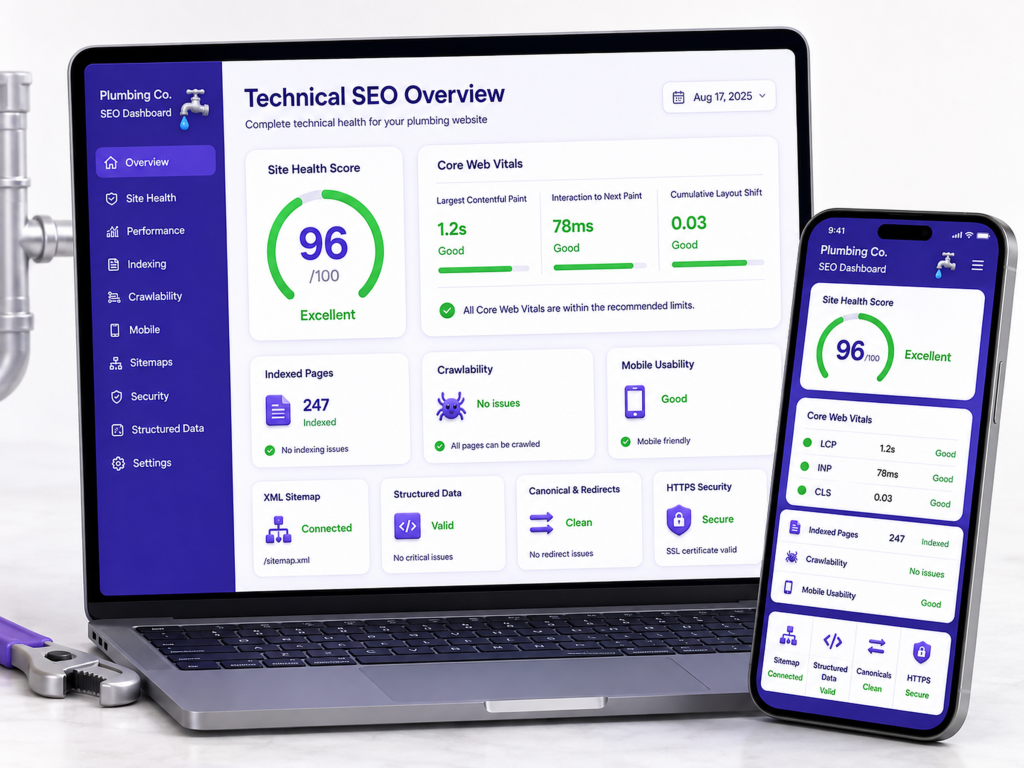
Technical SEO matters because a great service page has limited value if Google struggles to access it or a customer cannot use it comfortably on a phone. Mobile experience should be a priority.
The site needs responsive design, clear navigation, working forms, usable click-to-call buttons, and reasonable load times.
For businesses with an old or underperforming site, a carefully planned website redesign can address user experience and technical problems together, but any redesign should preserve valuable existing URLs and redirects rather than treating launch day as a clean slate.
Crawlability also matters. Priority pages should be accessible through internal navigation, included appropriately in the XML sitemap, free from accidental noindex directives, and supported by sensible canonical and redirect rules. Google Search Console can help identify indexing and search-performance issues.
Use Structured Data for What It Actually Does
Structured data provides standardized information about a page.
For local businesses, Google’s LocalBusiness structured data documentation explains how appropriate markup can describe details such as business information and opening hours. What structured data does not provide is a secret route into Google AI Overviews.
Google says there is no special schema.org markup or AI-specific structured data required to appear in AI Overviews or AI Mode.
That distinction matters because “AI schema” is increasingly marketed as though it were a separate ranking system. It isn’t.
Content SEO for Plumbers: Answer Problems Customers Actually Have
A plumbing blog should have a reason to exist. Publishing “five fun facts about plumbing” because the website hasn’t had a new article this month isn’t much of a content strategy. Better topics come from actual customer problems.
Why does a water heater leak from the bottom? What causes recurring drain backups? When should old galvanized plumbing be replaced? Why has water pressure suddenly dropped? What should a homeowner do before a plumber arrives after a burst pipe?
Those topics connect information demand to real plumbing expertise and real services.
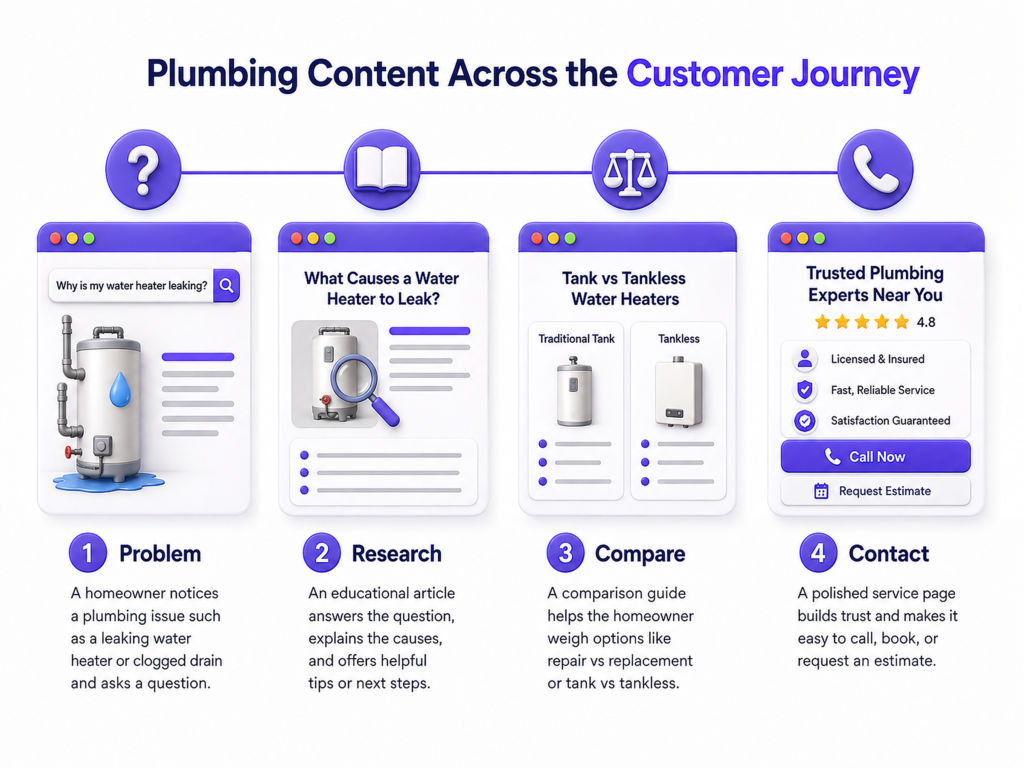
Create Content Across the Customer Journey
Not every article needs to produce an immediate phone call. Someone reading a water heater comparison may still be weeks away from replacement. That does not make the visit worthless.
Good informational content can introduce the company earlier, demonstrate expertise, answer objections, and guide the customer toward the appropriate service when the decision becomes more commercial.
The important thing is alignment. Informational pages should answer questions. Comparison pages should help customers make choices. Service pages should help customers take action.
Use First-Hand Plumbing Experience
The easiest article for a competitor to reproduce is one assembled entirely from the same pages that already rank. A much harder article to copy includes details from real work.
A licensed plumber can explain which faults are commonly misdiagnosed, what signs point to a deeper sewer issue, what technicians frequently find in older homes, and when a seemingly simple repair needs a professional assessment.
Project photographs, expert commentary, real diagnostic observations, and original case information can all add substance.
For plumbing content, that means answering the homeowner’s real problem more completely, not simply repeating “plumber SEO keywords” a few more times than the page ranking above you.
Earn Relevant Backlinks and Build Industry Authority
Backlinks still help search engines discover relationships and evaluate authority across the web. The emphasis should be on relevance and legitimacy. A plumbing company does not need hundreds of unrelated links from sites created primarily to sell guest posts.
Large-scale search research also supports focusing on link quality and authority rather than arbitrary link counts. Backlinko’s analysis of 11.8 million Google results found that stronger overall link authority and more referring domains were correlated with higher rankings.
Better opportunities may come from industry organizations, manufacturers, suppliers, business partners, relevant publications, professional associations, useful research, and genuinely reference-worthy content.
Original resources can make earning easier. A detailed water heater cost study based on actual project data, an analysis of common plumbing failures observed across hundreds of jobs, a technical comparison guide, or a well-documented case study gives another website a reason to reference the company.
That is more defensible than buying a package labelled “100 high-authority backlinks.” Local citation building, map prominence, and locally focused authority signals are more appropriately covered in the dedicated local SEO strategy.
AI Search Visibility for Plumbers: SEO, AEO, and GEO
AI search matters, but it should be treated as an extension of good SEO rather than a replacement for it.
Google’s current guidance says the same foundational SEO practices remain relevant to AI Overviews and AI Mode, and there are no additional technical requirements for inclusion. A page must be indexed and eligible to appear in Google Search with a snippet before it can be eligible as a supporting link in these generative experiences.
Google’s newer generative-AI optimization guidance also states that SEO remains relevant because AI search is rooted in Google’s core Search ranking and quality systems.
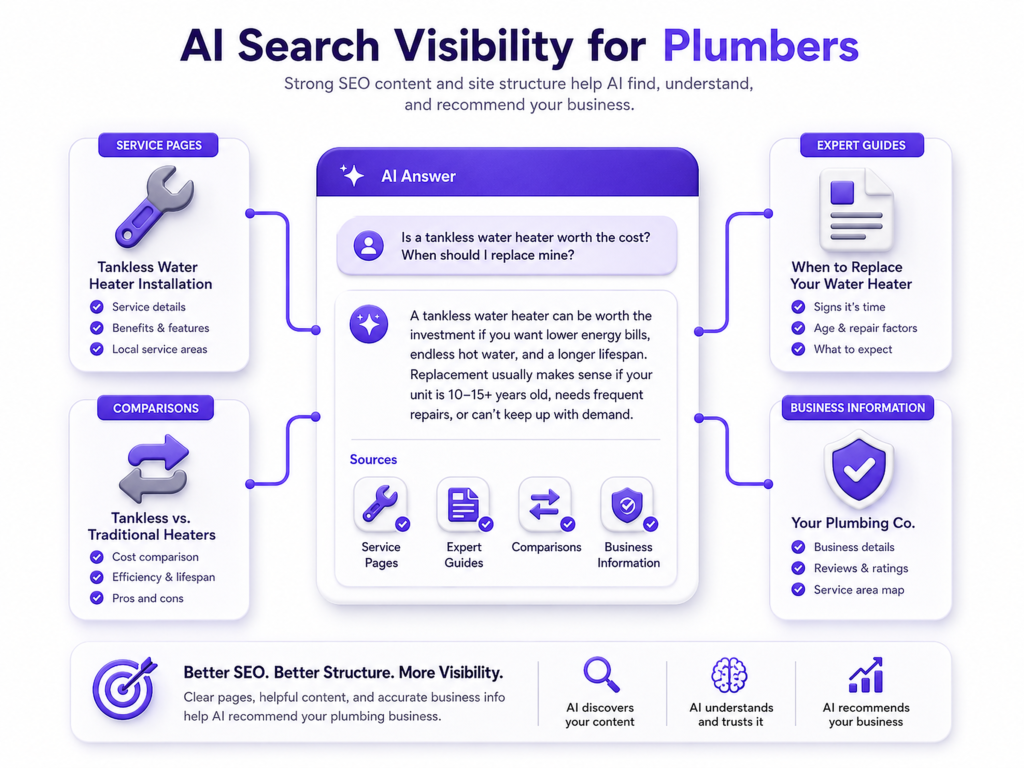
AI Queries Can Combine Several Intent Signals
Traditional searches are often short. A user might type: “tankless water heater.” A conversational AI query could ask whether a tankless system is worth the additional cost for a four-person household, what maintenance it requires, how long it lasts, and when replacing an older tank system makes financial sense.
That search crosses several topics at once. A website with strong service pages, expert comparisons, problem-solving articles, clear internal links, and consistent business information gives search systems more useful material to work with.
AEO and GEO Don’t Replace Traditional SEO
Answer Engine Optimization and Generative Engine Optimization are useful ways to describe the goal of appearing in AI-generated answers. They don’t require abandoning SEO fundamentals.
Google’s May 2026 Search Central guidance specifically reinforces the importance of valuable, unique, non-commodity content while correcting common AEO and GEO misconceptions.
Google is also specific about what does not provide an advantage in its generative Search features. Plumbing companies do not need llms.txt files, artificially broken-up or “chunked” content, pages rewritten specifically for AI systems, special structured data for AI features, or manufactured brand mentions simply to improve visibility in Google Search.
If an SEO agency is selling any of these as a separate requirement for Google AEO or GEO, ask what evidence supports the recommendation. Strong technical SEO, crawlable pages, useful content, clear site architecture, genuine authority, and first-hand expertise remain the more important foundation.
There is one important distinction, though. Google’s guidance applies to Google Search. ChatGPT and Perplexity use their own retrieval and source-selection systems, so their optimization considerations are not identical, even though there is overlap around crawlability, authority, useful content, and clear site structure. For that separate strategy, see Webtec’s guide to optimizing your website for ChatGPT and Perplexity.
Turn Plumbing SEO Traffic Into Phone Calls and Booked Jobs
Here’s where a lot of SEO reporting loses the plot.
- A higher ranking is useful.
- More impressions are useful.
- More organic traffic is useful.
- None of those metrics proves the campaign is generating worthwhile plumbing work.
- Search visibility has to connect to conversion.
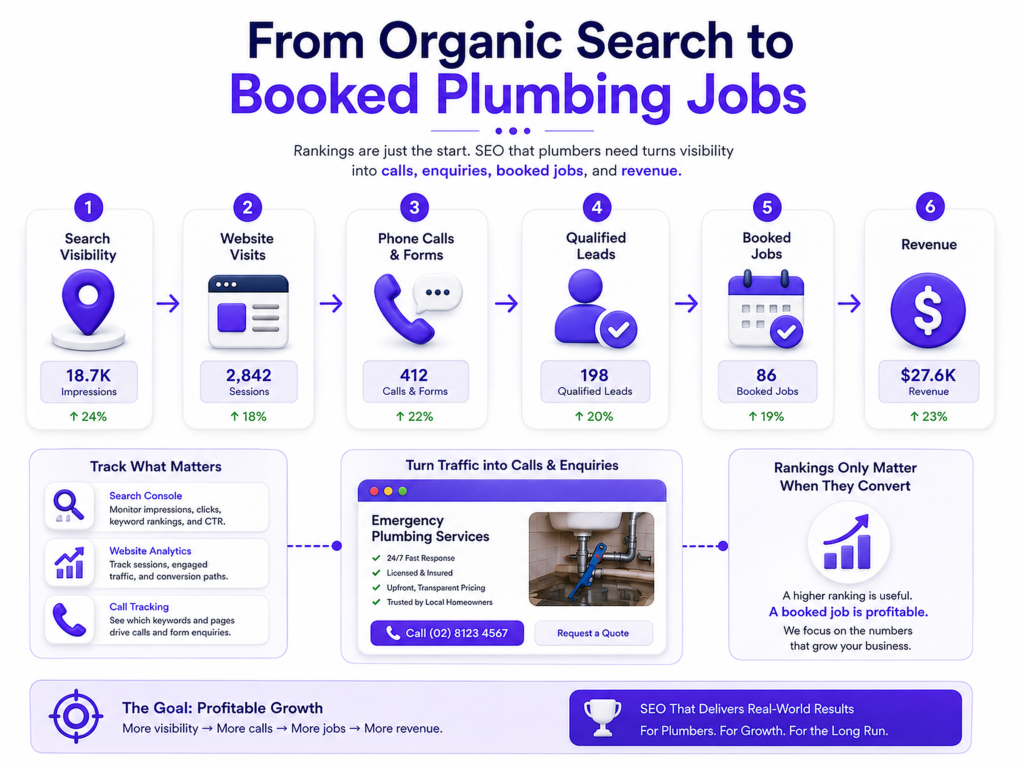
- An emergency page needs an obvious phone number and direct action.
- A repiping page may need an estimate request.
- A tankless water heater comparison article may need more education before the visitor is ready to contact anyone.
Those pages shouldn’t all use the same conversion path. Those pages shouldn’t all use the same conversion path. BrightLocal’s 2026 U.S. consumer research found that 73% of recent local-business searches started on mobile, while 75% of consumers used more than one channel during the same search journey. For plumbing companies, that makes a fast mobile experience, clear contact options, consistent business information, and strong trust signals especially important.
This is where SEO and conversion rate optimization meet. Search intent gets the right person onto the page; CRO reduces the friction that stops that person from becoming a lead.
Trust signals should also appear close to the decision. Relevant reviews, service-area information, real project photographs, credentials where appropriate, warranties when genuinely offered, and clear contact options can all reduce uncertainty.
Don’t hide all of that proof on the About page. A water heater customer should see evidence related to water heaters. A commercial customer should see commercial plumbing experience.
Specific proof tends to persuade more effectively than generic claims such as “best quality” or “industry-leading service.”
Track Plumbing SEO by Leads and Revenue, Not Rankings Alone
Keyword positions are useful diagnostic information. They should not be the entire report. A plumbing company should know which organic landing pages attract visitors, which queries produce visibility, how many calls and forms originate from organic search, and, where the systems allow it, which enquiries turn into booked jobs.
Google Search Console and Google Analytics can help provide the search and website layers. Properly configured call tracking can add another view.
The useful question isn’t “Did organic traffic increase?” It is “Did organic search produce more of the enquiries and jobs this company actually wants?”
There is also a new 2026 measurement development worth watching. Google announced dedicated Search Generative AI performance reports in Search Console in June 2026, with an initial rollout to a subset of websites. The reports provide separate visibility data for generative Search experiences such as AI Overviews and AI Mode.
Where that reporting is available, plumbing companies can measure AI-search visibility more directly instead of relying entirely on third-party estimates. The business outcome still matters most: visibility should eventually connect to leads, calls, and revenue.
SEO vs. Google Local Services Ads for Plumbers
SEO and Local Services Ads solve different problems. SEO builds organic assets and visibility. Paid advertising can capture immediate demand.
|
Factor |
SEO for Plumbers |
Local Services Ads |
|
Visibility |
Organic Search and local results |
Sponsored local placement |
|
Cost model |
Investment in website, content, authority, and strategy |
Paid lead model for eligible businesses |
|
Speed |
Usually builds gradually |
Can capture demand sooner |
|
Longevity |
Strong pages can continue generating visibility |
Visibility depends on active campaign conditions |
|
Best use |
Sustainable search presence |
Immediate high-intent demand |
|
Main dependency |
Relevance, authority, local strength, execution |
Eligibility, competition, budget, campaign performance |
For many growing plumbing companies, the strongest approach is coverage rather than choosing one channel exclusively. Organic search, Maps, and digital advertising can support different moments in the same customer journey.
The important part is attribution. Marketing spend should follow profitable work, not whichever dashboard contains the biggest number.
DIY SEO vs. Hiring a Plumber SEO Company
A small plumbing company can handle some foundational SEO internally. Improving core service pages, publishing useful expert content, monitoring Search Console, fixing basic on-page issues, and reviewing website conversions do not always require a large agency. The equation changes as the company grows.
Multiple locations create more keyword and page decisions. Older sites may have technical problems. Competitive metro markets need stronger service content and authority. Website migrations introduce ranking risk. Larger operations may need CRM attribution, call tracking, CRO, scalable content, and ongoing competitor monitoring.
That’s where professional SEO services for plumbers become more useful, not because SEO is mysterious, but because execution becomes more complex. A credible plumber SEO agency should be able to explain what it is doing and why.
The strategy may include technical SEO, keyword research, service-page optimization, content strategy, authority development, internal linking, analytics, AI-search monitoring, and conversion improvements.
Be cautious with a plumber SEO company that guarantees a number-one ranking, creates dozens of copied city pages, sells bulk backlinks, hides its methods, or reports traffic without explaining what happened to the leads.
Google itself states that there is no way to request or pay for a better organic local ranking. Good SEO can be technical without being a black box.
How to Prioritize a Plumbing SEO Campaign
Not every plumbing company should start with the same checklist. The priority should be the problem currently limiting growth.
|
Current Problem |
First SEO Priority |
Why |
Typical Time to See Early Impact |
|
Important pages are not indexed or technically unstable |
Technical SEO |
Strong content cannot perform if search engines cannot access it properly |
Days to weeks |
|
Commercial services have weak or generic pages |
Service-page SEO |
High-intent searches need relevant destinations |
1–3 months |
|
Organic traffic is mostly informational |
Commercial keyword mapping |
The site needs stronger coverage of revenue-producing searches |
1–3 months after page changes |
|
Website has little topical depth |
Content strategy |
Supporting content can expand visibility and authority |
3–6 months |
|
Competitors have much stronger authority |
Backlink and authority development |
Good pages may still struggle without external credibility |
3–6+ months |
|
Traffic is growing, but leads are flat |
CRO and measurement |
The bottleneck occurs after the click |
Days to weeks |
|
Maps and local visibility are weak |
Local SEO |
Requires a dedicated local SEO strategy |
1–3 months |
|
Search presence is strong, but AI visibility is limited |
AEO/GEO refinement |
Existing SEO assets can be adapted for broader search discovery |
Weeks to months; less predictable |
Note: These ranges describe when early signs of improvement may begin to appear, not guaranteed ranking or revenue timelines. Competition, website authority, technical condition, market size, implementation quality, and search-engine recrawling can all affect how quickly results develop.
The sequence matters. If a site’s main service pages are weak, publishing another twenty informational articles may not be the best first move.
If traffic already exists but nobody converts, chasing additional rankings may simply send more people into the same broken funnel. If the main problem is Google Maps visibility, the dedicated local SEO strategy should take priority. A strong campaign diagnoses first and expands second.
Common Plumbing SEO Mistakes That Cost Leads
The most common mistake is trying to make one page rank for everything. The opposite problem is creating dozens of thin or overlapping pages that have no clear search intent or meaningful unique value.
Keyword volume can also become a distraction. A national plumbing question may bring thousands of visitors who are nowhere near the company’s service area.
Cheap backlinks create another problem because quantity is easy to sell and difficult for a busy business owner to evaluate.
Then there is the website that ranks but doesn’t convert. The number is hard to find. Reviews sit several clicks away. The service itself isn’t clear. The form asks for too much information.
And in 2026, there is a newer shortcut to avoid: mass-publishing generic AI-generated plumbing content simply because it is cheap to produce. AI can assist a workflow, but it does not replace genuine plumbing expertise, local evidence, accurate information, or editorial judgment.
FAQs About SEO for Plumbers
How does SEO for plumbers work?
SEO for plumbers works by matching valuable plumbing searches with relevant service pages, technically accessible content, useful supporting resources, strong authority signals, and a website built to turn search visitors into enquiries. Local visibility can support the wider strategy but requires its own Maps and geographic SEO work.
What do plumber SEO services include?
Plumber SEO services may include technical audits, keyword research, service-page optimization, on-page SEO, internal linking, content strategy, backlink development, analytics, AI-search monitoring, and conversion rate optimization. Local SEO can be added as a separate workstream when Maps and geographic visibility are priorities.
What are the best plumbing keywords to target?
The best plumbing keywords depend on the company’s services and revenue priorities. Useful targets may include water heater replacement, sewer line repair, repiping, commercial plumbing, leak detection, cost-related searches, problem queries, and comparison terms. Search intent and commercial value matter alongside search volume.
Should every plumbing service have its own page?
Important services generally deserve dedicated pages when there is enough distinct information and search demand to justify them. A focused page gives customers and search engines a clearer understanding of the service than a short paragraph buried on a general services page.
How long does SEO take for a plumbing company?
There is no universal timeline. Results depend on competition, the website’s technical condition, service-page quality, current authority, content depth, existing rankings, and how quickly improvements are implemented. Some technical changes can have an effect sooner, while competitive commercial rankings usually require more time.
Is SEO better than Google Ads or Local Services Ads for plumbers?
Not in every situation. SEO is useful for building longer-term organic visibility, while paid channels can capture demand more quickly. Many plumbing companies use both and evaluate them according to lead quality, cost, and booked revenue.
Can SEO help plumbers appear in Google AI Overviews and AI tools?
Yes, strong SEO can improve the underlying visibility, clarity, and authority of a plumbing business across search experiences, although no company can guarantee inclusion in an AI-generated response. Google says its traditional SEO best practices remain foundational for AI Overviews and AI Mode.
Make Organic Search Produce More Plumbing Jobs
SEO for plumbers works best when each part of the system has a clear role. Commercial keywords identify valuable demand. Service pages give that demand somewhere relevant to land.
Technical SEO keeps the website accessible. Content captures research and comparison searches. Backlinks strengthen authority. AI-search optimization broadens discovery. Conversion work turns visits into enquiries. Measurement shows whether those enquiries become worthwhile jobs.
Local SEO remains an important part of that system, but Maps, Google Business Profile, proximity, city pages, service areas, citations, and near-me searches deserve their own dedicated strategy rather than being duplicated here.
If your plumbing company is attracting traffic without enough qualified enquiries, or important commercial services are still difficult to find in organic search, Webtec’s SEO services can assess the complete website and search funnel, from technical foundations and service-page opportunities to content, authority, AI visibility, and conversion.
Get a free SEO audit to see which part of your plumbing SEO strategy is limiting growth and where the strongest opportunities exist.