
Summary
Local SEO for orthodontists is the most effective way to attract new patients in your area. This comprehensive guide reveals proven strategies to outrank competitors and secure more patient bookings:
- Google Business Profile optimization techniques that drive 93% more patient actions than poorly optimized profiles
- Local pack ranking factors that determine whether your practice appears in the coveted top 3 positions
- Review generation and management systems that build trust and improve local rankings
- Strategic schema markup implementation that enhances search engine visibility
- NAP consistency protocols that establish credibility across all online platforms
- Content strategies that convert local search traffic into scheduled appointments
Introduction: Why Some Orthodontists with Fewer Reviews Still Outrank Their Competitors
A practice in downtown Seattle with 47 Google reviews consistently outranks three competitors with over 200 reviews each. The difference lies in understanding how Google’s local algorithm actually works versus relying on outdated assumptions about local SEO for orthodontists.
The Local Pack appears in the #1 organic position on 93% of local-intent searches, making it the single most valuable digital real estate for orthodontic practices. Yet many orthodontists focus solely on accumulating reviews while ignoring the technical and strategic elements that actually determine local rankings.
This guide addresses the complete local SEO framework based on current Google ranking factors and proven orthodontic practice results. These strategies work equally well for other dental specialists, periodontists, and medical practices targeting local patients.
Understanding Local SEO for Orthodontists: The Foundation
Local search engine optimization targets patients within your specific geographic service area. Unlike general SEO that competes globally, local SEO for orthodontists focuses on capturing patients who can actually visit your practice.
Forty-six percent of all Google searches have local intent, meaning nearly half of all searches are looking for businesses they can visit in person. For orthodontists, this percentage is even higher since treatment requires regular in-person appointments.
The key difference between orthodontic SEO and general dental SEO lies in patient behavior. Orthodontic patients typically research extensively before choosing a provider, comparing treatment options, reviewing credentials, and evaluating practice locations. This makes local SEO for orthodontists both more complex and more rewarding when executed properly.
Google Business Profile: The Foundation of Local Rankings
Your Google Business Profile represents the cornerstone of local SEO for orthodontists. Google My Business (GMB) is king. Having keywords in your business name and GMB categories that are an exact match to the keywords being used by the searcher will give you the biggest boost.
Essential Google Business Profile Elements
| Element | Impact on Rankings | Optimization Strategy |
| Primary Category | High | Select “Orthodontist” as primary category |
| Business Name | High | Include location if naturally part of practice name |
| Address Accuracy | Critical | Ensure NAP consistency across all platforms |
| Business Hours | Medium | Update regularly including holiday hours |
| Photos | Medium | Upload 10+ high-quality interior/exterior photos |
| Business Description | Medium | Include local keywords naturally |
The most common mistake orthodontists make is incomplete profile optimization. Complete your Business Profile on Google means filling every available field, not just the basic information. Google rewards comprehensive profiles with higher local pack visibility.
Strategic Category Selection
Choose your primary category carefully. “Orthodontist” should always be the primary selection rather than the broader “Dentist” category. Add relevant secondary categories like “Dental Clinic” or “Pediatric Dentist” if you treat children specifically.
Secondary categories expand your visibility for related searches without diluting your primary focus. Avoid irrelevant categories that might confuse Google’s algorithm about your core services.
Photo Optimization Strategy
Upload photos systematically across these categories:
| Photo Type | Quantity | Impact |
| Exterior Views | 3-5 | Helps patients locate practice |
| Reception Area | 2-3 | Builds trust and comfort |
| Treatment Rooms | 3-4 | Showcases modern equipment |
| Team Photos | 2-3 | Personalizes practice experience |
| Before/After Results | 5-10 | Demonstrates treatment outcomes |
High-quality photos increase engagement rates and signal professionalism to both Google and potential patients.
Local Pack Ranking Factors: What Actually Determines Your Position
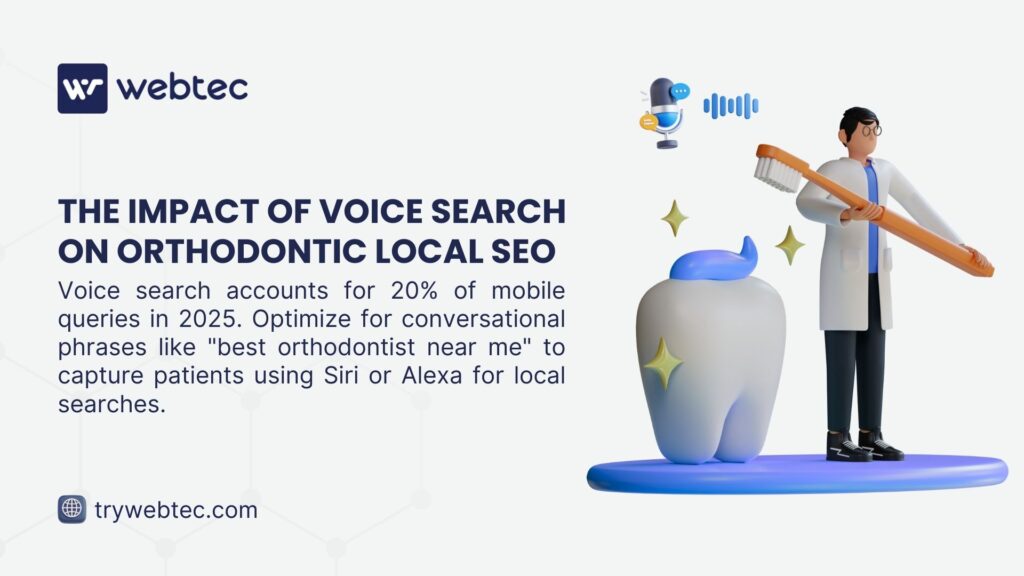
44% of local searchers clicked Local 3-pack, compared to 29% organic, 19% paid, and 8% more local results clicks. These statistics highlight why local pack positioning matters more than traditional organic rankings for orthodontists.
The Three Primary Ranking Factors
Google evaluates local pack positions based on three core criteria: relevance, distance, and prominence. Understanding these factors allows orthodontists to strategically optimize their local presence.
Relevance measures how well your practice matches search queries. This includes category selection, keyword usage in your business description, and service listings that align with common orthodontic searches.
Distance considers proximity between your practice location and the searcher’s position. While you cannot change your physical location, you can optimize for nearby neighborhoods and suburbs through strategic content creation.
Prominence evaluates your practice’s overall reputation and authority. This encompasses review quantity and quality, online mentions, website authority, and offline recognition.
Advanced Ranking Factor Analysis
Recent studies reveal additional factors influencing local pack positions:
| Factor | Influence Level | Optimization Approach |
| NAP Consistency | Critical | Standardize across all directories |
| Review Response Rate | High | Respond to 100% of reviews within 24 hours |
| Google Posts Frequency | Medium | Publish weekly updates |
| Website Loading Speed | Medium | Achieve under 3-second load times |
| Mobile Optimization | High | Ensure perfect mobile functionality |
| Local Content Creation | High | Publish location-specific blog content |
The searcher’s proximity to the business and the physical address of the business are next in the pecking order, but optimization can overcome distance disadvantages through superior relevance and prominence signals.
Review Generation and Management Systems
Businesses with 5 stars on the 3-Pack receive 69% of the attention, while 4 stars receive 59% and 3 stars 44%. This data demonstrates the exponential impact of review quality on patient acquisition.
Legal Review Funnel Implementation
Create systematic review generation that complies with Google’s guidelines:
| Timing | Method | Compliance Notes |
| Treatment Completion | Email follow-up with review link | Never incentivize reviews |
| Retainer Delivery | In-person request | Focus on patient satisfaction |
| Final Appointment | Thank you card with QR code | Make requests voluntary |
| 30-Day Follow-up | SMS reminder | Respect patient preferences |
The key to sustainable review generation lies in timing requests when patients feel most satisfied with their treatment outcomes. At Sturgill Orthodontics, we’ve found that inviting patients to share their experience right when they first see their new smile leads to the most enthusiastic feedback.
Review Response Strategy
Google’s algorithm acknowledges active customer interaction, which can influence your ranking in search results. Professional responses to all reviews, both positive and negative, signal active practice management.
Positive Review Response Template: “Thank you [Patient Name] for taking the time to share your experience! We’re thrilled that you’re happy with your new smile. Our team works hard to provide exceptional orthodontic care, and your feedback motivates us to continue delivering the best possible results for our patients.”
Negative Review Response Approach: Address concerns professionally without violating patient privacy. Invite offline resolution and demonstrate commitment to patient satisfaction. Never ignore negative reviews, as non-response signals poor customer service.
NAP Consistency and Local Citations
Name, Address, and Phone (NAP) consistency remains a fundamental local SEO requirement for orthodontists. Citations are mostly evaluated by “NAP” which stands for Name/Address/Phone. This ranking factor all comes down to one thing: consistency.
Critical Citation Platforms
| Platform Type | Priority Level | Examples |
| Major Directories | Essential | Google, Bing, Apple Maps |
| Healthcare Directories | High | Healthgrades, WebMD, Vitals |
| Local Directories | Medium | Yelp, YellowPages, BBB |
| Industry Associations | Medium | AAO Directory, Local Dental Society |
Maintain identical formatting across all platforms. If your practice name includes “LLC” or “PC” on legal documents, use it consistently everywhere or remove it consistently everywhere.
Address Standardization Protocol
Use the exact address format that appears on your Google Business Profile across all other platforms. Minor variations like “Street” vs “St.” or “Suite” vs “Ste.” can dilute citation effectiveness.
Content Strategy for Local SEO
Content creation for orthodontic practices should target local search intent while providing genuine value to prospective patients. Google loves fresh content, and writing a blog is a great way to give Google new content to discover.
Location-Based Content Framework
| Content Type | Search Intent | Example Topics |
| Service Pages | Commercial | “Invisalign Treatment in [City]” |
| Educational Content | Informational | “When Should [City] Teens Start Orthodontic Treatment?” |
| Local Resource Pages | Navigational | “Orthodontic Care Near [Neighborhood]” |
| Community Content | Local Interest | “Supporting [City] Youth Sports Programs” |
Create dedicated pages for each community you serve, even if multiple locations share the same physical address. This strategy captures searches for specific neighborhoods and surrounding areas.
Blog Content That Drives Local Traffic
Develop content that addresses common orthodontic questions with local context:
Treatment Cost Articles: “Average Cost of Braces in [City]: What [State] Families Should Expect” Age-Specific Guidance: “Best Age for Orthodontic Treatment: [City] Parent’s Guide” Treatment Comparisons: “Invisalign vs Traditional Braces: [City] Orthodontist’s Perspective”
Each piece should naturally incorporate local keywords while providing genuine value to readers considering orthodontic treatment.
Technical SEO Elements for Orthodontic Practices
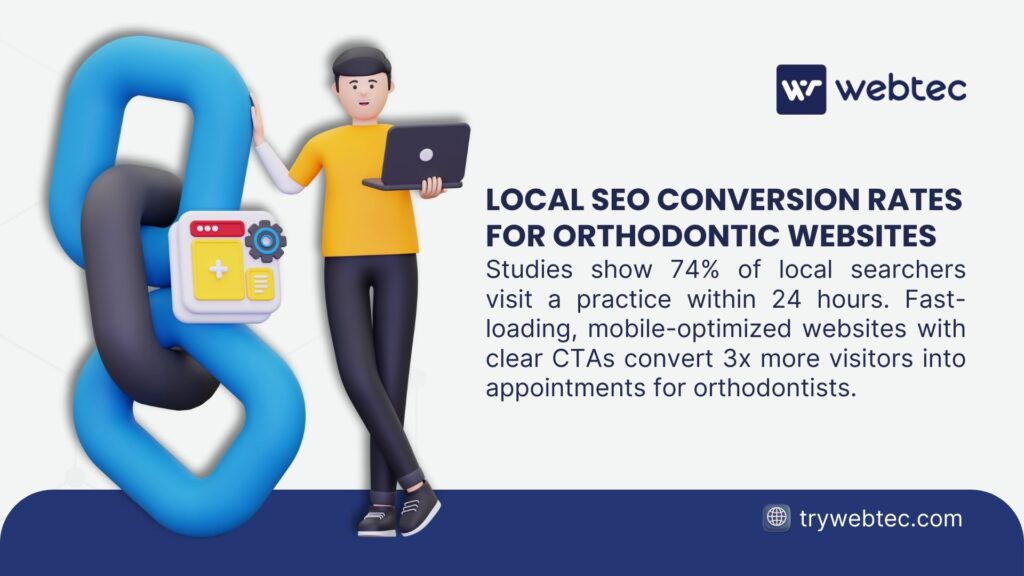
Technical optimization ensures search engines can properly crawl, index, and display your orthodontic practice website. 53% of patients will abandon a website that takes longer than 3 seconds to load, making site speed optimization critical for both user experience and search rankings.
Essential Technical Elements
| Element | Impact | Implementation |
| Site Speed | High | Optimize images, enable compression |
| Mobile Responsiveness | Critical | Use a responsive design framework |
| SSL Certificate | Required | Implement HTTPS across the entire site |
| Schema Markup | Medium | Add LocalBusiness and MedicalBusiness markup |
| XML Sitemap | Medium | Submit to Google Search Console |
Schema markup helps search engines understand your practice information and can enhance local search visibility. Implement the LocalBusiness schema with your NAP information, operating hours, and service offerings.
Mobile Optimization Priority
There has been a 150%+ growth in searches on mobile for “___ near me today/tonight” on Google in the past two years. Mobile optimization isn’t optional for orthodontic practices competing in local search.
Test your website on multiple devices and screen sizes. Ensure appointment scheduling forms work seamlessly on mobile devices, as many patients book consultations while comparing local options.
Social Media’s Role in Local SEO
While social media signals don’t directly impact local pack rankings, they contribute to overall online presence and can drive local engagement that supports SEO efforts.
Platform-Specific Local Strategies
| Platform | Local SEO Value | Optimization Approach |
| High | Complete local business information | |
| Medium | Use location tags and local hashtags | |
| YouTube | Medium | Create location-specific content |
| Low | Professional networking with local connections |
Facebook deserves special attention due to its local business features and high user engagement for healthcare searches. Maintain accurate business information and encourage patient check-ins when appropriate.
Measuring Local SEO Success
Track specific metrics that correlate with patient acquisition rather than vanity metrics that don’t drive practice growth.
Key Performance Indicators
| Metric | Importance | Tracking Method |
| Local Pack Rankings | Critical | Local rank tracking tools |
| Google Business Profile Views | High | Google Business Profile insights |
| Website Traffic from Local Search | High | Google Analytics with UTM parameters |
| Phone Calls from Search | Critical | Call tracking numbers |
| Appointment Bookings | Ultimate | Practice management system |
The top five local SEO metrics marketers see as important are rankings in the Google Local Pack / Local Finder (52%), new leads/enquiries (42%), Google organic rankings (41%).
Focus on metrics that directly correlate with patient acquisition. Local pack visibility means nothing if it doesn’t translate to consultation bookings and treatment starts.
Advanced Local SEO Strategies
Geographic Content Expansion
Create location-specific landing pages for each area you serve, even suburbs and neighborhoods within your primary city. This captures long-tail local searches and demonstrates comprehensive area coverage.
Each location page should include:
- Unique, valuable content about orthodontic care in that specific area
- Local landmarks and geographic references
- Community involvement and partnerships
- Area-specific patient testimonials when available
Competitive Intelligence
Monitor competitor local SEO strategies through systematic analysis:
| Analysis Area | Tools | Frequency |
| Local Pack Positions | Manual search + rank tracking | Weekly |
| Google Business Profile Updates | Direct monitoring | Monthly |
| Review Generation Patterns | Review monitoring tools | Monthly |
| Content Creation | Competitor website monitoring | Quarterly |
Understanding competitor strategies helps identify opportunities and avoid tactical mistakes that could harm your local rankings.
Link Building for Local Authority
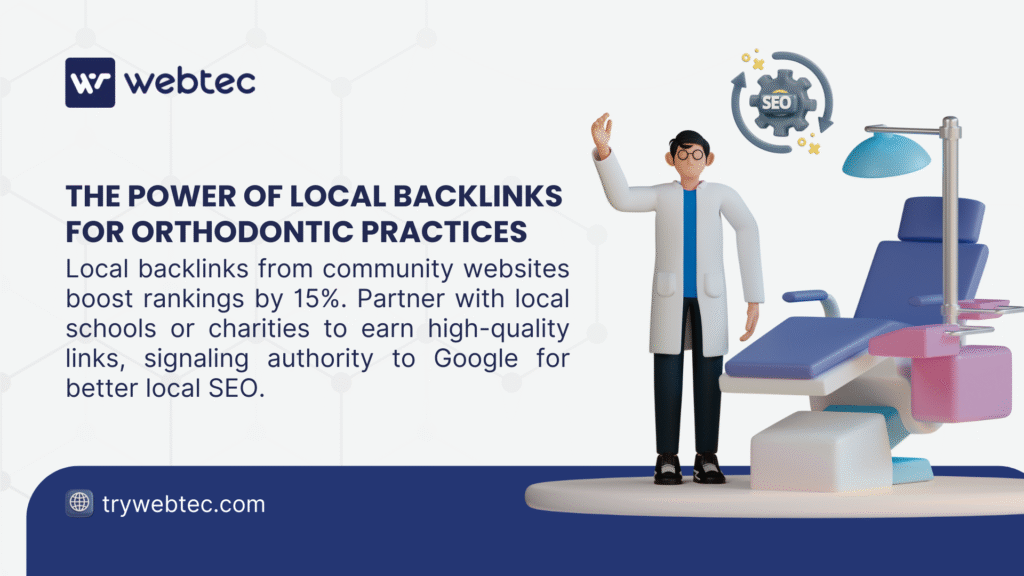
Develop local authority through strategic link acquisition from relevant community sources:
Healthcare Directories: Maintain listings in specialty medical directories Community Organizations: Participate in local chambers of commerce and business associations Educational Partnerships: Collaborate with local schools on oral health education Charity Involvement: Support community events and health fairs
Quality local links signal geographic relevance and practice authority to Google’s algorithm.
Common Local SEO Mistakes That Harm Orthodox Practices
Inconsistent Business Information
The most damaging mistake involves NAP inconsistencies across online platforms. Even minor variations can confuse Google’s algorithm and dilute local ranking potential.
Neglecting Google Business Profile Management
Many practices claim their Google Business Profile but fail to maintain it actively. Regular updates, fresh photos, and consistent posting signal active practice management.
Generic Content Without Local Context
Creating content that could apply to any orthodontic practice anywhere fails to capture local search intent. Always incorporate geographic relevance naturally.
Ignoring Negative Reviews
Failing to respond to negative reviews professionally damages both reputation and local search performance. Address all feedback constructively and promptly.
Integration with Broader Marketing Strategy
Local SEO for orthodontists works best when integrated with comprehensive marketing efforts rather than implemented in isolation.
Coordination with Other Marketing Channels
| Channel | Local SEO Integration | Benefits |
| Paid Advertising | Use local keywords for ad targeting | Reinforces local relevance |
| Email Marketing | Include local events and community news | Strengthens local connections |
| Print Advertising | Drive traffic to location-specific pages | Connects offline and online efforts |
| Referral Programs | Encourage online reviews from referring patients | Enhances social proof |
This integrated approach amplifies the effectiveness of individual marketing tactics while building comprehensive local market presence.
The Future of Local SEO for Orthodontists
Local search continues evolving with new technologies and changing user behaviors. Voice search, artificial intelligence, and mobile-first indexing will shape future local SEO strategies.
Emerging Trends to Monitor
Voice Search Optimization: Prepare for conversational queries like “Find the best orthodontist near me for my teenager.” AI-Powered Search Results: Google’s AI features will likely emphasize authoritative, comprehensive content. Visual Search Integration: High-quality practice photos and treatment images will become increasingly important. Hyper-Local Targeting: Expect even more granular geographic targeting based on precise user locations
Staying ahead of these trends requires continuous learning and strategic adaptation rather than reactive changes after algorithm updates.
Key Takeaways
Local SEO for orthodontists requires systematic optimization across multiple elements rather than focusing on any single ranking factor. Success comes from consistent implementation of proven strategies combined with ongoing monitoring and refinement.
The practices that dominate local search results invest in comprehensive optimization that addresses Google Business Profile management, content creation, technical performance, and reputation building simultaneously.
Most importantly, local SEO for orthodontists should focus on attracting qualified patients who need orthodontic treatment rather than generating maximum traffic volume. Quality leads that convert to treatment starts matter more than vanity metrics.
For orthodontic practices ready to implement these local SEO strategies systematically, working with specialists who understand the unique challenges of healthcare marketing can accelerate results while avoiding costly mistakes. Webtec’s orthodontic SEO services provide the technical expertise and healthcare industry knowledge needed to achieve sustainable local search success.
You May Like These:
- SEO for Lawyers: Improve Your Online Presence
- SEO for Electricians: Complete Guide to Local Search Domination
- SEO for Dental Practices: Complete Guide to Drive Growth and Revenue